
അൽഷിമേഴ്സ്, പാർക്കിൻസൺസ് തുടങ്ങിയ നാഡീരോഗങ്ങൾക്ക് ഫലപ്രദമായ ചികിത്സ നൽകാൻ നാനോപാർട്ടിക്കിൾ സാങ്കേതികവിദ്യയും പ്രെഡിക്റ്റീവ് മോഡലിംഗും സഹായിക്കുമെന്ന് പുതിയ പഠനം വ്യക്തമാക്കുന്നു. രക്ത-തലച്ചോറ് തടസ്സം മറികടന്ന് മരുന്നുകൾ കൃത്യമായി എത്തിക്കാൻ ഈ നൂതന രീതികൾ വഴി സാധിക്കും. ഇത് ഭാവിയിൽ മാരകമായ നാഡീരോഗങ്ങളെ ചികിത്സിക്കുന്നതിൽ വലിയ മാറ്റങ്ങൾ കൊണ്ടുവരും.
By Samudrapom DamReviewed by Susha Cheriyedath, M.Sc.Oct 9 2026
From tuning nanoparticle size and surface chemistry to modeling their path through the brain, researchers are testing several ways to get therapies past one of medicine's toughest biological barriers.
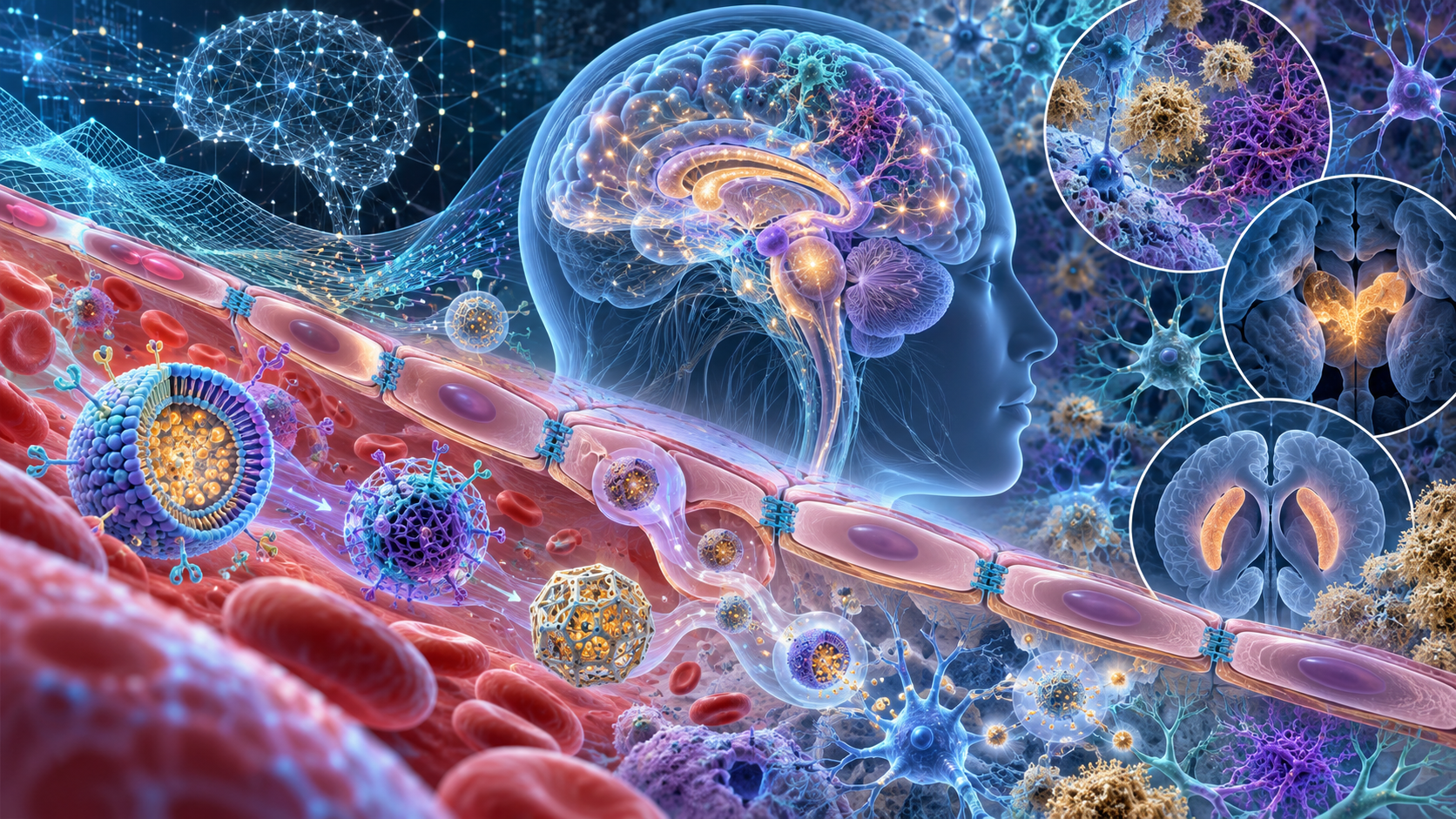
Paper: From Design to Bedside: Brain-Targeted Engineered Nanoparticles and Predictive Modeling for Neurodegenerative Diseases Therapeutics. AI-generated abstract conceptual image created using ChatGPT/OpenAI
Want to read later? Download your clean, ad-free, print-friendly PDF copy by clicking here.
Nanomedicine could reshape therapeutic approaches for neurodegenerative diseases by improving the precision of brain-targeted drug delivery, but its clinical efficacy remains uncertain. A recent paper in Pharmaceutical Research reviewed brain-targeted engineered nanoparticles (NPs) and predictive modeling for neurodegenerative disease therapeutics.
Importance of NP Technology and Predictive Modeling
Rapid advances in NP technology, including efforts to improve penetration across the restrictive blood-brain barrier (BBB), could change how we treat complex neurological disorders. Conventional therapeutics may show strong in vitro efficacy yet fail clinically because of poor brain penetration.
Drug delivery systems based on NPs offer potential solutions for Huntington's, Parkinson's, and Alzheimer's diseases. These neurodegenerative diseases remain incurable, reflecting their complex underlying pathologies, brain structure, and barriers to effective drug delivery. Current treatments mainly manage symptoms or offer modest disease-modifying benefit. The review notes that only about 2% of an IV or oral dose reaches the target site in the NP systems it discusses.
In NP engineering, recent developments, including targeted ligand decoration, surface charge (-10 to -20 mV), and particle sizes of 10-100 nm, have reduced premature clearance and improved BBB crossing in studied systems.
Predictive in silico methods include machine learning (ML), physiologically based pharmacokinetic (PBPK), pharmacokinetic/pharmacodynamic (PK/PD), and CFD models for fluid flow and particle transport. These approaches predict NP biodistribution, region-specific uptake, and residence times.
These computational tools help reduce experimental burden, inform design before in vivo testing, and accelerate lead selection. PK/PD models link drug exposure with pharmacological response, PBPK models estimate how formulations move through the body, and CFD focuses on local transport and fluid flow. Their accuracy relies on suitable inputs and experimental validation.
Biocompatibility and Safety Assessment
Minimizing potential toxicity and maintaining biocompatibility are necessary to translate NP-based therapies into clinical use. For instance, gold- or silver-based NPs can induce inflammatory responses and oxidative stress, resulting in neurotoxicity.
Biocompatible carriers, such as lipids, chitosan, poly(D,L-lactide-co-glycolide) (PLGA), and MOF nanocarriers, are being investigated as ways to reduce these risks. In particular, MOFs can degrade under physiological conditions into non-toxic components while retaining drug-delivery efficacy, though the review also notes possible accumulation in non-target tissues.
NP immunogenicity must also be reduced to avoid adverse immune responses. Such responses can compromise the therapy's effectiveness and safety. Surface modification approaches, particularly polyethylene glycol (PEG)ylation, have been used extensively to improve NP circulation and stability.
The PEG coating provides a hydrophilic stealth layer that can reduce clearance by the reticuloendothelial system (RES). The FDA-approved Doxil® shows that PEGylated formulations can succeed clinically, but it does not show that brain-targeted NPs are clinically effective.
A study by Lipka et al. reported that one hour after IV injection, more than 95% of PEGylated gold NPs continued to circulate. Another study by Klibanov et al. showed that PEGylated liposomes have circulation half-lives of 5 h, while unmodified ones have circulation half-lives of < 30 min.
Improving the BBB Permeability
The BBB's restrictive nature requires novel approaches, including ligand functionalization to engage receptor-mediated transcytosis. Studied targets and ligands include low-density lipoprotein receptor-related protein 1 (LRP-1), the transferrin receptor (TfR), insulin receptors, lactoferrin (Lf), and receptor-targeting antibodies and peptides.
For example, Lf-modified NPs and TfR-conjugated PLGA NPs demonstrated improved uptake in mice.
Peptide- or antibody-functionalized NPs targeting LRP-1 or insulin receptors have also crossed the BBB and reduced inflammation in the brains of mice with Alzheimer's disease. These findings are preclinical. Yet, several challenges exist, including limited receptor specificity and short serum half-lives.
Artificial Intelligence (AI)-driven Models and ML
In neurodegenerative disease, AI/ML is showing potential for predicting pharmacokinetics of NPs from physicochemical descriptors and refining formulations.
In predictive modeling, ML and AI algorithms can speed the development of NP-based delivery systems by screening combinations of drug-release profiles, surface properties, shape, and size.
AI-driven and ML models process large volumes of data efficiently. For example, deep neural networks like the DeePred-BBB Model can predict the BBB permeability of various substances from their molecular fingerprints and physicochemical properties. Such predictions do not establish how a complex NP formulation will behave in living brain tissue.
The review describes AI/ML for NP transport as being at an earlier stage than PBPK modeling. These methods also have limitations, including limited interpretability and sensitivity to biases present in training datasets. Models trained mainly in silico may not perform comparably under complex biological conditions, so experimental validation remains necessary.
CFD Models
CFD models can be tailored to different scenarios and capture temporal and spatial patterns of NP transport and fluid flow in brain vasculature.
By providing a detailed analysis of NP transport in the brain's interstitial spaces and vascular network, they simulate the diffusive and convective behavior of NPs. CFD combines mass-transport and fluid-flow equations to predict NP distribution and deposition over space and time.
CFD simulations can represent time-varying physiological conditions, including pulsatile blood flow, shear stresses, and NP-fluid interactions. This does not mean CFD routinely operates in real time in clinical practice; the paper notes that computational demands limit such use. Incomplete BBB representation in NP transport simulations and difficulty reconstructing the brain vasculature are major CFD limitations.
These approaches could advance NP-based strategies toward clinical impact in neurodegenerative disease. Translational and regulatory challenges remain, including the need for humanized preclinical benchmarks, biocompatibility, safety, patient variability, and differences between animal models and human outcomes. Humanized brain organoids and organ-on-chip systems are intended to narrow this animal-to-human gap, alongside stronger clinical validation.