
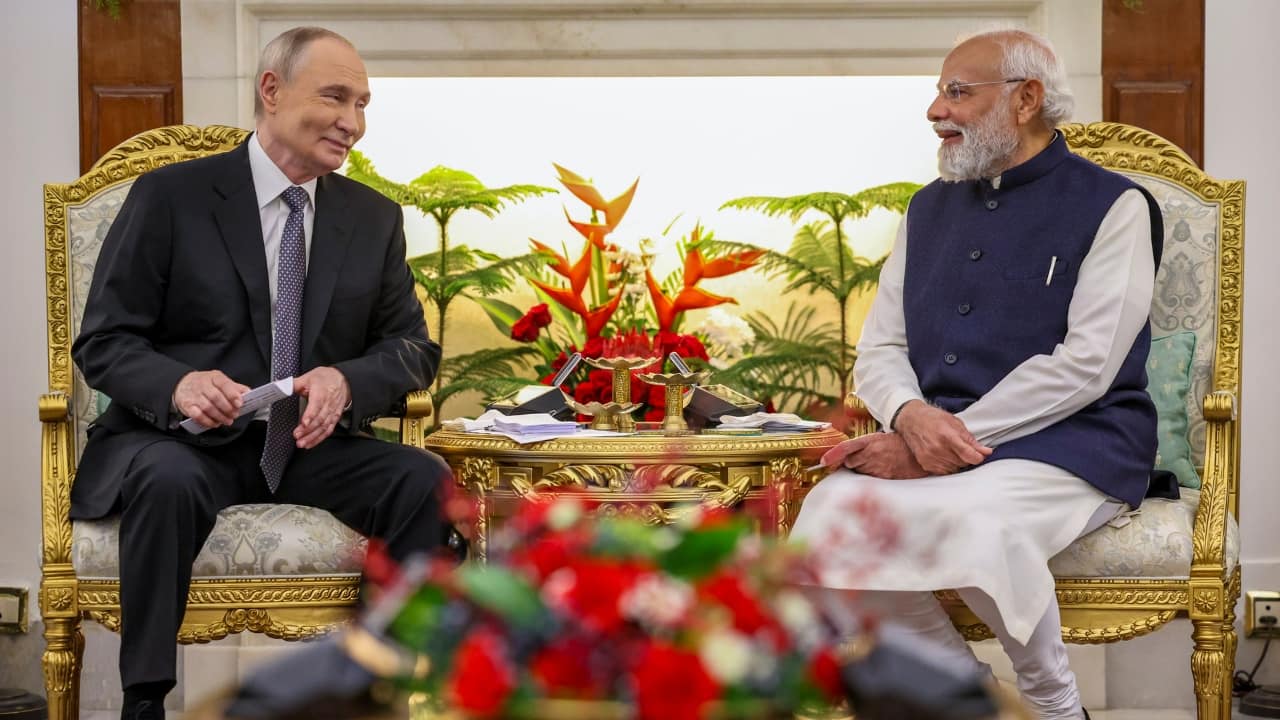
Russian President Vladimir Putin praised India’s culture as unique, diverse, and united at the Valdai Discussion Club on October 1. He said India’s ability to remain united despite many languages and traditions could serve as an example for other nations. "India cannot help but amaze everyone by their scale."
Russian President Vladimir Putin has praised India's linguistic and cultural diversity, saying the country's ability to remain united despite differences in language and tradition could serve as an example for relations between nations. Speaking at the Valdai Discussion Club on October 1, Putin described Indian culture as "unique, diverse, united" and said India's experience offered a model for countries with different cultures, customs and histories to build relations with one another. "India cannot help but amaze everyone by their scale and diversity," Putin said in remarks circulated by Russian state media. JUST IN: 🇷🇺🇮🇳 Russian President Putin praises India's "unique, diverse, united" culture. "India cannot help but amaze everyone by their scale and diversity." pic.twitter.com/WpzBvi8UBv -- BRICS News (@BRICSinfo) October 1, 2026 Putin referred specifically to India's linguistic diversity, saying Prime Minister Narendra Modi had spoken to him about the number of languages used across the country. "The majority speaks their own languages, and they all live together. It's amazing," Putin said. He added that India's cultural diversity coexisting within a single country offered a broader lesson. "The Indian culture has something that is so inherently theirs that it could serve as an example. It's unique, it's diverse, but united," Putin said. "And I think that's the right path. Looking at what's happening in India, you could build relations between different countries with diverse cultures, different traditions and customs and history," he added. Putin delivered his annual address at the Valdai forum outside Moscow on October 1. This year's gathering included participants from 40 countries, according to RT's live coverage of the event. Putin has previously cited India's linguistic diversity The Russian president has made a similar argument about India before. In December 2025, days after a visit to New Delhi, Putin cited India while discussing the importance of protecting linguistic diversity in large countries. Speaking at a meeting of Russia's Council for Civil Society and Human Rights, he referred to the number of languages spoken in India and argued that large countries such as India and Russia needed to preserve "unity in diversity". At the time, Putin was discussing proposals to preserve languages in Russia, including through the use of artificial intelligence. RT reported that he drew a comparison with India, describing both countries as large, culturally diverse states. Putin's latest reference to the number of Hindi speakers should be read as his own account of what Modi had told him. The latest full official language census available in India is from 2011. It recorded 528.3 million people, or 43.63% of the population at the time, as returning Hindi as their mother tongue. India's Constitution currently lists 22 languages in its Eighth Schedule. Remarks follow recent Modi-Putin meetings The comments come weeks after Modi and Putin met in New Delhi on September 11 on the margins of the 18th BRICS Summit. According to the Prime Minister's Office, the two leaders reviewed cooperation spanning political ties, trade, defence, energy, space, skill mobility and people-to-people relations. They also discussed India-Russia engagement within BRICS and regional and global developments. That was their second meeting of 2026. Modi and Putin had met in Bishkek on August 31 on the sidelines of the Shanghai Cooperation Organisation Summit, where they reviewed progress across economic, defence, energy, space, mobility and people-to-people cooperation. The two leaders also took stock of the India-Russia Inter-Governmental Commission meeting held in Moscow earlier in August. During the September meeting in New Delhi, Putin invited Modi to Russia for the 24th India-Russia Annual Summit. Modi accepted the invitation, with the dates to be decided through diplomatic channels, the PMO said. Culture forms part of broader India-Russia relationship Cultural exchanges have long formed one part of India-Russia ties, alongside defence, energy, trade, science and technology. India and Russia established a strategic partnership in 2000 and elevated it to a "Special and Privileged Strategic Partnership" in 2010, according to the Ministry of External Affairs. The relationship includes institutional cooperation in political, economic, defence, scientific, cultural and people-to-people areas. The joint statement issued after the India-Russia Annual Summit in December 2025 identified cultural interaction and people-to-people exchanges as components of the bilateral relationship. The two sides backed reciprocal cultural festivals, greater cooperation in films and joint production, and expanded tourism and academic exchanges. The MEA has also documented the longstanding popularity of Indian cinema in Russia, particularly during the Soviet period, as well as the presence of Indian-language teaching at Russian institutions and the popularity of yoga across Russia. Cultural cooperation also features in India's BRICS chairship India has also made cultural exchanges part of its BRICS presidency in 2026. The BRICS Cultural Festival held in Bhopal on August 6 and 7 included participation from Russia and other member and partner countries. The festival was organised around the theme "Harmony and Peace to All", according to the Culture Ministry. A collective performance featuring languages from participating BRICS countries was presented as a representation of unity through cultural diversity. The BRICS Culture Ministers' Meeting that followed adopted the Bhopal Declaration, which set out plans for greater cultural cooperation, artist exchanges and people-to-people engagement among participating countries. Putin's latest remarks place India's internal linguistic and cultural diversity within that broader argument: that countries with distinct histories and traditions can retain their differences while maintaining cooperation.