
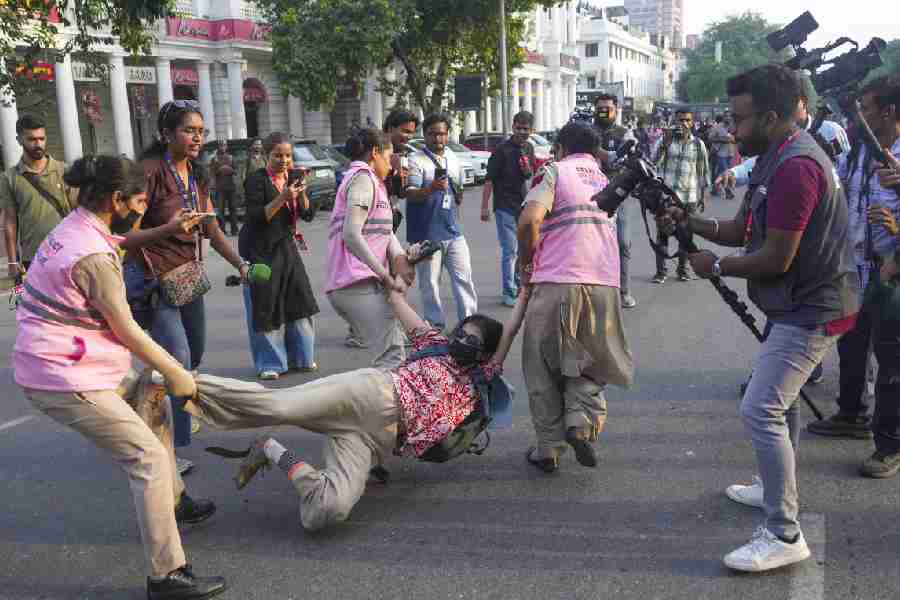
The United Nations human rights office on Saturday expressed concern over mass detentions of protesters in Delhi. Authorities held over 7,000 people during the day. The UN said, “All those arbitrarily detained must be immediately and unconditionally released.” Police later released many, but kept three party leaders in custody.
The United Nations human rights office on Saturday expressed concern over reports of mass detentions of demonstrators, protest leaders, civil society members, lawyers and journalists in Delhi, urging authorities to release all those arbitrarily detained “immediately and unconditionally”.
In a statement on the detentions before and during Saturday’s demonstrations in Delhi, UN Human Rights spokesperson Thameen Al-Kheetan called on the authorities to respect the right to peaceful assembly and exercise restraint in dealing with demonstrators.
“We are concerned by reports of mass detentions in India of demonstrators, protest leaders, members of civil society organisations, lawyers and journalists, before and during today’s large-scale demonstrations in Delhi,” the statement said.
“We call on the authorities to ensure that the right to peaceful assembly is fully respected and fulfilled. Restrictions on peaceful protests must meet strict tests of necessity and proportionality,” it added.
The UN human rights office also said law enforcement personnel should exercise “utmost restraint” in their response to peaceful protesters, in line with India’s democratic traditions and human rights obligations.
“All those arbitrarily detained must be immediately and unconditionally released,” the statement said.
The office further urged the authorities to engage in “meaningful dialogue” to address the concerns raised by the demonstrators.
The statement came amid a police crackdown on protesters in the national capital on Saturday, with more than 7,000 people detained during the day, according to officials quoted by PTI, as authorities tightened security ahead of a planned demonstration at Jantar Mantar.
Later on Saturday evening, police sources quoted by ANI said all protesters held at detention centres in Delhi had been released except CJP leaders Abhijeet Dipke, Saurav Das and Ashutosh Ranka.
The protest, called by the Cockroach Janta Party (CJP), was aimed at demanding the resignation of chief election commissioner Gyanesh Kumar over alleged irregularities in the Election Commission’s Special Intensive Revision (SIR) of electoral rolls.
Delhi Police had denied permission for the demonstration, citing inadequate notice and concerns over compliance with rules during an earlier protest.
Police imposed prohibitory restrictions and deployed drones to monitor movements across the city. Several protesters and political leaders, including CJP leader Abhijeet Dipke and four former chief ministers, were detained at different locations. YouTuber Dhruv Rathee was detained at his residence in Gurugram ahead of the protest.
Abhijeet Dipke and party leaders Saurav Das and Ashutosh Ranka were detained by Delhi Police inside their aircraft shortly after it landed in the capital from Mumbai.
In a video shared by the CJP, Dipke could be heard telling the police officers who boarded the plane: “We are here to be arrested, come and arrest us.”
Among those detained were several Opposition leaders, including former chief ministers Arvind Kejriwal of the AAP, Mamata Banerjee of the Trinamool Congress, and Pinarayi Vijayan and Manik Sarkar of the CPI(M).
CPI(M) general secretary M.A. Baby, veteran Left leader Brinda Karat, CPI(ML) Liberation general secretary Dipankar Bhattacharya, activist Yogendra Yadav, lawyer Prashant Bhushan and All India Students’ Association (AISA) president Neha Bora were also taken into custody.
India says 'unwarranted interference'
The Permanent Mission of India in Geneva dismissed the UN’s concerns as “misplaced” and “unwarranted interference” in the country’s internal affair.
Tthe Permanent Mission of India in Geneva said, "The right to peaceful assembly is guaranteed by our Constitution and safeguarded by robust institutions, an independent judiciary and a free media."
"As in every democracy, Indian citizens exercise this right subject to reasonable restrictions in the interest of public order," it said in a social media post.
The mission maintained that the authorities had followed due legal process and that anyone seeking redress could approach the Indian judiciary.
"The OHCHR's concerns are therefore misplaced and constitute an unwarranted interference in the internal affairs of India," it said.