
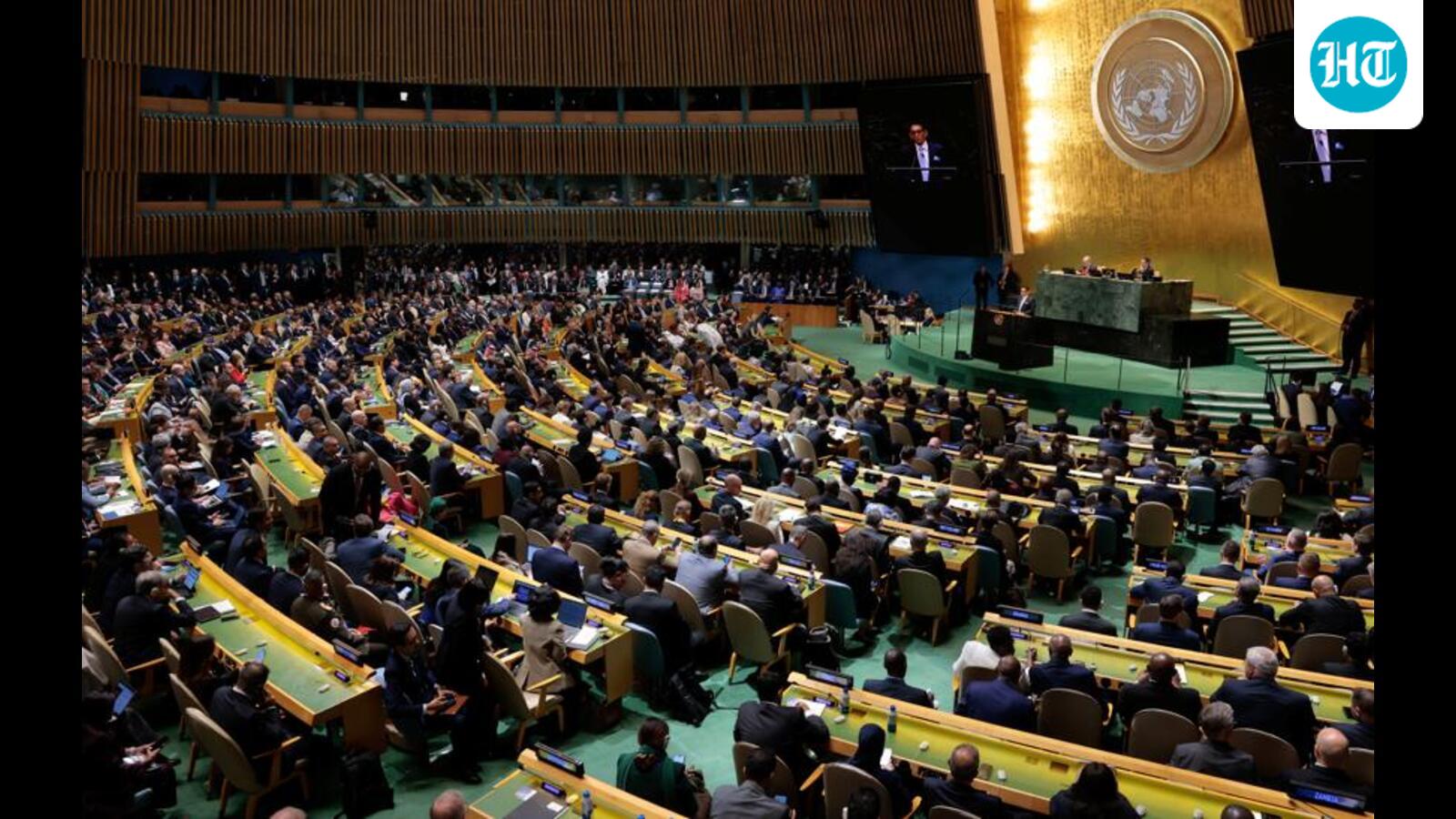
The 81st session of the United Nations General Assembly opened on September 8 with a focus on restoring trust. President Khalilur Rahman said he would work with all member-States "to ensure our Organization is fit for the future". The UN also started reforms to improve efficiency and fix its budget.
The formal theme of the 81st session of the United Nations General Assembly (UNGA), which opened on September 8, is "Restoring trust, Managing Transformation: A United Nations that Delivers For All". President of the General Assembly Khalilur Rahman stated that he would work with all member-States "to ensure our Organization is fit for the future and worthy of a resounding affirmation".
The invocation of trust is both important and ironic, because confidence in the world body is clearly under strain. Pew's 2026 survey found favourable views of the UN declining significantly in 10 countries, even though a 55% median across 37 countries still viewed the organisation positively. The problem, therefore, is perhaps less a rejection of multilateralism than declining confidence in the UN's ability to deliver. UNGA-81 has, if anything, stressed the continuing importance of international cooperation. French President Emmanuel Macron put the choice starkly, warning that the alternative to a rules-based international order was a return to the "law of the jungle".
And the UN has also made an attempt to steady the ship, looking sharply inward at its own institutional housekeeping since last year. It has organised that effort around three broad workstreams: making the machinery more efficient, reviewing the many mandates accumulated over time, and examining whether structures themselves need reorganisation.
Along the way, it has also managed to revise archaic rules. A change adopted in June eased an outdated financial requirement that could have forced the UN to return funds it did not actually hold in cash, helping avert an immediate financial crunch. In September, member-States approved the merger of the UN System Staff College into UNITAR, the first institutional merger under UN80, the system-wide reforms programme initiated in March 2025. The secretariat's 2026 budget has been reduced by about 9%. These are modest but tangible signs that the efficiency agenda is moving from review to implementation.
But efficiency reform, necessary as it is, cannot substitute for institutional reform. It addresses only one dimension of the trust deficit. Restoring trust also requires representation and a meaningful voice in rule-making. Structural reform of the UN Security Council (UNSC) is, therefore, essential if the reform exercise is to be meaningful, not selective. Simply put, representation is not a courtesy; it creates legitimacy, and legitimacy makes institutions more effective.
This year's high-level debate has again brought the question of reform to the fore. Member-States broadly agree that the UN must adapt to stay relevant, even if they differ sharply on how. African leaders have pressed the case for correcting Africa's exclusion from permanent representation on the UNSC. The veto, too, has come under renewed scrutiny. The UK has joined the Franco-Mexican initiative on voluntary veto restraint in cases of mass atrocities, gaining support from 128 States. Others have called for abolition of the veto or greater accountability for its use.
The creation of the cross-regional Partners for Multilateralism initiative, with India among its initial co-sponsors, points in the same direction. Its declaration calls for a multilateral system that is more "effective, representative, inclusive and fit for purpose". From Kenyan President William Ruto's "permanently discussed, yet permanently excluded" to Indian external affairs minister S Jaishankar's "large sections of humanity cannot be excluded", the pressure for structural reform was hard to miss. Differences remain -- some countries continue to oppose new permanent seats and favour expansion of the elected category -- but the wider message is clear: Reform cannot stop at efficiency and administrative restructuring. Restoring trust also requires addressing representation and decision-making.
That is easier said than done. UNSC reform is member-State driven. The issue has been debated for decades, while the present Intergovernmental Negotiations have been under way since 2009. They have been rolled over year after year and still lack an agreed-to negotiating text or a deadline, with major differences remaining over membership, the veto, and regional representation. Charter amendment itself sets a high bar: Any change requires a two-thirds vote in the General Assembly and ratification by two-thirds of UN members, including all five permanent members.
Does that make reform a lost cause? Not necessarily. As President Ruto pointed out, the UN has changed its architecture before. In 1963, the UNSC had expanded from 11 to 15 members. His larger point was a simple one: Difficulty is not the same as impossibility.
The conclusion? Restoring trust requires two tracks: making the UN work better, and making it better reflect the world it serves. The first has begun. The second remains the unfinished business of reform.
India has continued to place reformed multilateralism at the centre of its case for global governance. But its case today is not framed only in terms of representation. At UNGA, Jaishankar also stressed India's record as a contributor -- in development, humanitarian response, capacity-building and peacekeeping. The argument is, therefore, about both contribution and voice. And perhaps Prime Minister Narendra Modi supplied its simplest formulation at BRICS: "If our future is shared, then the right to shape that future must also be shared".