
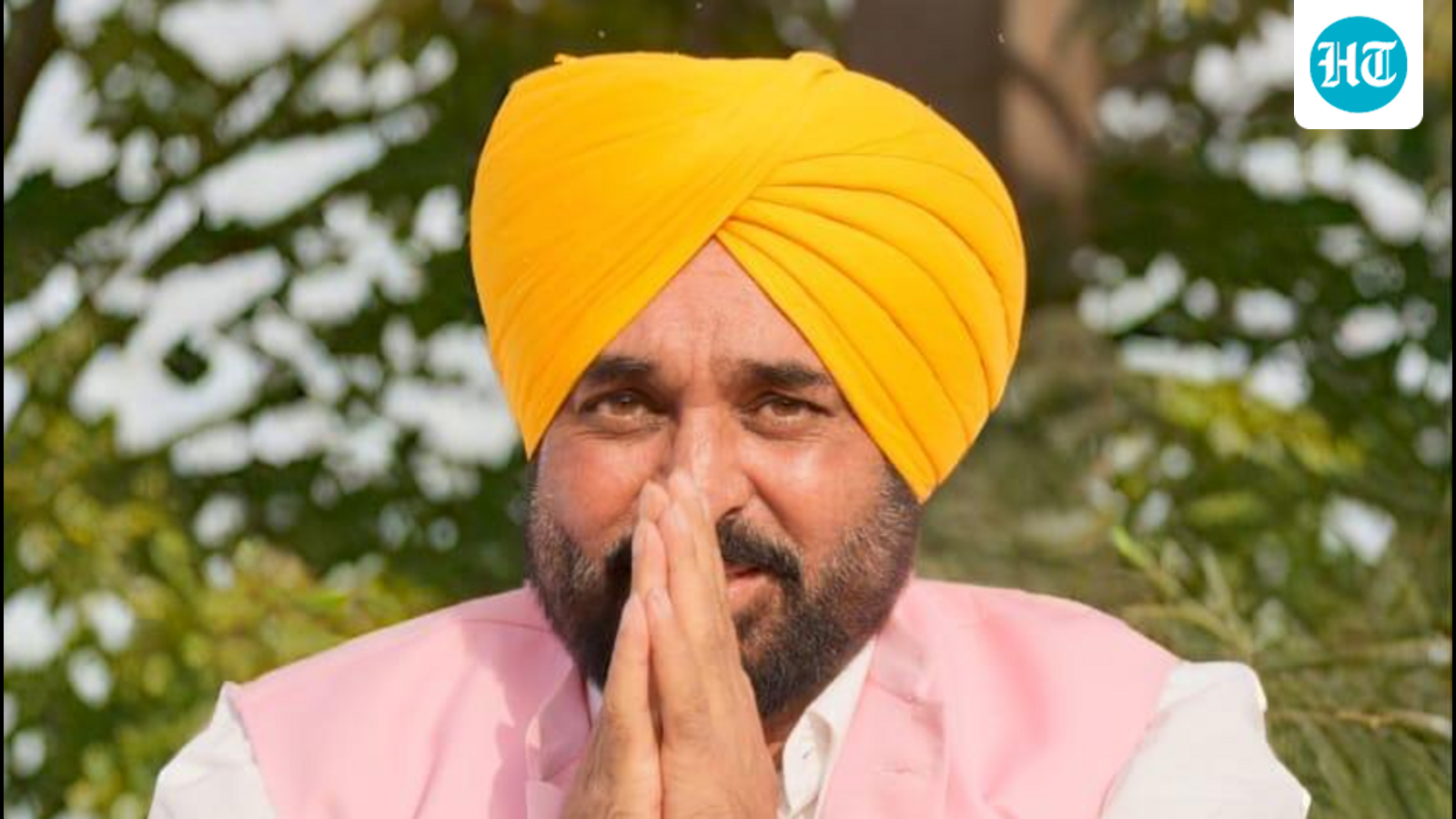
The Supreme Court on Tuesday agreed to hear the Punjab government’s plea against a high court order for a CBI probe into graft charges linked to the Chief Minister’s office. The CJI said, "We will try and list this tomorrow or day after," as the court manages many pending matters.
The Supreme Court on Tuesday agreed to list the Punjab government's challenge to a high court order directing the Central Bureau of Investigation (CBI) to register a criminal case into alleged corruption linked to chief minister Bhagwant Mann's office, but declined an urgent hearing the same day, saying the matter could be accommodated on Wednesday or Thursday.
Chief Justice of India (CJI) Surya Kant, responding to senior advocate Vikas Singh's request for an immediate hearing, said that the court would try to accommodate the petition within the next two days, despite Singh's plea that the high court's direction raised serious questions about the federal structure and warranted urgent intervention.
"Not today. We will try to accommodate you tomorrow or the day after. There are many matters. We will try and list this tomorrow or day after," the CJI told Singh, who appeared for the Punjab government.
Singh argued that the high court had ordered a CBI inquiry against state government officers without sufficient material to establish the commission of a cognisable offence. "It is settled law that no case can be registered unless there is evidence of a cognisable offence. The high court has yesterday ordered a CBI inquiry against our officers. I want the listing today itself," he said.
Singh added that the timing of the proceedings, ahead of elections, raised concerns about interference with the federal structure. "Just before the elections, all these things are coming up. It is a clear case of federal structure which is being sought to be tinkered with," said Singh, pressing for the matter to be taken up on Tuesday.
The Punjab government moved the Supreme Court in the early hours of Tuesday, filing a special leave petition around 1.42am against the Punjab and Haryana High Court's Monday order directing the CBI to register an FIR and investigate allegations of corruption involving senior state government officials and the chief minister's office.
The high court bench, comprising Chief Justice Ashwani Kumar Mishra and Justice Rohit Kapoor, had directed the CBI to proceed with the investigation and submit a report within two months. It also asked the Punjab Police to extend full cooperation to the central agency.
The case arises out of communications sent by the Enforcement Directorate (ED) to Punjab director-general of police Gaurav Yadav between July 24 and August 12, seeking registration of a criminal case over alleged corruption involving Mann's officer on special duty (OSD), Rajbir Singh Ghuman, and others.
According to the ED, a private individual, Nitin Gohal, allegedly acted as an intermediary between people seeking favours from the state government and Ghuman. The alleged activities included influencing transfers and postings of government officials, leaking confidential government documents, facilitating arms licences and securing government approvals in exchange for monetary and other benefits.
The ED's communication alleged that Gohal, in coordination with associates, collected proceeds of crime worth crores of rupees in the form of cash, land and other benefits.
The high court's intervention followed a public interest litigation filed by advocate Nikhil Saraf, who alleged that the state authorities had failed to act on the ED's communications despite the seriousness of the allegations. The petition sought an independent investigation into alleged corruption involving senior government officials, including claims relating to transfers, policy decisions and tender allocations.
In its Monday order, the high court said the material shared by the ED prima facie indicated the involvement of senior public officials in acts of corruption and warranted registration of an FIR to enable a proper investigation. It also criticised the state police for its handling of the matter, observing that it had conducted what appeared to be only a preliminary inquiry since receiving the ED's information on August 3. The court noted that although notices had been issued to several persons, Ghuman had not been asked to join the investigation.
The high court was also unimpressed by the police's reliance on the need for legible copies of the ED documents to explain the delay in acting on the allegations. Holding that a fair and transparent investigation was necessary, the court entrusted the probe to the CBI, directing it to register an FIR and proceed forthwith.