
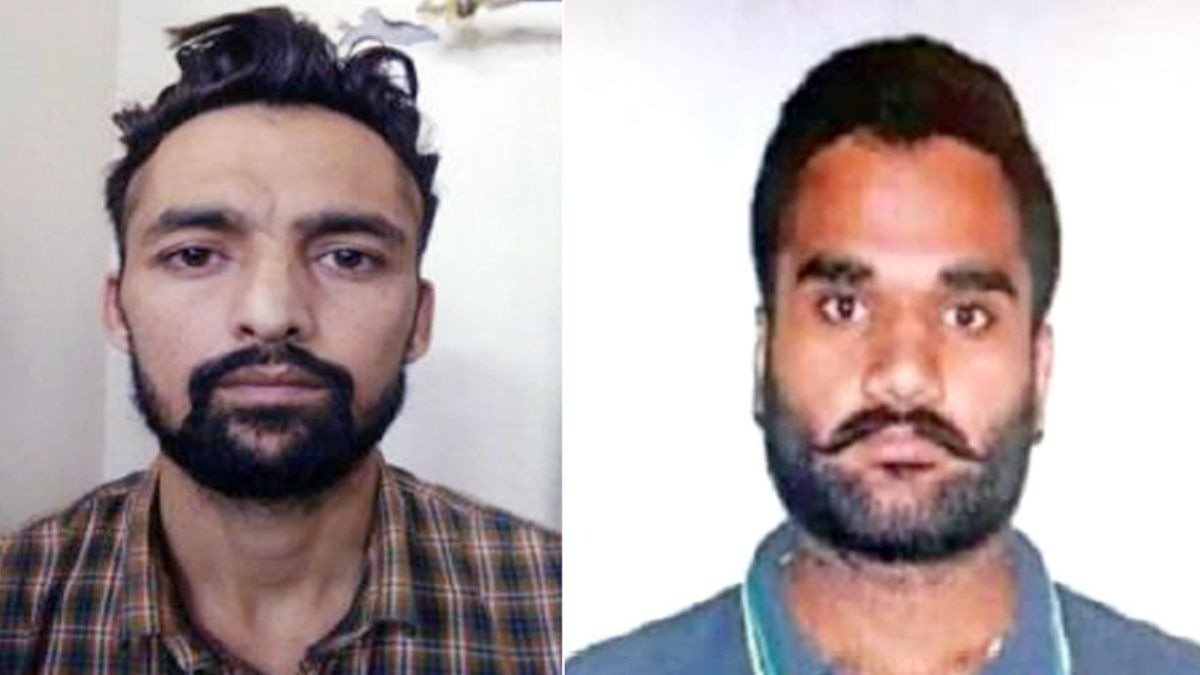
The FBI added Satinderjeet Singh, alias Goldy Brar, to its 10 Most Wanted Fugitives list on September 28. The agency offered $1 million for information leading to his arrest. Brar faces charges of racketeering and extortion in the United States. He is also a prime accused in the Sidhu Moose Wala case.
For years, the same photograph has followed Goldy Brar around Punjab -- a bearded young man, gaze level with the lens, his name printed beneath. It has appeared on police notices and in intelligence dossiers, flickered across television screens and circulated endlessly on social media.
It usually came with a familiar story. Another young man from the state had gone abroad and, from that safe distance, was said to be ordering violence at home, and perhaps even running one of the deadliest gangs from North India.
On September 28, the photograph turned up somewhere it had never been before. That day, the Federal Bureau of Investigation (FBI) added Satinderjeet Singh, alias Goldy Brar, to its list of 10 Most Wanted Fugitives and offered up to $1 million for information leading to his arrest.
Brar is the 543rd name on a list the FBI has kept since 1950. In the United States, he faces charges of racketeering conspiracy, extortion and conspiracy to traffic narcotics.
The FBI manhunt
The FBI list is not a ranking of the world's most dangerous criminals. It is a publicity tool, built on a simple wager: show a face widely enough and someone, somewhere will recognise it. The wager sometimes pays. Last year, the bureau listed Ryan Wedding, a Canadian accused of running a drug empire. He was arrested this January.
Brar now shares the list with one other Indian. Bhadreshkumar Chetanbhai Patel, from Viramgam in Gujarat, has been on it since 2017 -- wanted for stabbing his wife Palak to death in the kitchen of a Maryland doughnut shop in 2015. The two cases have little in common. Patel's is a single, intimate act of violence, carrying a $250,000 reward. Brar's, prosecutors allege, is the work of an enterprise.
Brar was born in Punjab's Sri Muktsar Sahib. He is the son of a Punjab police assistant sub-inspector. In 2017, he left for Canada on a student visa, one of the many thousands of young Punjabis who make that journey every year. Five years later, in May 2022, within hours of singer Sidhu Moose Wala being shot dead in his car in Punjab's Mansa district, Brar publicly claimed responsibility for the killing. He remains a prime accused in the case.
What has changed now is how Washington sees Brar. American prosecutors no longer describe Brar as merely an Indian gangster sheltering in Canada. They allege that he leads the North American arm of the Lawrence Bishnoi organisation, a network accused of drug trafficking, extortion, kidnapping and targeted killings across several countries. The FBI believes he is now living in the United States.
The US case begins in an improbable place for the headquarters of an international criminal enterprise: an Indian prison. Bishnoi has been in custody for more than a decade, and currently held in a jail in Gujarat. Imprisonment, US prosecutors allege, barely slowed him. Smuggled mobile phones and internet-based devices, the indictment says, allowed Bishnoi to keep issuing instructions to associates outside.
Two men are said to have carried those instructions abroad -- Brar in North America and Rohit Godara in Europe. Prosecutors call them Bishnoi's trusted lieutenants, each responsible for directing members and associates in their regions.
If the allegation holds, it describes an organisation with a surprisingly clear chain of command -- its leader behind bars in India and its operations run by men thousands of kilometres away. According to the FBI, Brar has ties to Sacramento and Fresno in California, as well as to Canada, India and Mexico. It is here that the story moves beyond Punjab.
Some of the most striking allegations concern narcotics. Prosecutors say that in November 2024, Bishnoi and Brar oversaw a 49-kg shipment of cocaine, bound for Canada, that was intercepted in California. They also allege that the organisation made a practice of robbing rival traffickers in the Los Angeles area, "ripping" their loads in the trade's language, and in this way seized about 520 kg of cocaine between March 2024 and July 2025, along with some 500 kg of methamphetamine.
None of this has yet been tested in court. If proved, however, it would describe something far more ambitious than an extortion racket run from overseas: an organisation seeking a share of the North American drug trade and prepared to use violence to keep it.
For much of the past decade, the Bishnoi gang and its rivals were understood almost entirely through Punjab. The Moose Wala killing turned the gang war into a national story. The investigations that followed into extortion calls, shootings, threats and contract killings kept leading abroad, most often to Canada. The diaspora, and the fear that some of its members came to live with, became part of the story. The US is now part of it too.
Operation Hard Ball
On July 7, the US Department of Justice unsealed three indictments under Operation Hard Ball, a multi-year investigation into three India-linked organised crime groups. Thirty-seven people were charged. Twenty-four are in custody; 17 arrested in a coordinated sweep across the US, Canada and Spain; 11 of them in California; and seven who were already being held. Investigators seized about 1,000 kg of cocaine and a dozen firearms. Since then, four more fugitives have been caught and one has been found dead.
The Bishnoi organisation is the subject of one indictment. The second concerns Jaggu Bhagwanpuria, once Bishnoi's associate and now his rival, who is also accused of running his network from an Indian jail. Prosecutors put its strength at about 1,000 members and associates worldwide -- roughly 100 of them in the US.
The third targets a network allegedly led by Ravinder Singh Dhanda, a Vancouver resident accused of moving large quantities of cocaine and methamphetamine from Southern California towards Canada.
What US investigators are assembling, then, is not a case against one Punjabi gang but a map of several criminal networks with roots in India and operations in North America. That explains their choice of law. The Racketeer Influenced and Corrupt Organizations Act, or RICO, allows prosecutors to build a case around an enterprise rather than a single crime. Drug deals, extortion demands, threats and shootings can all be presented as the work of one organisation, and those who direct it can be held responsible for what its members do.
The investigation may also mark a shift in how India and the US work together. American officials are understood to have exchanged and verified information with Indian central agencies on Bishnoi, Brar, Godara, Bhagwanpuria and others before the arrests, according to reports. The US Attorney's Office in Los Angeles has said it will seek Bishnoi's extradition while cautioning that such proceedings can take years.
For a long time, it was Indian agencies that had to persuade foreign governments to act against gangsters who had settled abroad. The Americans now have reasons of their own: the alleged crimes have reached their streets.
Hardeep Nijjar's killing
One strand of the case leads straight back into the troubled relationship between India and Canada. The US indictment alleges that Bishnoi and Brar ordered the killing of Hardeep Singh Nijjar, a Canadian citizen and prominent Sikh separatist who was shot dead by masked gunmen in the car park of a gurdwara in Surrey, British Columbia, on June 18, 2023.
His death set off one of the worst diplomatic ruptures between the two countries in decades. Then Canadian prime minister Justin Trudeau told his Parliament there were credible allegations linking agents of the Indian government to the killing. India rejected the charge, and each country expelled the other's diplomats.
The US indictment offers a different account. It attributes the killing to the Bishnoi organisation and makes no allegation against the Indian government. A day after it was unsealed, Lisa Moreland, a deputy commissioner of the Royal Canadian Mounted Police, said the investigation had turned up no evidence that Indian government officials were involved. India's ministry of external affairs said it had taken note of her remarks.
Three years after Trudeau's accusation, Canada's own police force has, in effect, distanced itself from it. That does not settle the question of guilt. The charges against Bishnoi and Brar remain allegations that must be proved in court. For Nijjar's family, the wait for answers continues.
Brar's rising notoriety
Washington's pursuit of Brar has intensified quickly. On July 8, the day after the indictments were made public, the FBI offered $50,000 for information leading to his arrest. By late September, the reward had grown twentyfold. The RCMP has said his listing reflects a shared resolve to find him.
Back home, India designated Brar an individual terrorist under the Unlawful Activities (Prevention) Act in 2024, accusing him of involvement in killings, extortion and the trafficking of arms and explosives. He remains wanted in several cases at home. In September 2025, Canada had listed the Bishnoi gang as a terrorist entity.
There is an irony in how this has unfolded. For years, distance seemed to be Brar's best protection. From abroad, he could allegedly direct associates, make threats and cultivate a reputation that carried all the way back to Punjab. Yet the same networks that kept him beyond the reach of Indian police have now drawn the attention of law enforcement on three continents.
The question is no longer only whether India will get Goldy Brar back. It is what becomes of the network around him, and of the young men -- some of them still teenagers -- whom such networks draw in.
If the US case is proved, Brar will not be remembered simply as a gangster who slipped out of reach. He will stand for a new phase in Punjab's gang problem, one in which a criminal organisation can recruit in one country, raise money in another, move drugs through a third, and order violence by phone from the other side of the world.
The FBI has put a $1 million price on Brar's capture. What it is really trying to expose is the machinery behind him. If prosecutors can make their case, that machinery reaches well beyond Punjab.