
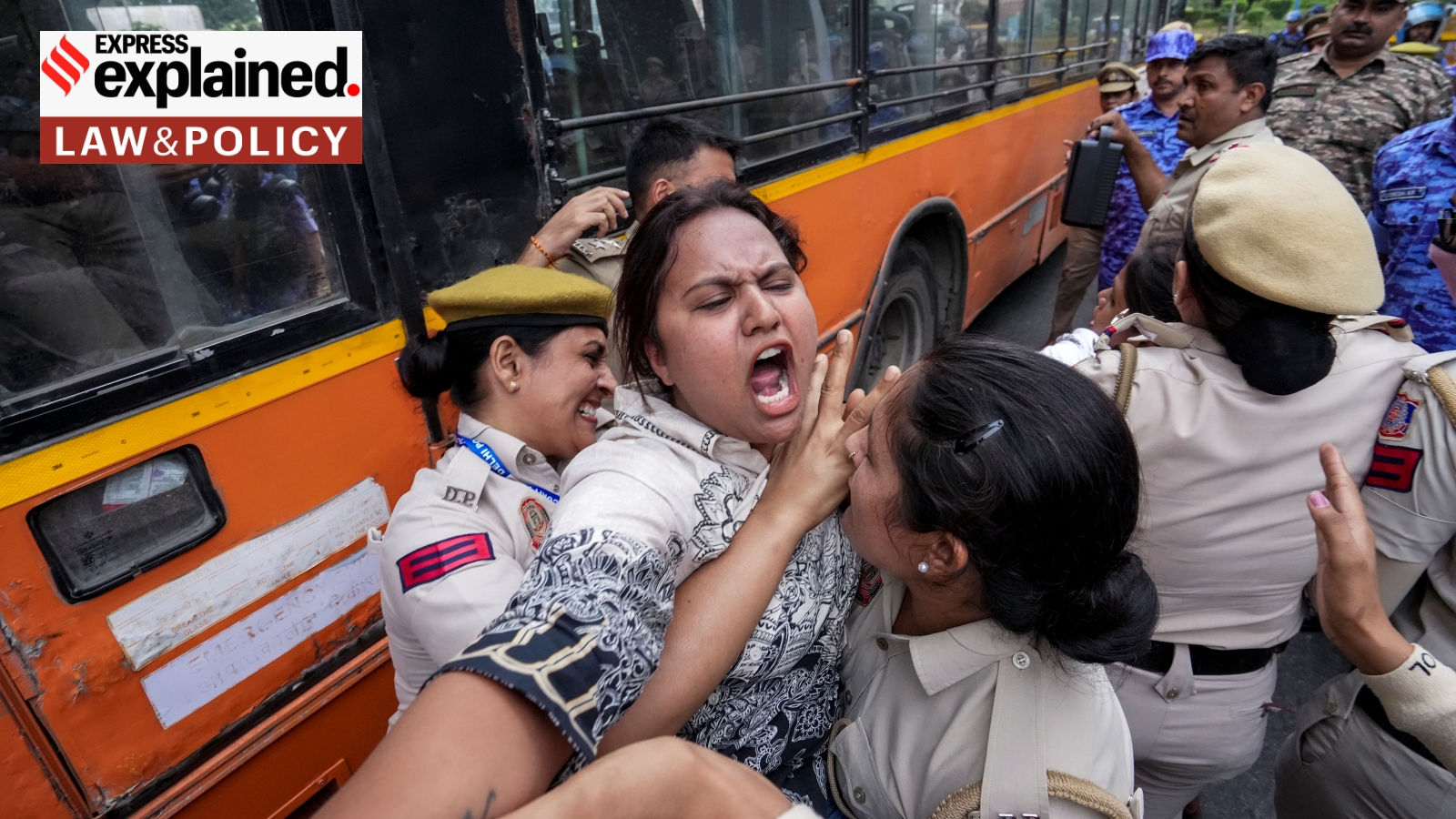
Delhi police imposed strict restrictions during protests demanding the resignation of Chief Election Commissioner Gyanesh Kumar. While the Constitution guarantees peaceful assembly, authorities cited public order to justify barricades and detentions. A former commissioner said, "If police consider a venue inappropriate, an alternative should ideally be provided" for protesters.
The sweeping restrictions imposed in Delhi ahead of and during the protests demanding the resignation of Chief Election Commissioner Gyanesh Kumar -- prohibitory orders, detentions, barricades, Metro restrictions and cancellation of trains -- have brought an old constitutional tension back into focus.
The Constitution guarantees citizens the right to speech and peaceful assembly. But these rights are not absolute, and the police are not required to wait for violence before acting: preventive policing is both a power and, in certain circumstances, a statutory duty.
The dispute is about where legitimate regulation ends and prohibition begins.
Can the State stop a peaceful protest because it has not given permission?
Articles 19(1)(a) and 19(1)(b) guarantee freedom of speech and expression and the right to assemble peacefully and without arms. But Articles 19(2) and 19(3) permit reasonable restrictions, including in the interests of public order.
This means the right to protest does not translate into a right to assemble at any place, in any number and under any conditions.
A former Delhi Police Commissioner told The Indian Express that from a policing perspective, whether a gathering is peaceful is not the only question. If protesters have permission to assemble at Jantar Mantar but begin marching towards Parliament, "even if peacefully", they have breached the conditions under which the assembly was permitted.
The Supreme Court has accepted the principle of regulation. In Himat Lal K Shah vs Commissioner of Police (1973), it held that the State can regulate assemblies on public streets since streets have competing public uses. But regulation cannot become an arbitrary power to prohibit assemblies altogether.
That distinction returned in Mazdoor Kisan Shakti Sangathan vs Union of India (2018), concerning protests at Jantar Mantar. The Court rejected a blanket prohibition and required authorities to devise a regulatory mechanism balancing protesters' rights against those of residents and commuters.
"However, if police consider a venue inappropriate because of its capacity or security concerns, an alternative should ideally be provided -- for instance, Ramlila Maidan for a gathering too large for Jantar Mantar," the former Delhi police commissioner said.
Thus, a permission system is constitutionally permissible. The question is whether it is being used to regulate a fundamental right or effectively extinguish it.
Can violence at an earlier protest justify restrictions on the next one?
Delhi Police has cited events during the July 20 protests in assessing the risks surrounding the latest mobilisation.
Legally, police can take past conduct into consideration. "Both past behaviour and current intelligence" matter when permission is considered, the former Delhi Police Commissioner said, since previous conduct can indicate the likelihood of future disturbance.
Preventive policing itself has statutory backing. Section 168 of the Bharatiya Nagarik Suraksha Sanhita (BNSS), replacing Section 149 CrPC, requires police officers, to the best of their ability, to prevent cognisable offences.
"If 163 has been imposed, permission not granted, and you say we don't care, we will march, you are essentially announcing that you are going to break the law," the former commissioner said.
But previous violence does not create an unlimited power to prohibit every subsequent gathering.
The Supreme Court has long required a close relationship between the anticipated danger and preventive action. In Madhu Limaye vs Sub-Divisional Magistrate (1970), while upholding the predecessor Section 144 CrPC, it stressed the urgency and gravity necessary to exercise such extraordinary power.
In Anuradha Bhasin vs Union of India (2020), the Court said preventive orders could be passed against an apprehended danger -- the State need not wait for violence to actually occur -- but the danger must warrant emergency action and restrictions must satisfy proportionality. Section 144, it said, could not be used to suppress legitimate democratic expression.
The Supreme Court's own intervention arising from the July protests is significant. In August, it constituted a High-Powered Enquiry Committee whose terms include examining blanket Section 163 orders so that they do not become a routine or pre-emptive means of foreclosing peaceful assembly rather than a proportionate response to a "real and imminent" public-order threat.
How far can preventive policing go before it becomes disproportionate?
Delhi Police had sought closure of entry and exit gates at 57 Metro stations, spread across the city, saying protesters could use the network to gather and move towards sensitive areas. Indian Railways also cancelled 245 trains originating from or terminating in Delhi, including mail, express and passenger services.
Police sources have told The Indian Express that the railway decision followed an analysis of the July 20 mobilisation. According to that assessment, a protest that began with the pressure group Cockroach Janta Party (CJP) subsequently drew manpower from Opposition parties. Party workers travelled into Delhi from several states over successive days, including by train, swelling numbers beyond what police had anticipated, even as senior political leaders largely stayed away from the protest itself.
The law allows police to anticipate such situations. The former Delhi Police Commissioner recalled earlier rail roko, chakka jam and Bharat bandh agitations where thousands were preventively detained.
On October 9, however, the Supreme Court questioned the proposed transport restrictions, invoked the principle of proportionality and cautioned against using a "hammer to kill a fly". It said measures could regulate transport where necessary but should not indiscriminately shut it down.
A former Uttar Pradesh DGP put the counter-question, "How can the State presume that thousands of ordinary people travelling in Metro trains and railway coaches will be violent? The principle of proportionality has to apply."
He added, "The question to be asked is could the perceived threat have been dealt with through targeted policing of particular stations and routes, crowd caps, selective access restrictions or interception of identified groups rather than disruption affecting large numbers of unrelated passengers?"
Does the sensitivity of Delhi's VIP zone change the balance?
Parliament, Rashtrapati Bhavan, Central Vista, the Supreme Court and other sensitive establishments lie within a relatively small area of central Delhi. Police therefore have concerns that do not necessarily arise at an ordinary protest site.
Crowd size matters too. The former Delhi Police Commissioner pointed out that a designated site has finite capacity: if a place meant for around 5,000 suddenly receives substantially more protesters, police cannot simply abandon regulation.
"Physical restraint may become necessary when agreed conditions break down," he said.
The Supreme Court's Shaheen Bagh judgment similarly made clear that the right to dissent does not permit indefinite occupation of public roads.
But there is another side. Protest is not merely physical assembly; it is communication.
"Protesters naturally seek to be near the institution from which they demand action. Sending demonstrators to a remote location where they can keep sitting there till eternity without being noticed can render the exercise meaningless," he said.
The constitutional task is therefore to find a middle ground: sufficient proximity for dissent to remain meaningful, while maintaining distance and conditions necessary to secure sensitive installations.
Who decides when preventive action has gone too far?
Ultimately, police make the first call because law-and-order decisions frequently have to be made before events unfold. But their assessment is not beyond judicial review.
"Yes, there is another view, which the CJP articulates. Why should you need permission for a peaceful protest in a democracy. If people think that's how it should be, there should be a new law. As long as there is a law asking police to do something, it will do it," the former Delhi police commissioner said.
That is where the courts come in. Constitutional courts can examine existing provisions and determine whether the restrictions imposed under them were lawful, necessary and proportionate.
The SC has taken cognizance of this. Its committee examining the July violence has been asked to scrutinise both alleged excesses by security personnel and violence attributed to protesters, while separately examining the use of blanket Section 163 orders.
Over the weekend, the Court intervened again over restrictions surrounding the latest protests, stressing free movement and lawful policing and questioning measures affecting people who had nothing to do with any threatened disorder.
"The problem is SC has itself not yet spelt out restrictions to Article 19 (2). The principle of proportionality is also not clearly defined. As long as it remains so, the State will have discretion," the former UP DGP said.