
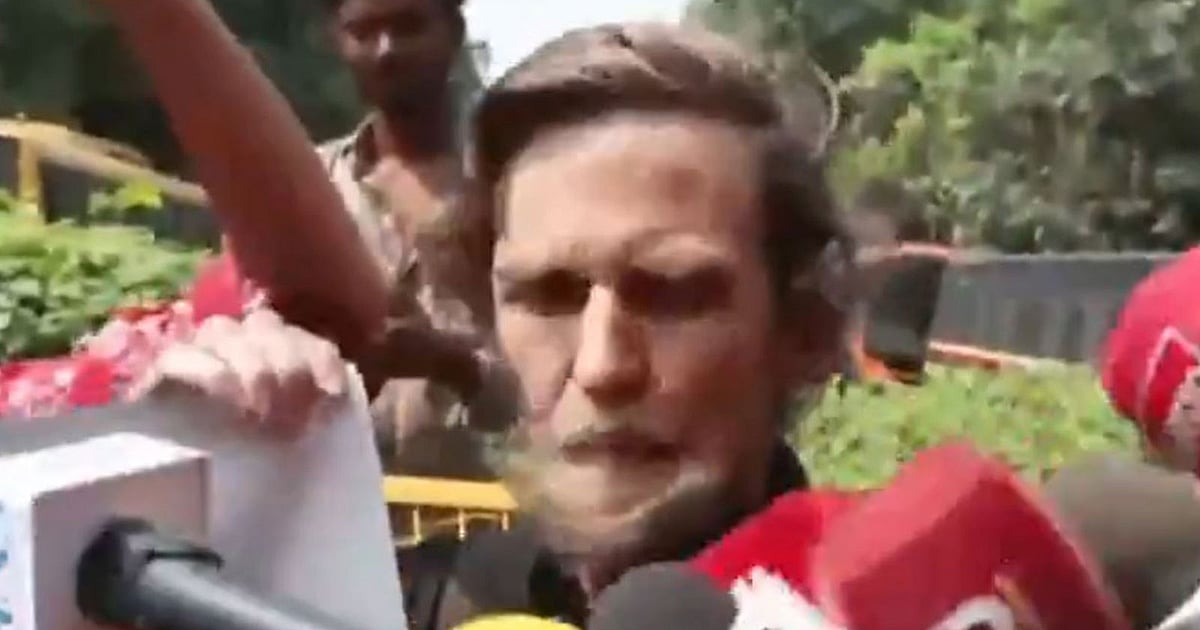
Economist Jean Drèze got detained by Delhi Police on 10 October at Jantar Mantar. Reporters failed to recognise him while he stood with protesters. He refused to leave the police station until other detainees were released. After eleven hours, police let everyone go. He remains a simple, dedicated public voice.
For nearly half a century he has been walking through India's villages, sharing the anxieties of the poor, and asking villagers and India's rulers questions governments would rather not answer. When he appeared at Jantar Mantar on 10 October in solidarity with protesters demanding the resignation of chief election commissioner Gyanesh Kumar, he stood out. ' Bhai saheb, aap ho kahan se? Kyun aaye ho yahan? (Sir, where are you from, why are you here?),' asked a swarm of reporters who failed to recognise the Indian who did not look like an Indian, before burly policemen intervened.
They bundled Jean Drèze, and three others, into a van and drove them to Adarsh Nagar police station, 16 kilometre away. There he encountered the day's other 'catch': men, many of them Muslims from Assam and West Bengal, picked up while going about their ordinary lives. Four hours later, Delhi Police had learnt of Drèze's identity and offered his freedom. He declined. He would leave only when the other detainees were released. After nearly eleven hours, police relented and everyone walked out together.
Social media was scandalised. How could journalists fail to recognise the man who had helped shape India's rural employment guarantee? By evening, "Who is Jean Drèze?" explainers had inundated media. The editor-in-chief of news agency ANI was trolled for defending the ignorance of 'young reporters' who, she argued, had no reason to recognise the economist. Not surprising at all in a country where importance of people is measured in terms of flashy cars, security cover and television appearances. Drèze, who leads a simple life, avoids self-advertisement and rarely mentions his achievements, was always likely to remain a stranger in a country he calls his own.
. So then who is Jean Drèze? Born in Belgium in 1959, he arrived in India in 1979 and earned a PhD from the Indian Statistical Institute. He lived in Palanpur, a village in Uttar Pradesh, conducting fieldwork. In 2002 he surrendered his Belgian passport and took up Indian citizenship -- a move much of India's upwardly mobile middle class might regard as eccentric and foolish.
His only full-time salaried job was at the London School of Economics in the 1980s. There, instead of confining himself to producing economic models, he slept alongside homeless people, cooked meals in an abandoned hospital occupied by squatters near The Oval, and helped organise a movement that opened empty buildings to people with nowhere to live. Economics departments everywhere have produced an impressive number of consultants and advisers. But they have produced few or no squatter before Drèze. He wrote about those days in No.1 Clapham Road: The Diary of a Squat (1990), a remarkable little book that considered by many as a masterpiece.
. Educated India, when it recognises him at all, generally knows him as Amartya Sen's co-author: Hunger and Public Action , India: Economic Development and Social Opportunity , and An Uncertain Glory . An extraordinary intellectual partnership, certainly. But to reduce Drèze as Sen's co-author is to diminish both: Drèze becomes a mere collaborator, and Sen, one of the most profound philosopher-economists of our time, becomes merely an author in need of a co-author.
Then there is the Right to Food Campaign and the struggle around Supreme Court proceedings that helped establish cooked midday meals in government schools as an enforceable entitlement. He was involved in drafting the rural employment guarantee legislation. He is also behind the PROBE report, which exposed the everyday realities of elementary schooling and shifted attention from impressive enrolment statistics to what actually happens inside classrooms.
In the winter of 1990-91, he joined the Gulf Peace Team an extraordinary attempt to prevent war by placing human beings, quite literally, in its path.
Not a particularly promising CV for someone seeking a corporate board position. But an unusually substantial one for someone interested in what economics might actually be for.
***
In 2017, Drèze published Sense and Solidarity: Jholawala Economics for Everyone . The title cheerfully appropriated one of the Indian elite's favourite terms of contempt -- jholawala -- and wore it like a badge of honour. Or, like a cloth bag slung over the shoulder, if you please. If anyone can spare 15 minutes from the demanding pleasures of social media, I strongly recommend reading the book's introduction. It may prove more rewarding than discovering who has insulted whom on television.
The method of Jholawala Economics... is deceptively simple, which perhaps explains why it continues to irritate the establishment.
Go to a village. Talk to people. Find out whether the ration shop opens, whether employment guarantee wages arrive, whether the anganwadi feeds children, whether pensions reach the elderly. Record people's experiences. Check the records. Tabulate the findings. Publish them. Return to see what has changed. Repeat. All this, preferably, on a budget smaller than a consultancy's working lunch.
. Drèze has spent years in Ranchi examining the welfare machinery of Jharkhand and Chhattisgarh, village by village, alongside students, volunteers and activists. In many places he is affectionately known as Jean dada , sometimes transformed by local pronunciation into Joun dada or Jon dada . The spelling matters little; the familiarity matters enormously. The work has flourished through hundreds of young people responding to that unfashionable invitation: "hard work no pay".
Together, these efforts have documented the revival of Chhattisgarh's public distribution system and exposed the cruelty of hunger in Jharkhand, where cancelled ration cards, biometric failures and bureaucratic indifference have deprived families of basic entitlements.
In 2019, this approach earned Drèze a detention, in Garhwa, Jharkhand, over a village meeting on food rights. Asked to sign a bond declaring he had no complaints against the government, he refused. A man unwilling to sign away his right to complain is difficult to accommodate in our increasingly ceremonial understanding of citizenship. He would also make a troublesome subject for a commemorative postage stamp.
. The philosophy nobody wants
One might call it a family inheritance, though of an unusual kind. His father worked on the mathematics of economics. His mother ran a shelter for women facing domestic violence. Jean brought the two worlds together: the rigour of economic reasoning and the moral urgency of human suffering.
The idea he and Amartya Sen helped make influential -- public action -- never meant merely action undertaken by the state. It meant action by the public: citizens organising, questioning, demanding, cooperating and insisting that democratic institutions fulfil their responsibilities. Add the voluntary simplicity Drèze embraced during his doctoral years and never quite outgrew, and the philosophy becomes clearer.
You cannot understand hunger merely by examining statistics in a comfortable seminar room. You cannot understand a school through enrolment figures alone. You cannot comprehend poverty without listening to those who live with it. Above all, you cannot genuinely work with people while permanently positioning yourself above them.
This is not a rejection of scholarship. It is a demand that scholarship remain answerable to life. There is serious economics behind Drèze's work, but also the conviction that knowledge carries obligations, solidarity is not a decorative sentiment, and democracy cannot be reduced to periodically counting votes.
A Delhi police station provided an unexpectedly concise demonstration of that philosophy.
We leave together.
Three words. No seminar required.
Being unrecognisable
And therein lies the difficulty.
We inhabit a public culture in which visibility is increasingly mistaken for significance. Intellectual standing is measured by television invitations, podcast audiences, institutional titles and the ability to manufacture a controversy before breakfast. Even compassion must now be photographed, branded and circulated.
A life devoted to work that does not advertise itself is therefore liable to disappear from public recognition.
What does one do with an economist whose achievements are recorded in other people's ration cards, job cards, school meals and village ponds? How does one measure the importance of a scholar more easily recognised at a rural worksite than in a television studio?
The difficulty is not that Drèze lacks credentials. It is that he has spent much of his life behaving as though credentials mattered only when they helped him do something worthwhile.
The question at Jantar Mantar deserves attention not because a young reporter failed to identify a distinguished economist. The troubling part is the culture of recognition it revealed: one in which the loudest voices become familiar while those patiently enlarging the possibilities of democratic life remain invisible.
Perhaps the reporter asked something more profound than he realised.
So let us not blame them.
Let us blame Jean Drèze, for being outrageously indifferent to celebrity. For neglecting to cultivate a personal brand. For wasting his time with ration shops, anganwadis, employment guarantee worksites, primary schools and people unlikely to increase anyone's social media following.
And, above all, for committing the unforgivable offence of treating solidarity not as a slogan but as a way of life.
Kumar Rana is a research activist. More by him here
. Join our official telegram channel ( @nationalherald ) and stay updated with the latest headlines