
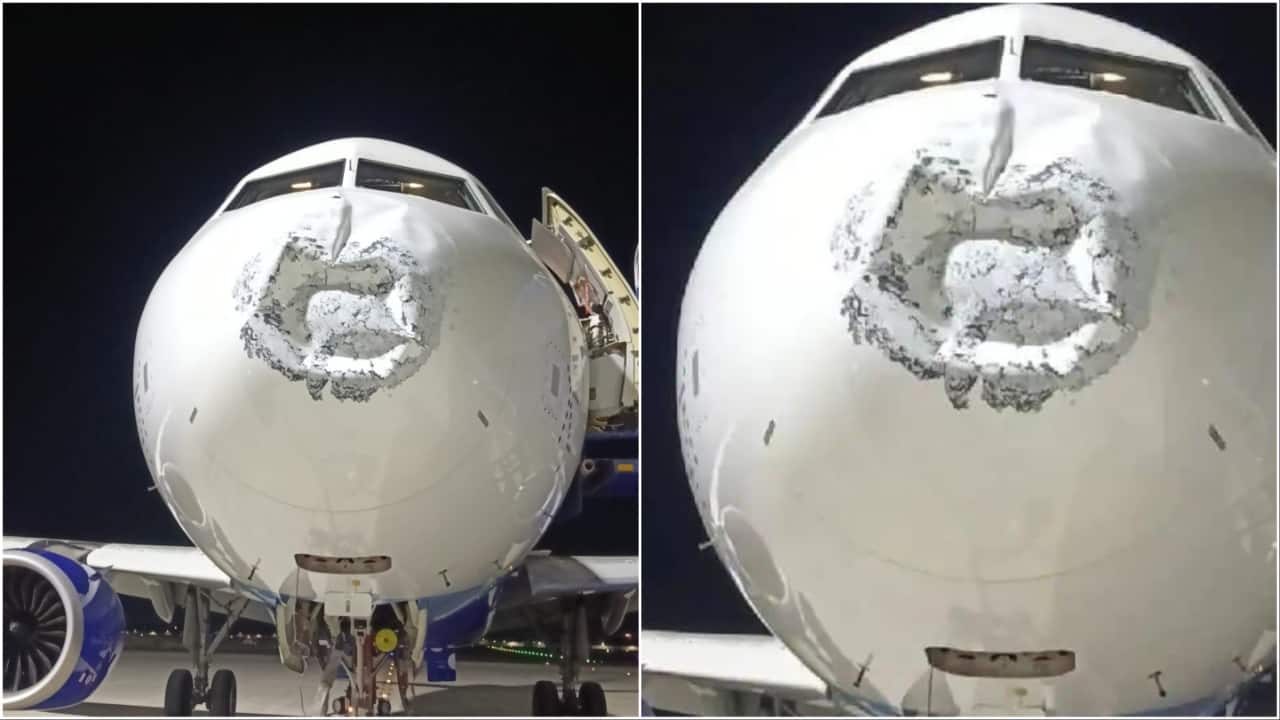
An IndiGo flight from Patna to Lucknow landed safely after being struck by lightning at 17,000 feet. The hit crushed the aircraft's nose cone, but all 104 passengers and six crew members got off without injuries. The DGCA started an investigation, and the plane is now grounded for structural testing.
Market Mastery
Webinar by Vishal Malkan
Find the weak links
in your portfolio by Vishal Malkan
An IndiGo flight from Patna to Lucknow landed safely after being struck by lightning at 17,000 feet, a hit that crushed the aircraft's nose cone. The jet was descending through severe weather when the strike occurred. It was carrying 104 passengers and six crew members, and no injuries were reported.
Despite the visible damage at the front, the aircraft touched down at Chaudhary Charan Singh International Airport ahead of schedule.
According to reports, the aircraft has since been grounded for comprehensive structural and electronic testing. The Directorate General of Civil Aviation (DGCA) has launched a mandatory investigation, and the plane must be cleared before it can return to passenger service. All affected passengers were moved to a replacement flight.
Why the nose cone takes the hardest hit
The nose cone, technically called the radome, is the most vulnerable part of an aircraft during a lightning strike. The rest of the fuselage is made of metallic alloys or composite materials layered with conductive copper mesh. The radome, however, has to be made of non-metallic fibreglass or composite materials.
This is because the weather radar dish sits directly inside the nose cone. Metal shielding around it would block the microwave radar signals, leaving pilots unable to see storm clouds.
Since the radome lacks the continuous conductive layer found elsewhere on the aircraft, a direct strike can cause serious localised thermal damage, structural crushing or surface puncture before the electrical arc passes on to the conductive body.
What happens when lightning strikes a plane
A lightning strike delivers hundreds of millions of volts. According to Element U.S. Space & Defense, a US-based aerospace and defence testing firm, a single bolt can drive a current of around 200,000 amps through an aircraft's frame. It typically strikes a sharp edge such as a wingtip or the nose and exits via the tail. A lightning strike delivers hundreds of millions of volts. It typically strikes a sharp edge such as a wingtip or the nose and exits via the tail.
Commercial airliners are built on the principle of a Faraday cage, a continuous conductive shell that blocks electromagnetic fields and guides electrical charge along the outer skin of the fuselage.
The charge enters at an extremity such as the nose cone or a wingtip, travels along the exterior metallic skin or embedded copper foil mesh and exits through static discharger wicks on the trailing edges. This conductive outer layer insulates the cabin, shielding sensitive avionics, fuel tanks and passengers from the electrical current.
How aircraft are designed to survive lightning
Beyond the conductive outer hull, Element U.S. Space & Defense said fuel tanks, fuel lines and other combustible components are placed in areas where lightning is least likely to strike. Fly-by-wire systems and other electronics are tested to withstand the electromagnetic effects of a strike.
Safer in the air than on the ground
An aircraft in flight is designed to discharge a strike's energy back into the atmosphere without harming those on board. A plane on the ground faces greater risk during a storm, the firm noted, as refuelling, luggage loading and metal staircases used for deplaning become hazards.