
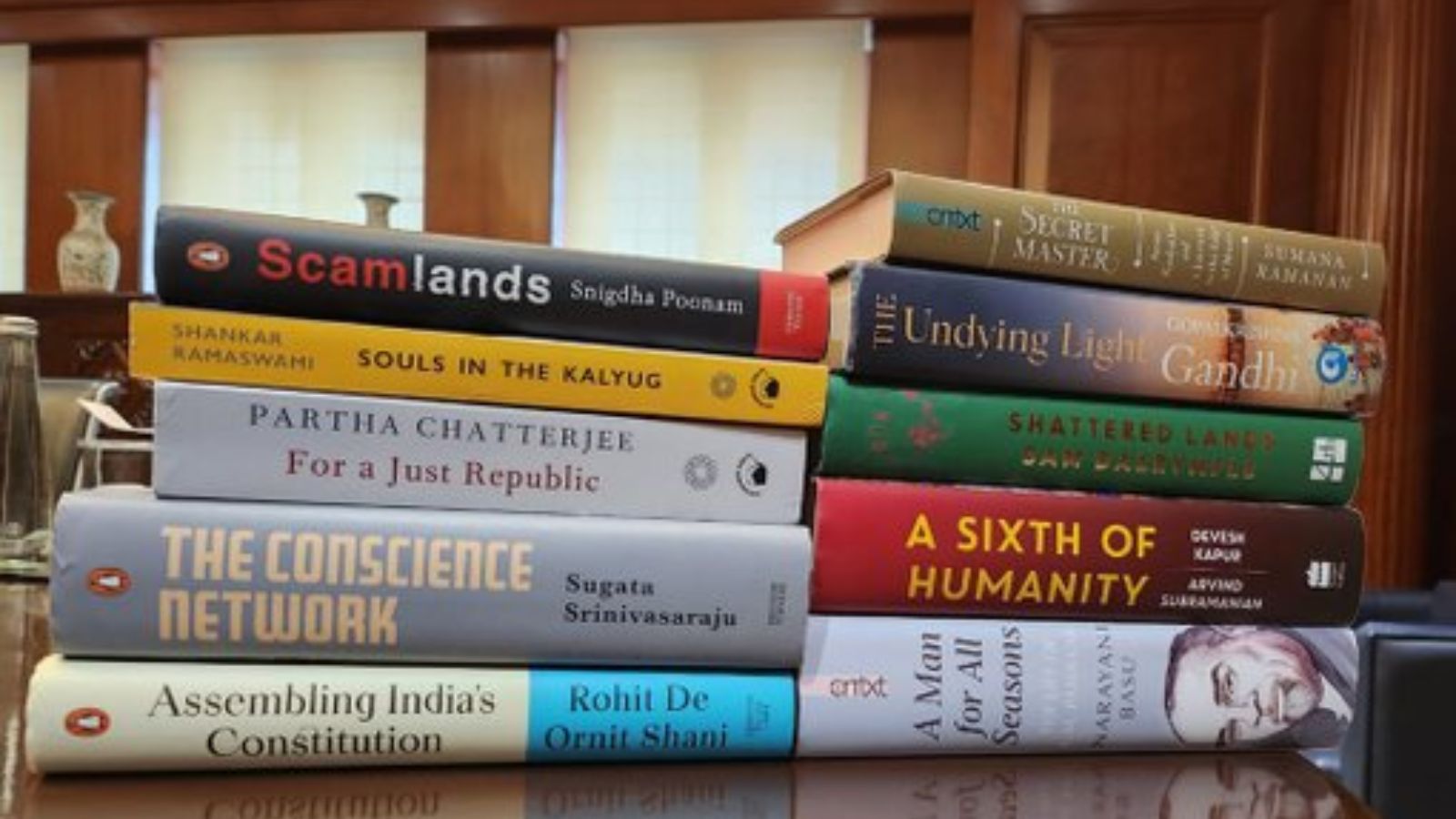
Ten non-fiction works made the Kamaladevi Chattopadhyay NIF Book Prize 2026 longlist. The winner gets a Rs 15-lakh cash prize at the Bangalore Literature Festival 2026 on December 12. Five books, including works by Narayani Basu and Sam Dalrymple, are great picks for your reading list this year. Happy reading!
Ten works of non-fiction have made it to the Kamaladevi Chattopadhyay NIF Book Prize 2026 longlist. The winner will be awarded a Rs 15-lakh cash prize at the Bangalore Literature Festival 2026 on December 12.
Five recommended books from the longlist to add to your TBR are:
A Man for All Seasons: The Life of K M Panikkar by Narayani Basu
K M Panikkar -- diplomat, statesman, and public intellectual -- was one of the major architects of post-colonial India, shaping its domestic and foreign policy, including constitutional reform in the princely states and the Cold War. His ideas, visions and decisions steered the direction of Independent India. He was Independent India's first ambassador to both nationalist and communist China, Nehru's man in Cairo and France, and, unsurprisingly, had enemies in both the CIA and India's own Ministry of External Affairs. Historian Narayani Basu finally tells his story, a must-read for anybody interested in studying how India found its feet in the wake of the British Raj.
Shattered Lands: Five Partitions and the Making of Modern Asia by Sam Dalrymple
This history of modern South Asia, told through five Partitions, has been nominated for several prestigious awards, including becoming a finalist for the 2026 Orwell Prize for Political Writing. It is an exploration of how the British Raj, which included India, Pakistan, Bangladesh, Burma, Nepal, Bhutan, Yemen, Oman, the UAE, Qatar, Bahrain and Kuwait at the start of the 20th century, spawned 12 modern nations and how the boundaries-whether contested or accepted-came to be.
A Sixth of Humanity: Independent India's Development Odyssey by Devesh Kapur and Arvind Subramanian
Written by Arvind Subramanian, former Chief Economic Adviser of India and Senior Fellow at the Peterson Institute, and political scientist Devesh Kapur, the Starr Foundation Professor of South Asian Studies at Johns Hopkins SAIS, this book is a must-read for anybody who wants to understand modern India. The book studies how India, the world's largest and most diverse country, attempted four concurrent transformations -- building a state, creating an economy, changing society, forging nationhood -- under universal suffrage.
Souls in the Kalyug: The Politics and Cosmologies of Migrant Workers in Contemporary India by Shankar Ramaswami
This anthropological study is a must-read for anybody interested in the lived realities of India's migrant workers. Ramaswami proposes a three-part answer to how these workers create lives less injurious than their circumstances might suggest: resistance and collective struggle in a Delhi metal factory; friendships built in empathetic closeness and fellowship; and metaphysical resistance to soul-distorting processes in our decivilising times, or the Kalyug.
The Conscience Network: A Chronicle of Resistance to a Dictatorship by Sugata Srinivasaraju
Many accounts describe the Emergency imposed by Indira Gandhi between 1975 and 1977, but Sugata Srinivasaraju's The Conscience Network uniquely focuses on the Indian diaspora. Set in the United States amid echoes of the Emergency in India, it chronicles how American pacifists, Quakers, civil rights activists, academics, authors, senators, and Congressmen came together in solidarity -- a network of conscience to save India's democracy.
The full list
📌 A Man for All Seasons: The Life of K M Panikkar by Narayani Basu
📌 For a Just Republic: The People of India and the State by Partha Chatterjee
📌Shattered Lands: Five Partitions and the Making of Modern Asia by Sam Dalrymple
📌Assembling India's Constitution: A New Democratic History by Rohit De and Ornit Shani
📌 The Undying Light: A Personal History of Independent India by Gopalkrishna Gandhi
📌 A Sixth of Humanity: Independent India's Development Odyssey by Devesh Kapur and Arvind Subramanian
📌 Scamlands: Inside the Asian Empire of Fraud That Preys on the World by Snigdha Poonam
📌 The Secret Master: Arun Kashalkar and a Journey to the Edge of Music by Sumana Ramanan
📌 Souls in the Kalyug: The Politics and Cosmologies of Migrant Workers in Contemporary India by Shankar Ramaswami
📌 The Conscience Network: A Chronicle of Resistance to a Dictatorship by Sugata Srinivasaraju
The jury comprised Tata Sons and Tata Group chairperson N Chandrasekaran, political scientist Niraja Gopal Jayal, technology lawyer Rahul Matthan, historian of science Jahnavi Phalkey, historian Srinath Raghavan, former Foreign Secretary of India Nirupama Rao, and entrepreneur Manish Sabharwal.