
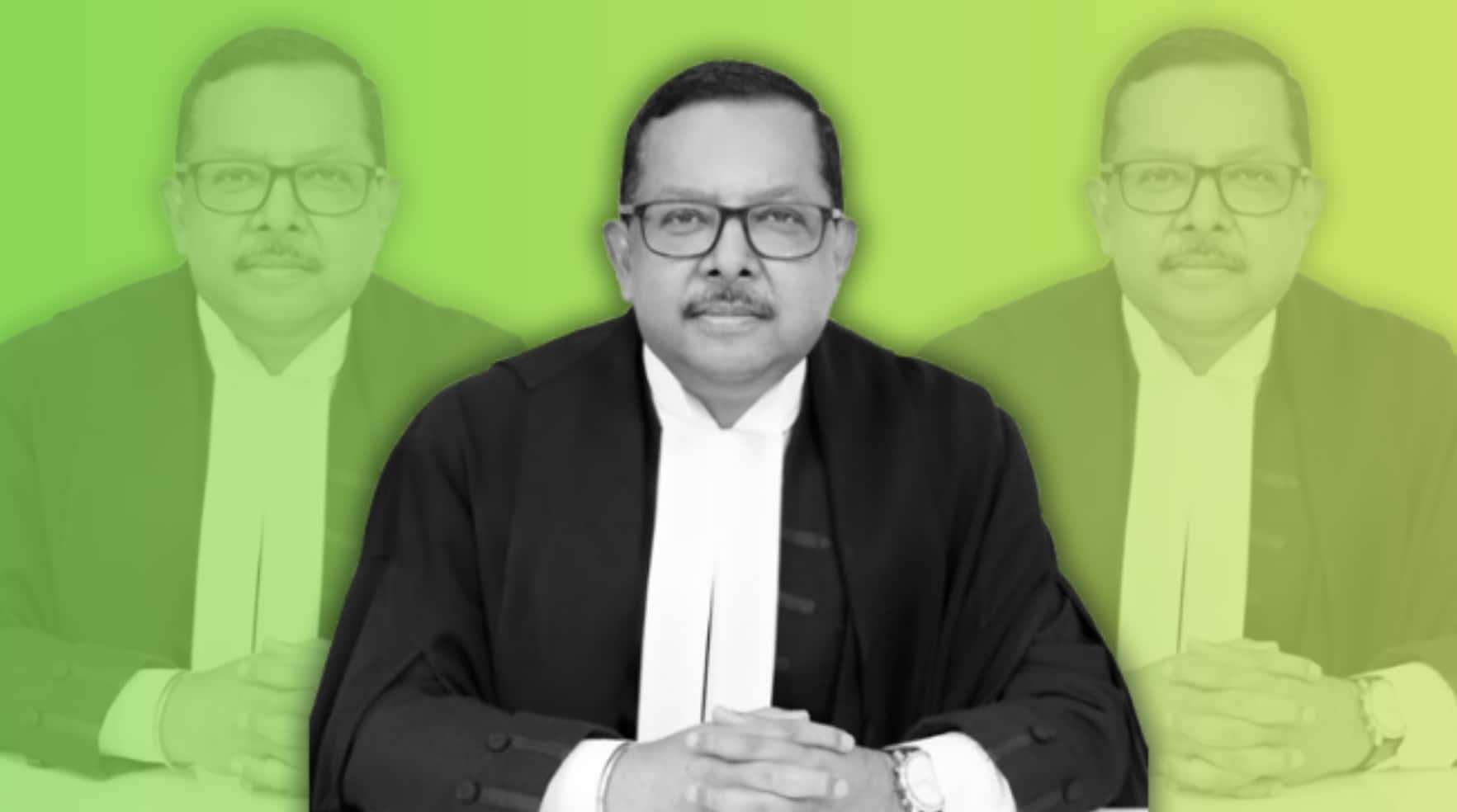
Supreme Court judge Justice Ujjal Bhuyan said any process disenfranchising millions is intrinsically arbitrary. Speaking on Sunday at NALSAR University, he argued that removing names from electoral rolls without notice violates rights. However, former CJI BR Gavai and retired judges questioned the propriety of his remarks on a pending issue.
Supreme Court judge Justice Ujjal Bhuyan's remarks on voter disenfranchisement have triggered a political and legal debate over the Election Commission's Special Intensive Revision (SIR) of electoral rolls, with opposition leaders welcoming his observations while former Chief Justice of India BR Gavai and retired judges questioned the propriety of a sitting judge commenting on an issue pending before the Supreme Court. Justice Bhuyan made the remarks on Sunday while delivering the valedictory address at the 19th Justice Bodh Raj Sawhney Memorial Moot Court Competition at NALSAR University of Law in Hyderabad. His comments came amid the continuing controversy surrounding the SIR exercise and criticism of Chief Election Commissioner (CEC) Gyanesh Kumar by opposition parties. What Justice Bhuyan said about voting rights Justice Bhuyan's central argument was that voting rights are closely connected to citizenship and the constitutional framework governing elections. He referred to Section 22 of the Representation of the People Act, 1950, which permits deletion of an entry from an electoral roll, but stressed that such deletion requires a reasonable opportunity of being heard. According to him, except where a voter is dead, a name already included in an electoral roll cannot be removed without notice and a hearing. "A citizen to be a voter and to vote is of the greatest importance and forms the foundation of free and fair elections. Section 22 of the Representation of the People Act 1950 permits deletion of an entry in the voters list. But only after the said voter has been given a reasonable opportunity of being heard. Except in the case of a dead man, the name of a voter once enlisted in the electoral roll cannot be deleted without notice and hearing," he said. Bhuyan further said voting and inclusion in electoral rolls could not be separated from the status of an Indian citizen. "From the persona of an Indian citizen, the right to vote or the right to be included in the voters list cannot be detached. It will be like taking out the soul from the body," he added. He also argued that the Constitution does not envisage separate categories of citizens based on whether they possess voting rights. He linked wholesale disenfranchisement to Articles 14 and 326 of the Constitution. "Any process which leads to wholesale disenfranchisement of Indian citizens, making them citizens without voting rights, in my view, would be outrightly violative of Articles 326 and 14 of the Constitution of India," he said. Bhuyan went further, describing a process that removes voting rights from millions as inherently arbitrary and contrary to the constitutional order. "If any process results in disenfranchising millions and millions of Indian citizens, making them second-class citizens in their own country, in the sense of being citizens without a voting right, such a process is intrinsically arbitrary. No amount of whataboutery can justify it," he said. He maintained that no authority or court could approve the removal of citizens' voting rights in violation of the Constitution. "It is a negation of the constitutional order which we have adopted based on the Constitution of India. Indian citizens' right to vote is intertwined with India's long years of struggle against foreign rule. Article 326 cannot be tinkered with at all. No authority can do it. No court can endorse it or condone it. No one is above the Constitution," Bhuyan said. Article 14 guarantees equality before the law and protection against arbitrary or unequal treatment. Article 326 provides for elections to the Lok Sabha and state legislative assemblies on the basis of adult suffrage, entitling Indian citizens aged 18 years and above to be registered as voters, subject to constitutional and legal disqualifications. Why the remarks are linked to SIR The observations came against the backdrop of the Election Commission's SIR exercise and opposition criticism of CEC Gyanesh Kumar. In May, the Supreme Court had upheld the ECI's SIR exercise, initially undertaken in Bihar between June and September 2025, holding that the exercise was constitutional and legally tenable and could not be invalidated merely because it followed a process different from ordinary electoral-roll revision. A bench comprising Chief Justice of India (CJI) Surya Kant and Justice Joymalya Bagchi held that SIR could not be declared ultra vires simply because it differed from the routine revision procedure under the statutory framework. The court also clarified that the ECI's role was confined to determining eligibility for inclusion in electoral rolls and did not extend to deciding citizenship. Deletion of a person's name from the voter list, it held, did not take away citizenship because that question could only be determined by the competent authority under law. The controversy intensified after an Indian Express report said Election Commissioners Sukhbir Singh Sandhu and Vivek Joshi had formally objected on at least 14 occasions over 10 months to decisions concerning electoral rolls, voter registration and the poll panel's technology systems. The ECI rejected the suggestion that these objections amounted to institutional dissent, saying operational queries, inputs and suggestions during the draft stage were part of its normal administrative process. It also said the decisions concerning the SIR schedule were unanimous. Opposition parties rally behind Bhuyan Opposition leaders in Maharashtra strongly endorsed Justice Bhuyan's comments. NCP (SP) spokesperson Clyde Crasto said arbitrary removal of millions of voters was inconsistent with citizens' fundamental right to vote. He accused the BJP of using "whataboutery" to deflect attention from alleged irregularities involving the CEC and the ECI. Maharashtra Congress president Harshwardhan Sapkal said constitutional rights were being undermined and described Bhuyan's observations as reflecting the situation in the country. He also alleged that the SIR process was being used to obstruct voting rights. Sapkal backed the concerns reportedly raised by the two Election Commissioners and said objections from Maharashtra's Chief Electoral Officer were also valid. He questioned whether there was any morality left in Union Home Minister Amit Shah and Prime Minister Narendra Modi. He also referred to a vigilance probe ordered by the Kerala government into a 2006 road project from the period when Gyanesh Kumar was PWD secretary in the state, and claimed that "Prime Minister Narendra Modi is a vote thief". Shiv Sena (UBT) leader Akhil Chitre said Bhuyan's observations could not simply be dismissed. He argued that removal of eligible voters without lawful justification, transparency or due process raised constitutional concerns under Articles 14 and 326, while Article 324 gives the ECI constitutional responsibility for elections without placing its actions beyond scrutiny. "Electoral power must serve the voter, not override the elector," Chitre said. Former law minister Ashwini Kumar also supported Bhuyan, saying his observations reflected concerns about mass disenfranchisement and stressing the need for transparent and fair electoral processes. Congress MP and Supreme Court advocate Abhishek Manu Singhvi welcomed what he described as the "fearlessness" and directness of Justice Bhuyan and former Supreme Court judge Justice RF Nariman in addressing vote dilution and elimination. Singhvi said there was little new in the underlying issues, but highlighted the specificity and openness with which the jurists had spoken. Justice Nariman, speaking on "The Constitution and the Common Man" at Rajkumar College in Rajkot on October 4, said the right to vote was "at great peril", citing the disenfranchisement of 90 lakh voters in West Bengal. He said around 22 lakh filed appeals, of which only about one lakh had been decided, with 93% reportedly decided in favour of voters, calling it "a completely illegal knocking out of the common man, of the citizen of India, so that a government obtains what it wants." Ex-CJI Gavai, former judges question judicial propriety Not everyone agreed with Bhuyan's intervention. Former CJI BR Gavai said judicial propriety prevented a sitting Supreme Court judge from commenting on a matter that was sub judice before the apex court. "Judicial propriety would not permit him to make any comment on the matter which is sub judice before the court," Gavai told PTI. Retired Delhi High Court judge SN Dhingra similarly criticised the remarks, saying they went beyond what was appropriate for a sitting judge at a public event. He said Bhuyan should have considered the matter carefully before making such observations and pointed out that the judge did not know all the facts of the issue. Another retired Delhi High Court judge, RS Sodhi, questioned the characterisation of SIR as disenfranchisement. He said voting rights operate within the statutory framework: those meeting the legal requirements are entitled to vote, while those outside those requirements are not. If a name was wrongly included or a person failed to meet statutory requirements, he said, the remedy was to follow the legal procedure for deletion or seek inclusion again where eligible. Sodhi also rejected the suggestion that such action automatically creates "second-class" citizens, calling such hardline formulations an insufficiently rational approach to the issue. A debate before Supreme Court The disagreement over Bhuyan's comments comes as petitions concerning SIR and other electoral issues remain pending before the Supreme Court. One of the matters concerns a new law relating to the poll panel that excludes the Chief Justice of India from its selection panel. Justice Bhuyan, who served as Chancellor of NALSAR, is known for expressing views on issues in the public domain. At the same event, he praised NALSAR students, saying they had shown what a law student should be like and describing them as "brilliant", "bold" and "brave". The ruling BJP and the ECI, meanwhile, have defended SIR, maintaining that the exercise is being conducted in accordance with law and constitutional norms.