
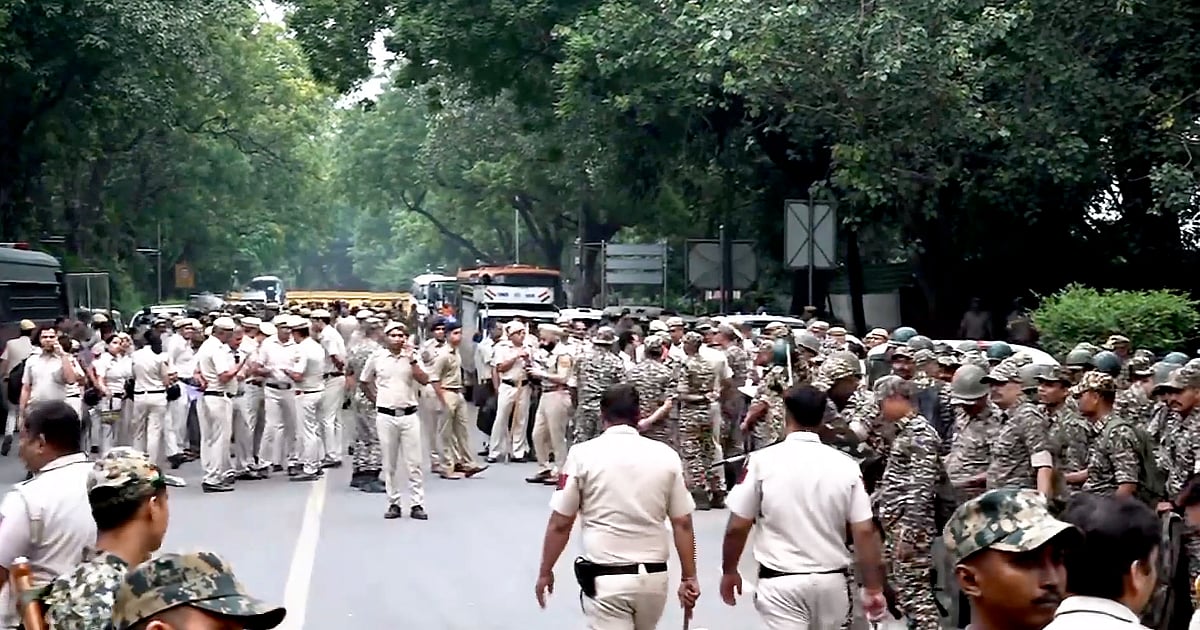
Delhi Police denotified Jantar Mantar as a protest site on October 11, 2026. Protests will now move to Ramlila Maidan, Burari Ground, and CBD Ground. Activist Prashant Bhushan said, "It is clear that the government wants to push protests to the outskirts of Delhi." Many groups now fear for democratic rights.
Jantar Mantar's place in Delhi's protest history dates back to the early 1990s, when restrictions on demonstrations at the Boat Club lawns near India Gate led to the emergence of alternative protest spaces.
NEW DELHI: Jantar Mantar, one of the most recognisable symbols of public dissent in the national capital for decades, will now become a 'just another' road in Lutyens' Delhi, with Delhi Police denotifying it as a designated protest venue and identifying Ramlila Maidan, Burari Ground and CBD Ground in east Delhi as alternative sites for demonstrations.
The order by the Delhi Police dated October 11, 2026 marks a significant shift in Delhi's protest geography, moving public demonstrations away from the vicinity of Parliament and the central government's offices, in fact, in the heart of Lutyens' Delhi.
The order signed by Commisioner of Police Anurag Kumar stated that the Ministry of Home Affairs had constituted a committee to examine alternative suitable venues for citizens to exercise their right to organise protests and demonstrations.
Based on the committee's recommendations, Jantar Mantar has been removed from the list of designated protest sites. Delhi Police also stated that detailed and revised standard operating procedures (SOPs) for organising demonstrations at the three newly designated venues would be issued separately."The standing order partially modifies the earlier Standing Order No. L&O/48/22, dated April 28, 2022," read the order.
For activists, opposition parties and civil society groups, however, the move raises questions about the right to peaceful assembly and the visibility of dissent in the heart of the capital.
Congress MP Charanjit Singh Channi criticised the move, warning that the restrictions could eventually be beefed up further. "After some time they will say don't enter Delhi, as if it belongs to BJP," he said.
Congress MP Gaurav Gogoi alleged that the decision reflected the government's apprehension about public opposition. "They are scared and are aware that they are not going to remain in power for long," he said.
Lawyer and activist Prashant Bhushan questioned both the legality and the intent of the move, arguing that the government cannot restrict peaceful assembly merely to officially designated sites.
"It is clear that the government wants to push protests to the outskirts of Delhi. They won't even permit Ramlila for large protests. This is malafide and illegal," he said, adding that peaceful assembly and protest are fundamental rights.
Abhijeet Dipke also sharply criticised the decision, drawing a connection between the removal of the protest venue and the future of democratic dissent.
"Today, Modi denotified Jantar Mantar as a designated protest site. Tomorrow, he will denotify democracy itself. The dictator's problem was never the protest site. It was the very idea of people protesting," he posted on X.
Jantar Mantar's place in Delhi's protest history dates back to the early 1990s, when restrictions on demonstrations at the Boat Club lawns near India Gate led to the emergence of alternative protest spaces.
The Boat Club had witnessed massive mobilisations, including a week-long farmers' protest led by Mahendra Singh Tikait in 1988.
Over the years, Jantar Mantar became a meeting point for people seeking justice, accountability and political change. The anti-corruption movement led by Anna Hazare in 2011 brought the site national prominence, turning it into a focal point for demands for a strong Lokpal. Pensioners, farmers, workers, students and civil society organisations subsequently used the space to press their demands.
The venue also became the centre of the wrestlers' protest in 2023, when Olympic medallists and other wrestlers demanded action against former Wrestling Federation of India chief Brij Bhushan Sharan Singh.
Its history, however, has not been without restrictions. In 2017, the National Green Tribunal ordered restrictions on protests at the site following complaints about noise and sanitation. The Supreme Court set aside the blanket prohibition in 2018, allowing peaceful demonstrations subject to appropriate regulations.
Social media was abuzz on Monday with people arguing that shifting demonstrations away from the corridors of power could make protests less visible and more difficult for citizens to organise.
Saurav Das, co-convener of Cockroach Janta Party, said, "The Jantar Mantar belongs to THE PEOPLE OF INDIA. Did the Ministry of Home Affairs consult with the people of India? Were any stakeholders consulted? Were any organisations consulted? Take it in writing just how they are denotifying people's Jantar Mantar; the Prime Minister will soon denotify democracy in India. This move is a step towards that."
He further said, "We do not accept this arbitrary decision. It is an assault on people's fundamental right to protest and peaceful assembly. Ab poora desh Jantar Mantar ban raha hai!"