
The Delhi Police on Monday (October 12) de-notified Jantar Mantar as a protest site. Officials now suggest Ramlila Maidan, Burari Ground, and CBD Ground as alternatives. This move follows a recommendation by a committee under the Ministry of Home Affairs. The police said, "Detailed and revised SOP for organising protest/demonstrations will be issued."
The Delhi Police on Monday (October 12) de-notified Jantar Mantar as a designated protest site, naming Ramlila Maidan and Burari Ground in north Delhi and CBD Ground in east Delhi as alternatives.
According to the notification, the decision follows a recommendation by a committee constituted by the Ministry of Home Affairs (MHA). "Detailed and revised SOP for organising protest/demonstrations at these three venues will be issued separately," the standing order said.
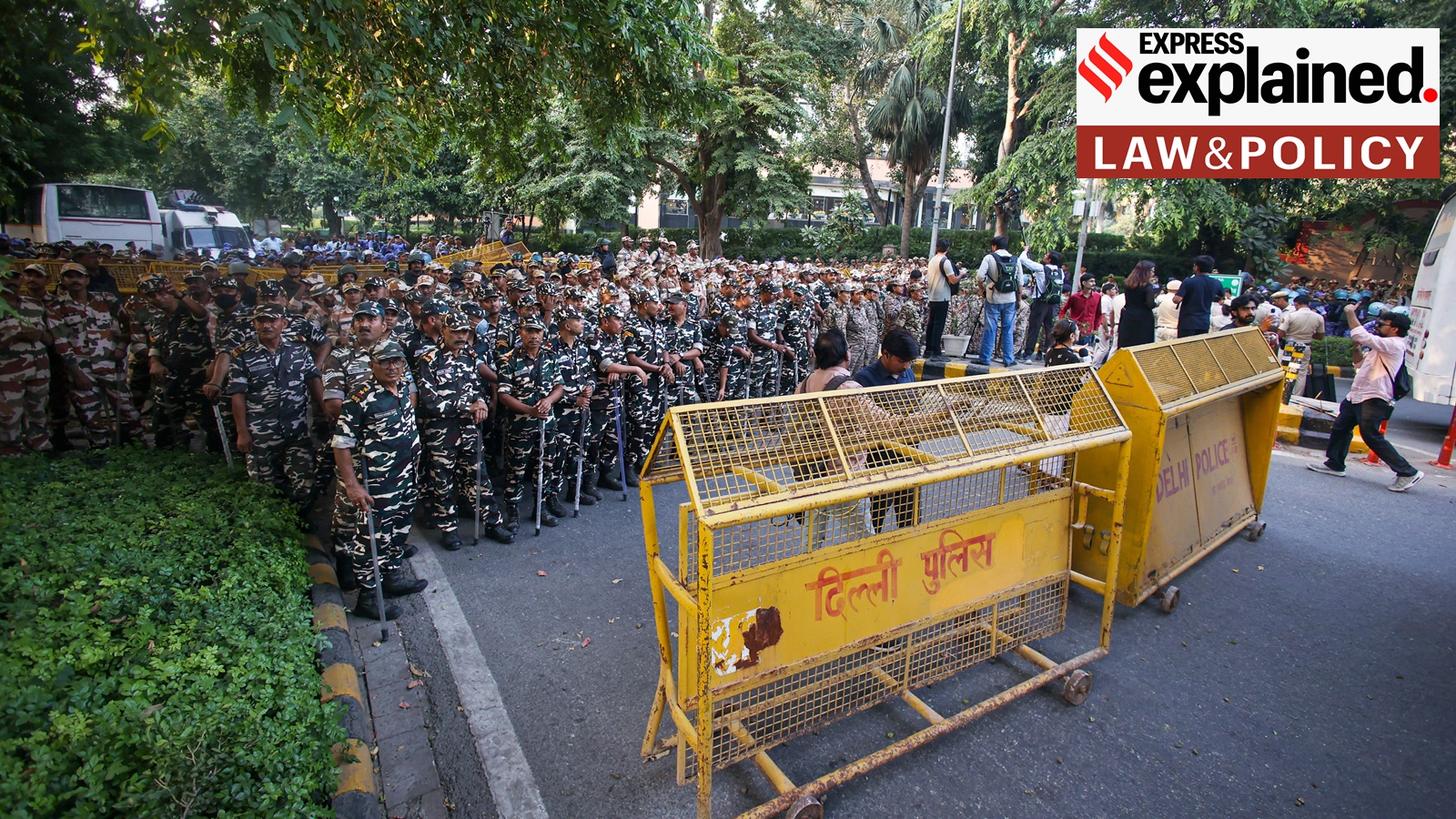
The move comes amid the Delhi police's heavy barricading and crackdown on protesters in central Delhi since October 10. Protesters have since taken to the streets and gathered at several locations, including outside areas where prohibitory orders have been imposed under Section 163 of the BNSS.
The designation of protest sites is intended to regulate demonstrations while addressing concerns over traffic, public safety, and residents' rights.
Who decides where you can protest?
Article 19 guarantees the fundamental rights to freedom of speech and expression and to assemble peaceably. These rights are subject to reasonable restrictions, including in the interests of "public order".
Unlike other states, Delhi's police and public order fall outside the legislative powers of the Delhi Assembly. Under Article 239AA(3)(a) of the Constitution, the Legislative Assembly has the power to make laws for NCT Delhi "except matters with respect to Entries 1, 2 and 18 of the State List," which cover public order, police and land.
Explained | CJP protest: The right to protest, and what happens when police deny permission
The Delhi police thus function under the MHA. The police regulate individual demonstrations, including applications for permission and compliance with conditions governing designated sites.
Under the earlier framework, organisers had to apply 10 days in advance to protest at Jantar Mantar, which had a cap of 1,000 people. Ramlila Maidan was another designated site, with a capacity of around 50,000 people.
Law and order vs 'public order'
While the police often cite maintaining law and order when regulating protests, Article 19 permits restrictions on fundamental rights on specified grounds, including "public order". The Supreme Court has treated the two differently.
In the 1966 SC ruling of Ram Manohar Lohia v. State of Bihar, the court observed that an act may affect law and order without affecting public order. It described law and order, public order and security of the state as three concentric circles, with public order occupying a narrower category.
"One has to imagine three concentric circles. Law and order represents the largest circle within which is the next circle representing public order and the smallest circle represents security of State. It is then easy to see that an act may affect law and order but not public order, just as an act may affect public order but not security of the State," it said.
In Re: Ramlila Maidan Incident (2012), the court said a restriction imposed to maintain law and order "would be least intruding into the guaranteed freedom", while public order "may qualify for a greater degree of restriction since public order is a matter of even greater social concern".
The court clarified that "Public order is something distinct from order or orderliness in a local area. Public order, if disturbed, must lead to public disorder whereas every breach of peace may not always lead to public disorder."
Speaking to The Indian Express, senior advocate Gopal Sankaranarayanan explained that law and order issues can involve localised disturbances, such as two people fighting on a street or a car blocking a road. Public order, he said, concerns disturbances that affect the wider community, such as large-scale disruption of transport, communication or access.
"Law and order is not a valid basis to limit the right to speech and expression," he said. He added that the police cannot invoke public order on their own to justify restricting fundamental rights. "The first step is a law needs to be made which gives police that power. Then the police exercise the power under that law," he said, adding that the police must identify the law under which they are exercising their powers.
Also in Explained | Protest vs public order: How far can police go to prevent 'trouble'?
Professor G Mohan Gopal told The Indian Express that dissent is the "lifeblood of a peaceful and law abiding society" and democracy exists specifically to accommodate different opinions. "Law and order means a system that protects human rights... If you understand it that way, there is no breakdown of law and order. The law is being misapplied and abused by those who are violating the right of people to protest," he argued.
Gopal added that shutting down designated protest sites and suppressing peaceful dissent under "law and order" risks driving citizens to the point of desperation. "Those who are defending the public order are forced to not comply with Section 163 in order to protest, because all the legitimate channels, democratic channels for defending the public order based on democracy have been closed," he said.
How can protest sites be designated?
The bench in Himat Lal K. Shah v. Commissioner of Police, Ahmedabad (1972), held that the police could require prior permission for public meetings on streets and there was "nothing wrong" with it. But it added that the State "cannot by law abridge or take away the right of assembly by prohibiting assembly on every public street or public place."
In Mazdoor Kisan Shakti Sangathan v. Union of India (2018), the case pertained to restrictions on demonstrations at Jantar Mantar and the proposal to move them to Ramlila Maidan. The petitioners argued that the ground would be too far from the "concentration of 'power'" in New Delhi, and would impact the protests' goals, concerning the very authorities the slogans are raised against.
While the court accepted that contention, it said that there is a need to balance the rights of protestors with those of residents and held that "while regulating such demonstrations in public interest, particular areas can be earmarked".
It thus allowed a limited portion of Jantar Mantar Road to remain open for regulated demonstrations by smaller groups, noting that the site had been used for protests for a considerable period.