
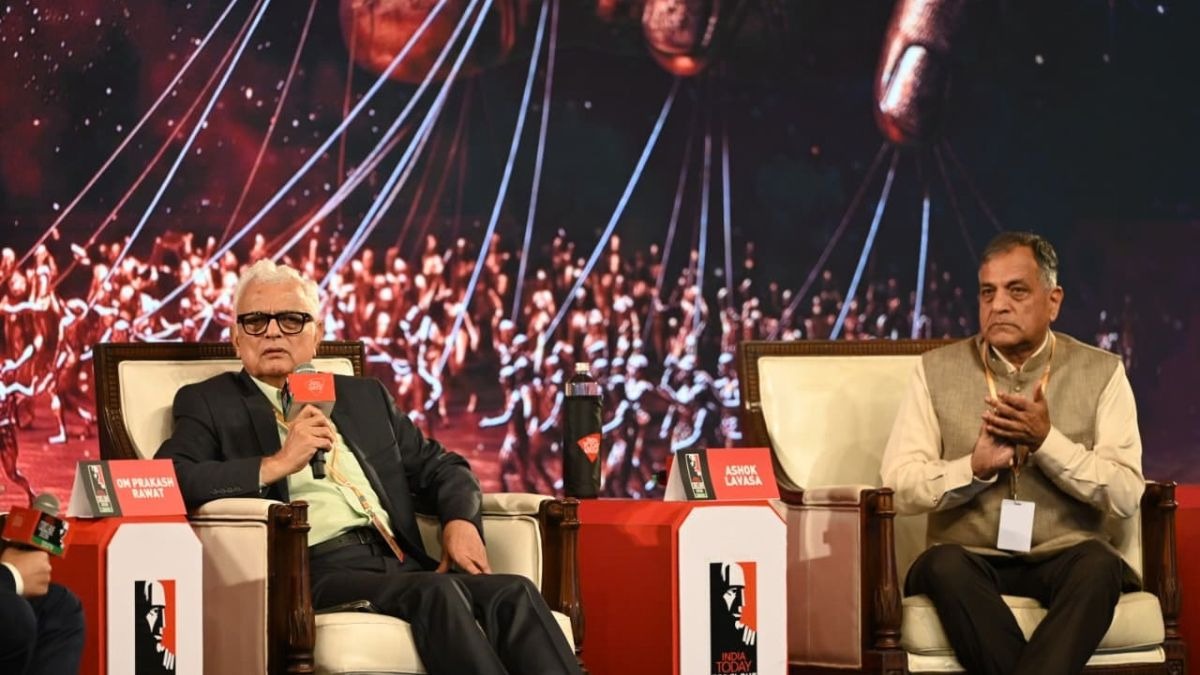
Former election commissioners Om Prakash Rawat and Ashok Lavasa discussed the Election Commission’s credibility at an India Today Conclave South session in Kochi on September 29. They debated the controversial Special Intensive Revision of electoral rolls. Rawat said, "The EC had set a global standard for conducting free, fair elections."
The Election Commission's (EC) credibility, the controversy around the Special Intensive Revision (SIR) of electoral rolls and the independence of the poll body's decision-making process came under intense scrutiny at an India Today Conclave South session, featuring former chief election commissioner Om Prakash Rawat and former election commissioner Ashok Lavasa, in Kochi on September 29.
The session, 'Election Commission on Trial: Are India's Elections Free and Fair?', saw the expert panellists being asked if the current EC could be trusted. Rawat urged caution before reaching to any conclusion. He said the EC had set a global standard for conducting free, fair and credible elections over the past 75 years, but acknowledged that the institution was facing controversy. His position was to wait for the facts to emerge before making a judgment.
Lavasa was more direct about the prevailing situation. He said a trust deficit had developed around the EC and that the institution itself had contributed to that perception. At the same time, he cautioned against equating the institution itself with its three commissioners. The EC, Lavasa said, remained essential to India's electoral democracy and should not be written off because of the actions, if any, of certain individuals.
A major part of the discussion centred on SIR, which Lavasa described as one of the most controversial decisions in the EC's history. He questioned the basic design of the exercise, arguing that it appeared to shift the burden of establishing eligibility from the election machinery to the voters. The constitutional criteria for being an elector, he pointed out, were citizenship, being at least 18 years old and not being disqualified by law.
Rawat offered a different perspective on the functioning of the election machinery. He stressed that the EC is not limited to its three commissioners but includes a vast field organisation. Drawing from his experience in Bihar, he said local election officials had conducted camps to help voters with the revision process. He argued that 15 million election personnel could not simply be manipulated by EC's commissioners at the top.
Both Rawat and Lavasa, however, agreed on the need for greater transparency. Rawat said the current commissioners should come out in the open and answer questions rather than rely only on issuing media statements. Lavasa similarly called for complete disclosure of facts, including acknowledgement of mistakes if any had been made.
The discussion also turned to the appointment of election commissioners. The 2023 law replaced the chief justice of India (CJI) on the selection committee with a Union cabinet minister nominated by the prime minister. The earlier Supreme Court framework had the prime minister, leader of the Opposition and CJI.
Rawat argued that the earlier system had produced credible elections even when appointments were made by the executive alone, and that institutional arrangements could evolve. Lavasa, however, questioned the rationale for removing the CJI, arguing that the new structure could create a perception of executive influence. He said this placed an unnecessary burden on those appointed to the EC.
On whether dissent within the EC should prompt anybody's resignation, Lavasa argued that dissent has a place in every institution and that eliminating dissenters would weaken the system.
On the delays in deciding disputes over party symbols, both supported greater transparency, although Rawat said fixed deadlines could be difficult because some cases involve large volumes of documents and affidavits.
The session ultimately returned to the theme of trust. For Rawat, the EC controversy over SIR needed time and facts before conclusions were drawn. For Lavasa, transparency and disclosure were essential to restoring confidence in an institution that remains central to India's electoral democracy.
SESSION HIGHLIGHTS
Om Prakash Rawat
* "I would say, let's wait and watch for some time and then make a conclusion about the Election Commission's functioning and the allegations being made."
* "They cannot. Even if they want to, they cannot manipulate the electoral process. There are so many people involved in the election machinery that it is not possible."
* "If they come out in the open, not through a press note but taking questions, then there is no issue; everything will be clarified."
* "If they continue doing this thing, the Election Commission will ultimately be the sufferer because the credibility of the institution will suffer."
* "The Election Commission set a gold standard throughout the world in conducting free, fair and credible elections in the last 75 years."
Ashok Lavasa
* "Clearly, there is a trust deficit in the air. And sadly, the Election Commission has contributed to this perception."
* "The only option before the Election Commission is to state the full facts before the people -- a complete disclosure, which could even mean admission of some mistakes which they might have made."
* "The entire SIR exercise is conceptually flawed. You are carrying out an exercise in which you are shifting the onus of establishing your eligibility on the elector."
* "This is turning the whole system upside down. The citizen is being asked to establish that he or she is eligible to be on the electoral roll, rather than the system establishing who is not eligible."
* "Dissenters should have a place in every system. If you start saying that all dissenters should go out of the system, I think you will end up weakening the system."