
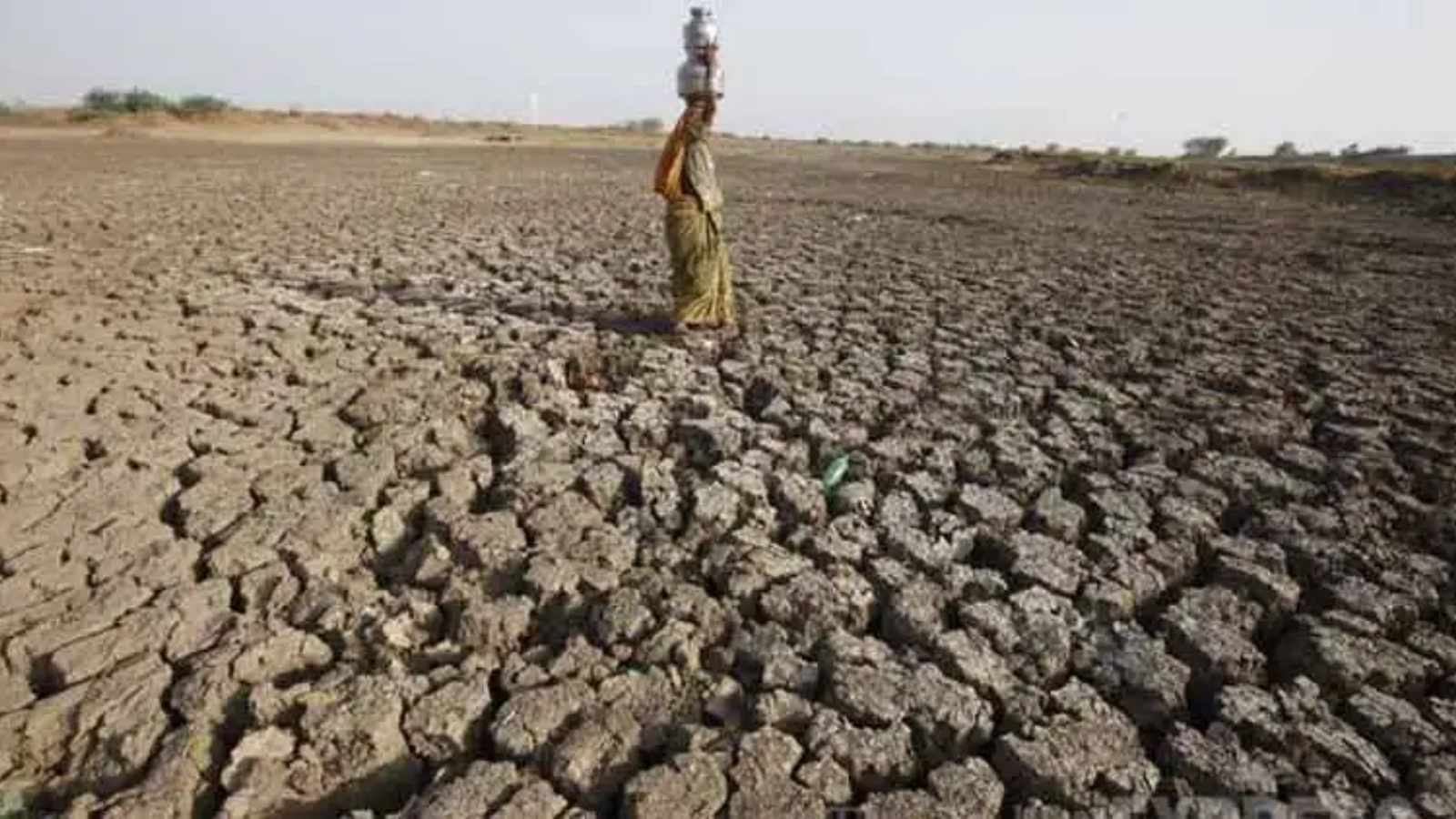
Devbhoomi Dwarka became the driest district in Gujarat this monsoon season, receiving only 16.45% of its decadal average rainfall by September 30. A.K. Das, the IMD’s regional director, said the dry monsoon could be the result of a "no system" moving towards these districts. Many areas faced a massive rain deficit.
Lord Krishna's Dwarka celebrated its driest Janamashtami in a decade this year.
As the official date for the end of the southwest monsoon season passed on Wednesday (September 30), official data showed that the coastal district of Devbhoomi Dwarka recorded its worst rainy season in 10 years, receiving only 16.45% of its decadal average rainfall.
This made Dwarka, a traditionally rainfall-surplus district, the driest district in Gujarat this monsoon season. The district, which was the wettest in the state in 2024, received 97% of its 10-year average rainfall the following year, and crashed to a deficit of 73% in 2026.
The Kalyanpur taluka of Devbhoomi Dwarka district had reported the least rainfall in the state with only 7.86% of the 10-year average until September 30.
Large deficits in two coastal districts
2024 was a bumper rainfall year for the two coastal Saurashtra districts of Dwarka and Porbandar. This year has seen the opposite situation. Both districts have been put in the category of "large deficient" by the India Meteorological Department (IMD).
According to data from the State Emergency Operation Centre (SEOC) Gandhinagar, as on September 28, 2024, Devbhoomi Dwarka had recorded 258.2% of the 10-year average, the biggest departure among all districts, and almost double the state average of 134.4% of the 10-year average.
This year, the onset of the monsoon was delayed by nine days after its usual date of arrival on June 15, and Devbhoomi Dwarka district did not receive any rain until June 30, the date by which the southwest monsoon usually covers the entire state. It was raining in Surat in South Gujarat, but the monsoon had not moved further.
In the southwest monsoon season of 2024, the district of Porbandar received 193.04% of the decadal average until September 28 of that year, much more than the departure across the state.
This year, Porbandar received just 30.86% of the 10-year average until September 28, and no rain has been reported since. In 2025 Porbandar had received 102.16% of the decadal average, as opposed to the average statewide figure of 111.7%.
What has happened this year: No system and El Niño
NO SYSTEM: A K Das, the IMD's regional director in Ahmedabad, said the dry monsoon this year could be the result of a "no system" moving towards these districts. In the IMD's monsoon terminology, a 'no system' period refers to a time when there are no organised low-pressure weather systems such as a depression or a cyclonic circulation actively driving the monsoon.
EL NINO: "Another reason could be the El Niño condition as a result of which there was a rainfall shift towards the eastern regions of the country," Das said.
El Niño is a climate pattern characterized by the unusual warming of surface waters of the tropical central and eastern Pacific Ocean. An El Niño event became firmly established in the middle of this year, is currently rapidly intensifying, and is expected to persist through February 2027, according to the latest update from the Geneva-based World Meteorological Organization (WMO).
The appearance of an El Niño is often correlated with a reduced rainfall year in the Indian subcontinent. The 2026-27 El Niño conditions are seen as having contributed significantly to the erratic and below-average rainfall during this year's southwest monsoon season.
The all-India average rainfall deficit over the four-month rainy season that ended on September 30 was close to 13% compared with the long-period average (LPA). According to the IMD, Southern peninsular India recorded the biggest deficit (28%), followed by the Eastern and Northeastern Indian regions.
Deficient rainfall in more than a third of districts
Gujarat government officials have expressed concern over the rainfall departures seen in districts across the state. Overall, the state had received 810.32 mm of rain until September 30, or 89.16% of the normal.
Eleven out of the 34 districts have fallen in the 20%-59% deficit range, while two districts have suffered deficits between 60% and 90%. Three talukas of Devbhoomi Dwarka district -- Bhanvad, Dwarka, and Khambhalia -- have received 24.3%, 20.4%, and 15.93% of their monsoon season average respectively.
The districts of Patan, Mehsana, Gandhinagar, Ahmedabad, Surendranagar, Morbi, Botad, Anand, Mahisagar, Panchmahal, Narmada, Tapi, Dang, Amreli and Bhavnagar have received rainfall in the "normal" range.
Only five districts -- Kheda, Bharuch, Surat, Navsari and Valsad -- received "excess" rainfall, which is defined as 20% to 59% above normal. Data from the Weather Bureau until September 30 show Valsad district recorded the highest surplus (39%), followed by Navsari (29%), Kheda (28%), and Surat (27%).