
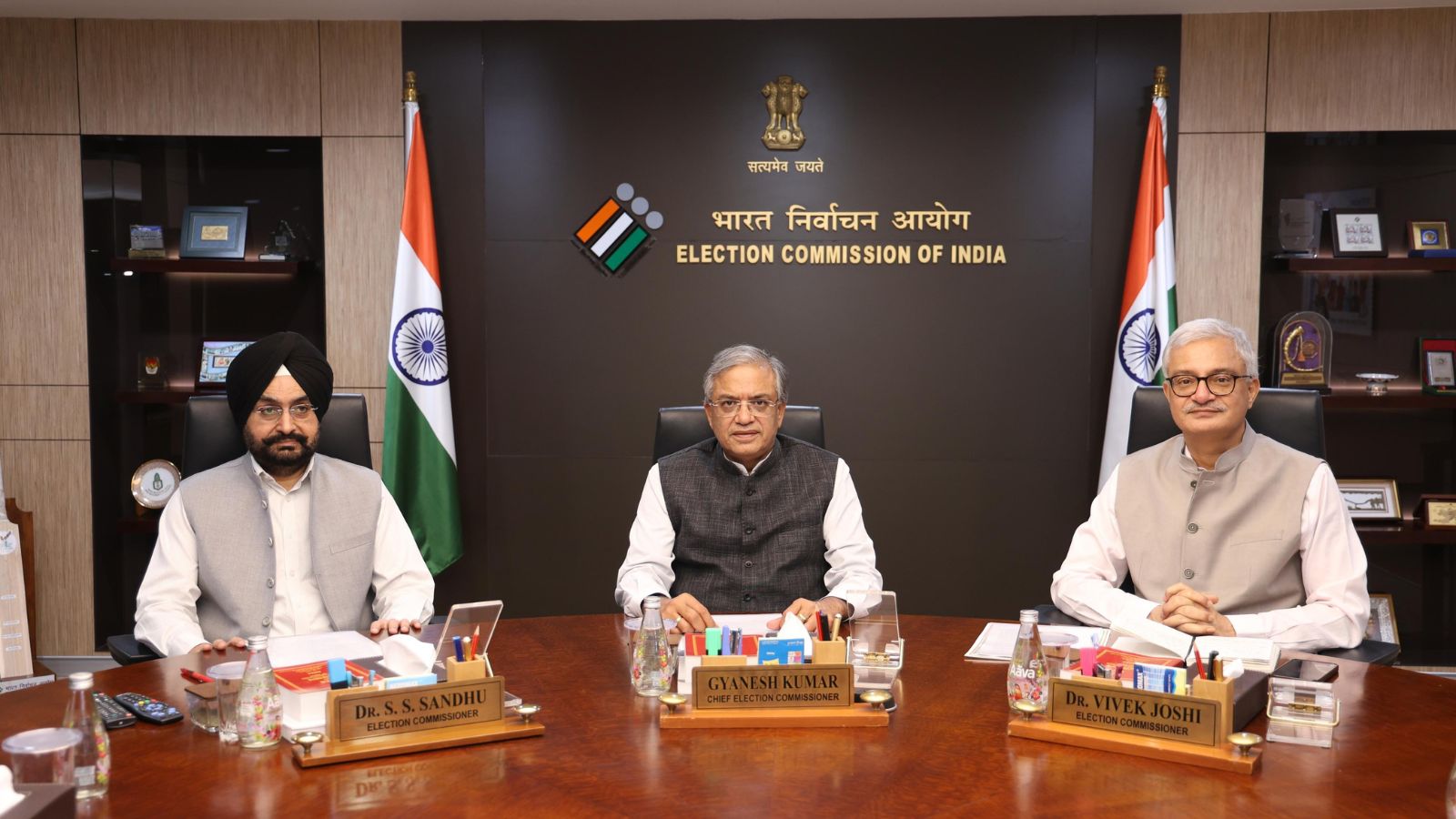
Recent developments have raised concerns about trust in India’s electoral machinery. A Supreme Court bench split over the appointment process for the CEC and ECs. While the court pushed for a neutral selection committee in March 2023, Parliament later passed a law that many feel favors the government’s own interests.
Two developments, unrelated but interconnected, in recent weeks have brought to the fore the critical imperative of ensuring trust in the machinery of India's electoral democracy. The first, and by far the more important, was The Indian Express's reportage on the actions of the CEC and some senior Election Commission officials that appear to undermine the right to vote. Apparently, these actions even fell foul of other Election Commissioners.
The other was a split verdict of a Supreme Court division bench, wherein one judge underscored the Court's March 2023 judgment and emphasised that the executive could not have exclusive powers in the appointment of the CEC and the ECs.
Article 324 of the Constitution vests superintendence of national and state elections in the ECI but leaves it to Parliament to decide how the CEC and ECs are appointed. With no legislation for nearly 75 years, the executive filled this constitutional vacuum and appointed the CEC and ECs until a Supreme Court judgment in March 2023 ruled against exclusive executive control over these appointments. Accordingly, until a law was passed, the SC created a selection committee to appoint the CEC and ECs. It was to consist of the Prime Minister, the Leader of the Opposition in the Lok Sabha, and the Chief Justice of India.
At the end of 2023, Parliament enacted a law on the subject that left out the Chief Justice but included a cabinet minister in the three-member selection committee. The cabinet secretary was to prepare a shortlist of candidates for the committee, whose decisions would be by majority vote. For many, including the learned judge, this did not square with the March 2023 judgment, given that the cabinet minister was hardly likely to differ from the PM, making the selection committee clearly loaded in the government's favour.
Institutional arrangements to ensure that the people at the helm of the election process, the CEC and the ECs, are as free as possible from bias and act with fairness are key imperatives for India. For this, having the government and the Opposition on the same page in the CEC and EC selection process would appear to be a critical ingredient -- not just in the constitution of a bipartisan selection body, but in ensuring that its outcomes reflect bipartisan agreement.
A leaf could be taken from the UN Security Council's procedure to select the UN Secretary-General -- none of the five Permanent Members with a veto must dissent from the choice. This can mean that the candidate who makes it is not always the one with the best technical qualifications, but someone not distrusted by any of the P-5. Complete trust is, of course, the ideal, but given its somewhat utopian likelihood, removing distrust is, perhaps, the best option.
The Constitution has entrusted the Election Commission with the "superintendence" of elections. Over the years, this has meant certain overriding administrative powers for the ECI. Such responsibilities call for acumen and experience from those helming the agency. Therefore, in the past, those holding top positions in the bureaucracy have been selected. This also sits well with the principle of seniority, a not unimportant consideration in our societal norms.
you may like
The imperative to accord respect to seniority would also suggest constituting the committee in a way that it is headed by the Chief Justice and includes a Union cabinet minister and the Leader of the Opposition. A situation in which the PM's views are not upheld by the committee is best avoided, while the Chief Justice outranks Union cabinet ministers in the warrant of precedence.
The difficult task is obtaining consensus and putting up with a few rounds of a lack of it - this is not dissimilar to what is currently happening at the UNSC with the selection of the next UNSG. For this, the role of the CJI becomes critical, but so does that of the cabinet secretary in suggesting names of not only those who have served in top bureaucratic positions, but also those who are not perceived to have political leanings and are not "close" to the political leadership. This is not an easy task but, perhaps, a critical one in a free and fair electoral democracy.