
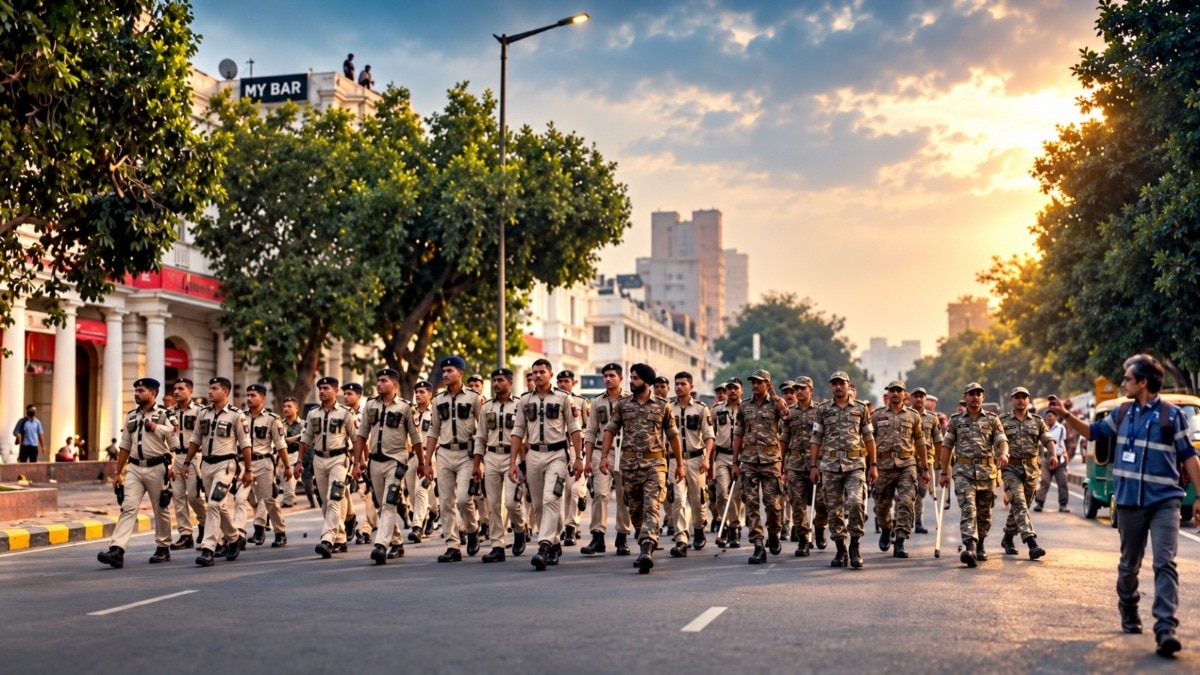
Delhi police detained journalists and office workers during the Cockroach Janta Party protest on Saturday. Around 25,000 security personnel fanned out across the capital, leaving roads deserted. While many protesters got picked up, journalists covering the event also faced detention. Authorities dropped them far away, leaving them to find their way.
Saturday offered a glimpse of the risks of reporting from the ground when a city is under heavy security restrictions. In central Delhi, journalists covering the Cockroach Janta Party's (CJP) protest were among those detained and put on police buses, despite carrying press IDs. Even office workers who were going about their daily business were taken away from Connaught Place.
For some, the press credentials helped them cross barricades and enter restricted areas. But they offered little assurance about what might happen once they were inside.
Central Delhi turned into a fortress on Saturday as around 25,000 security personnel fanned out across the national capital ahead of the CJP's protest demanding Chief Election Commissioner Gyanesh Kumar's resignation. Roads were deserted, shops remained shut, train services to and from two of Delhi's main railway stations were suspended, and access to the heart of the capital was restricted.
By the time I reached central Delhi at around 1.30 pm, Abhijeet Dipke, Saurav Das, Ashutosh Ranka, Dhruv Rathee, Yogendra Yadav, Neha Bora and several others who had become the faces of the protest had already been detained.
But the people caught up in the day's events were not limited to those who had gathered to protest. They included journalists, who were there to cover the developments and bring information to the public from areas where cellular networks were unavailable.
My colleague, Shivang Shukla, had been detained while covering the protest. Two journalist friends of mine, working with established media organisations, were also picked up in similar circumstances. None of the three were taken to a detention centre. Instead, they were dropped off far from the protest site and left to find their way back.
Central Delhi was completely cut off from the rest of the city, with mobile data unavailable across stretches of several kilometres. Delhi Police, the Central Reserve Police Force (CRPF), the Rapid Action Force (RAF), and the Border Security Force (BSF) were among the forces manning the streets. Personnel in different camouflage uniforms stood against the backdrop of Lutyens' Delhi's colonial-era architecture, which was a striking sight on streets largely devoid of civilians.
The usual traffic din was missing, as were the crowds that typically fill central Delhi on a Saturday. Parakeets and peacocks were among the few sounds breaking the silence. Every so often, however, police announcements warning that prohibitory orders under Section 163 of the Bharatiya Nagarik Suraksha Sanhita (BNSS) were in force cut through the quiet, cautioning that gatherings, damage to government property or assaults on police personnel could invite legal action.
BARRICADES, CANCELLED TRAINS, STRANDED COMMUTERS
Train services to New Delhi and Hazrat Nizamuddin railway stations were cancelled between 4 am and 2 pm on Saturday, but people still had journeys to make on the later trains. On my way to central Delhi, I saw commuters riding two-wheelers with luggage wedged between the rider and passenger, trying to reach the stations in time for trains after services resumed.
At the barricades, they had to explain their journeys to police personnel. My India Today lanyard spared me those questions. The company's name was enough for the barricades to be moved aside.
With Ola, Uber and Rapido directed by the police not to accept rides towards the area, reaching central Delhi was difficult. Yet, my visible press ID allowed direct access through Tilak Marg, while other vehicles were being directed to take the longer route via Delhi Gate. I crossed eight barricades, and my ID was checked only twice.
That access, however, did not mean journalists were spared police action. Shivang recounted how he was detained after approaching a protest by Students' Federation of India (SFI) members.
"I saw some SFI students protesting, so I went to cover them. I believe I was at a safe distance. I don't know who pushed me from behind. I assume it was a cop, but I don't want to make an allegation. The push brought me within reach of the cops who were putting protesters on a bus, and they started pushing me too," he said.
"I kept telling them, 'I am a journalist. Don't do this to me. Let me go.' But they pushed me inside the bus. It was very hostile. I almost got hit, but luckily, nothing much happened."
Shivang said he eventually pulled out his press ID through a bus window and called out to police personnel. He kept telling them that he was a journalist and had been pushed inside the bus. He was eventually released.
Another journalist friend, who works with a reputed magazine, was picked up while recording a commotion in Connaught Place, where a few protesters were shouting slogans. Dozens of police personnel chased protesters as journalists tried to capture the action. My friend was put on a bus and dropped near Minto Road, outside Connaught Place. He returned on foot about an hour and a half later.
Another friend, who is also a journalist working with a national daily, was also detained. She managed to get off the bus at a traffic signal and run away.
All three were wearing press IDs from established media organisations. Yet, the credentials that had helped them pass through barricades offered them little protection when police personnel decided to detain them. They were not arrested, but it tells a lot about how quickly access could count for little, even when journalists identified themselves and explained why they were at the scene.
CONNAUGHT PLACE SHUT, BUT WORK CONTINUED
A circular had directed shops in Connaught Place to remain shut on Saturday. But the commercial hub is more than a shopping district. It houses essential services, from postal facilities and diagnostic centres to other services people rely on in their daily lives. Some of those services continued to operate even as much of central Delhi remained shut.
That meant the people caught up in the restrictions were not all protesters or journalists.
A man, an office support worker, was also picked up by the police and put on a bus. Wearing a faded T-shirt, old trousers and worn-out slippers, he pleaded with the police, saying he was not there to protest. The havildar paid little heed and led him towards the bus.
Near Tolstoy Marg, I met a woman whom an RAF personnel was helping to leave central Delhi. She approached me with a request.
"Can you drop me somewhere I can get a bus?" she asked.
"Were you here for the protests?" I asked.
"No, I had to attend the office," she replied.
Before I could ask where she worked, the RAF personnel intervened. "They called her to work but made no arrangements to drop her back home," he said.
The difficulties people face can sometimes be strikingly similar, even when they find themselves on different sides of a barricade.
A few hours earlier, at the heavily barricaded protest site, I had watched security personnel rush towards a tempo van bringing them water. With shops shut across central Delhi and more than 25,000 personnel deployed, supplying food and water was not easy. Some relied on local vendors whose shops remained accessible through back entrances. Others depended on tempo vans bringing tea and water.
The RAF personnel who had helped the woman find her way out of central Delhi acknowledged the gap between being called to work and being able to get home safely.
In central Delhi's maze of barricades, the security operation swept up more than protesters. Journalists covering the developments, and workers trying to earn their daily bread, were caught in the same net.