
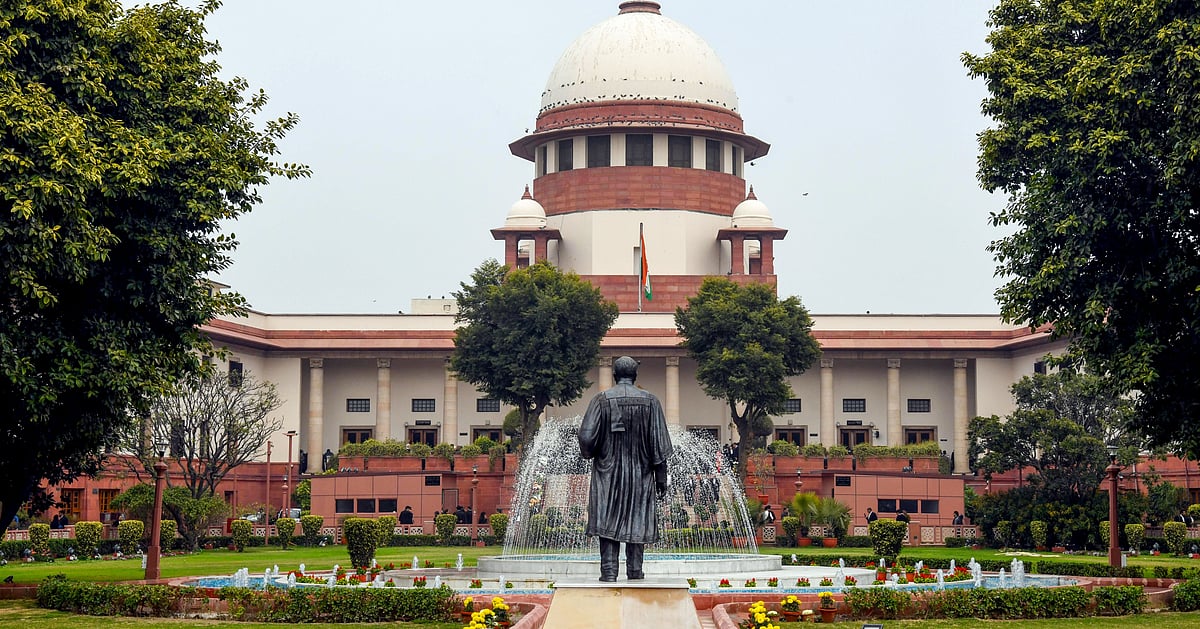
The Supreme Court ordered authorities to stop illegal detentions and remove barricades during Delhi protests. The bench said, "Right to movement and protest is a fundamental right." It also directed that internet services and Metro trains must function normally. The court will hear the matter again on October 13.
NEW DELHI: In a major interim direction, the Supreme Court's special bench, in an unprecedented hearing on a Sunday, ordered that no illegal detention can take place of people gathering peacefully and that barricades must be reviewed immediately based on law-and-order and traffic requirements.
"Right to movement and protest is a fundamental right. No unlawful detention is permitted. Any detention must follow legally established procedure. Peaceful assemblies must be allowed in accordance with law, especially outside areas where prohibitory orders under Section 163 BNSS are in force," said a two-judge bench of the top court, headed by Justice Joymalya Bagchi and Justice V Mohana.
The court also held that Metro trains and railway facilities shall function normally unless they need to be regulated, keeping in mind the reasonable restrictions envisaged under Article 19(2).
"Similarly, free movement of people in the city shall be ensured subject to law-and-order situation and/or traffic regulations. Imposition of barricades on roads shall be reviewed forthwith to ensure free movement subject to law-and-order and traffic requirements. Internet facilities should function unhindered. There shall be no illegal detention, particularly in cases of peaceful unarmed assemblage of people beyond the area where Section 163 BNSS is in operation," the court ordered the authorities, including the Centre and Delhi Police.
The bench also said it had been informed that a notice board stating that Section 163 BNSS had been invoked in and around the precincts of the Supreme Court had been put up on the court premises.
"We direct the authorities concerned to forthwith take down the said board, if not already done, so that there is no apprehension with regard to ingress and egress to the Supreme Court or any other court of law. Lawyers, journalists and other professionals shall not be hindered in discharge of their professional duties in any manner whatsoever," the bench said and listed the matter for further hearing on October 13.
The court passed these major interim directions after hearing a contempt plea and a habeas corpus petition filed by lawyer Shailendra Mani Tripathi and senior advocate Menaka Guruswamy, respectively.
The bench also observed that the contempt petitioners, including Tripathi, who alleged that the authorities had violated the court's directions by closing Metro stations, had made out a prima facie case.
.Delhi stir: Sibal questions legality of detentions, says protesters taken to undisclosed locations.
"Having considered the submissions of the counsel for the parties and perused the averments in the Contempt Petition, we are of the opinion that the petitioners (Tripathi and others) have made out a prima facie case. Accordingly, we issue notice upon the alleged contemnors (Delhi Police and others). They are directed to file counter affidavit to the said petition including a compliance report in terms of our order by October 13. Their personal presence is dispensed with in the meanwhile. Similarly, notice is issued in habeas corpus petition also," the court said.
It also accepted the government's assurance that Metro services would be normalised and remain so unless a public order situation arose. It directed the restoration of internet services and said lawyers must not be obstructed from discharging their professional duties.
The court said that, firstly, the authorities concerned had been directed to revisit the earlier notification issued by Delhi Metro regarding the closure of 57 Metro stations, keeping in mind the fact that Metro trains and other rail services may be regulated in appropriate situations but not prohibited outrightly.
Secondly, the order had directed the authorities to give wide publicity to the reconsidered decision. Thirdly, to avoid further inconvenience to the public, the court had directed the issuance of fresh traffic advisories in newspapers and on online platforms regarding free vehicle movement. The order had also called upon the authorities to submit a compliance report within four days, by October 13.
During the hearing on Sunday, senior advocates K K Venugopal, Kapil Sibal, N Hariharan, Gopal Sankaranarayanan, Dr Menaka Guruswamy, Shadan Farasat and other lawyers submitted that there had been flagrant violations of the directions given in the court's October 9 order. They said Metro services were not functioning, New Delhi railway station and Hazrat Nizamuddin railway station remained closed, no traffic advisories had been issued, and a large number of people had been subjected to undue harassment and illegal detention, including beyond the area covered by the prohibitory order passed under Section 163.
After hearing these submissions, the court said the petitioners had made out a prima facie case against the alleged contemnors.
.
Taking note of communications by Delhi Police directing the closure of 57 Metro stations and the cancellation of trains arriving at New Delhi and Hazrat Nizamuddin railway stations, the court observed that the notifications appeared to be "overreaching" insofar as they imposed a complete prohibition on essential public transport.
It held that Metro services could be regulated but not subjected to an outright ban, in line with the principle of proportionality. Tripathi alleged that Metro stations remained closed despite the court's order.
The petition seeks contempt proceedings against Union Home Secretary Govind Mohan, Delhi Police Commissioner Anurag Kumar and DMRC Chairperson D Thara.
Senior advocate Menaka Guruswamy's petition challenges the detention of political leaders, including former Delhi Chief Minister Arvind Kejriwal, former West Bengal Chief Minister Mamata Banerjee, former Kerala Chief Minister Pinarayi Vijayan and former Tripura Chief Minister Manik Sarkar. It alleges that several leaders were picked up from their residences and taken to undisclosed locations before reaching the protest site.
RJD Rajya Sabha MP Manoj Jha also moved the court, alleging disproportionate use of force, illegal detention, house arrests of protesters, students, advocates and political leaders, and sexual harassment of women protesters.
His plea challenges restrictions on public transport, mobile internet, road closures and phone jammers. It alleges that more than 6,000 people were detained and refers to 250 train cancellations and the closure of 45 Metro stations on October 10. It seeks a declaration that the authorities' actions between October 9 and 10 were illegal and unconstitutional.
.'If voting rights are taken away, no party is safe': CJP urges unity against SIR, vows protests till CEC resigns.Follow The New Indian Express channel on WhatsApp