
The Supreme Court on Monday refused to suspend CEC Gyanesh Kumar but issued notice on pleas regarding his solo decision-making. The Chief Justice said, "A three-member body should not need a bench to be reminded that it is still three-member." The court expects the Commission to decide by majority rule.
The Supreme Court on Monday refused to suspend CEC Gyanesh Kumar and issued notice on pleas that say he has been deciding for a three-member Commission by himself. The notice went to the Union, the Election Commission, Gyanesh Kumar, Sukhbir Singh Sandhu, Vivek Joshi, and two officers below them. The pleas want him suspended while the case is heard, a declaration that one man cannot exercise the Commission's powers, and, in one of them, criminal proceedings.
The SC bench said it presumes the decisions are lawful, and that it will annul any that are not. The Chief Justice added that the Commissioners are expected to decide unanimously and, where they cannot, by majority. A three-member body should not need a bench to be reminded that it is still three-member.
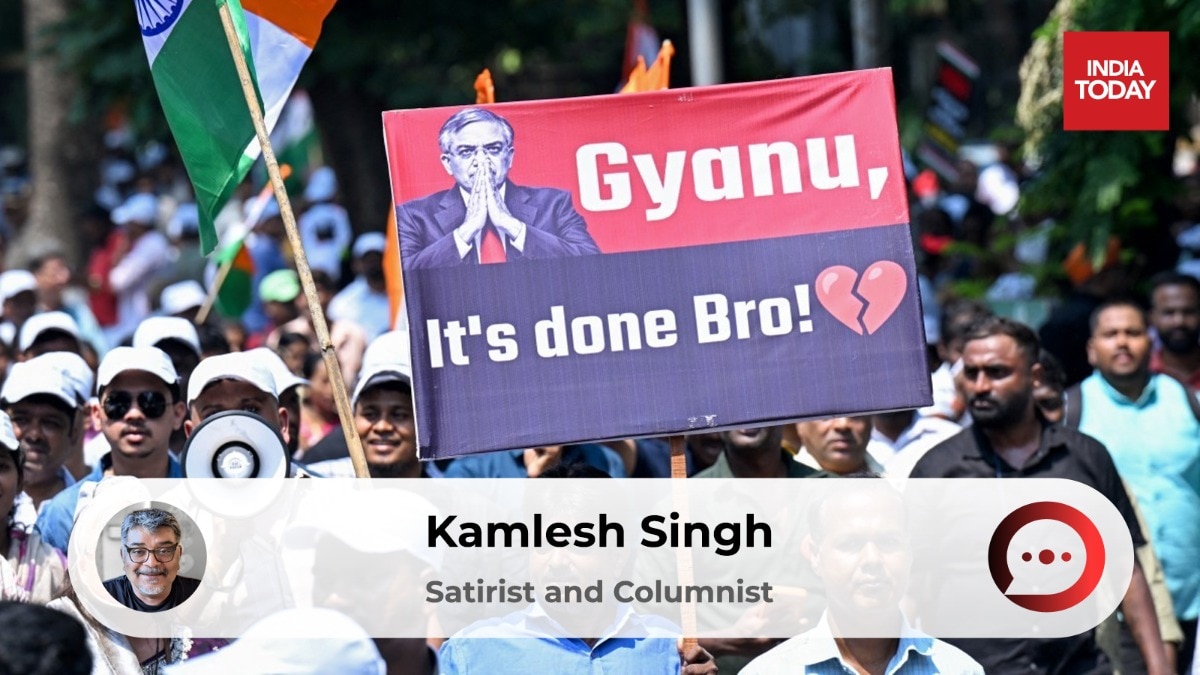
The kerfuffle over Kumar's tenure has travelled from Parliament to the streets and now to the Supreme Court. He should step down for this journey itself. Not because he stole an election, and not because he is part of some plot to make the BJP win every time, but because incompetence and arrogance have turned the Election Commission into a one-man show that has lost the plot.
Indian elections are layered too deep for one chair at Nirvachan Sadan to tilt the outcome. Booth agents, counting agents, polling staff, CCTV, local police, central police, observers, and a constant vigil by the candidates themselves, with the courts on standby. Kumar could not have rigged a result even if he wished to. Thank his predecessors and Parliament for that. However, Kumar presided over the disenfranchisement of millions of voters, who were removed from the rolls just before the elections took place, they had little time for appeal and remedy.
The man who could not run a routine revision of the rolls without a constitutional row is hardly a mastermind. Intensive revisions have been done a dozen-odd times since 1952, the last big one two decades ago, and he still turned this one into headline news and a story of 13 crore names struck off draft rolls.
For the same reason, "vote chori" is a slogan, a good one, but not a solid argument. Deleting names at random cannot win a seat, because nobody knows whom those voters would have backed. Where deletions look clustered, some have been explained as death, shifting and duplication, and some remain disputed.
The "logical discrepancies" being flagged in draft rolls include mismatched fathers' names, implausible age gaps with parents or grandparents, and people above 45 shown as new voters. None of these are made by the citizens, almost all of them are creations of the clerical machinery. Every Indian knows the ghost in government papers. Things have improved since computerisation, but the babu's talent for a human error has not retired. I have always suspected that some of it is kept alive to harass people into parting with their money.
Science writer Gauhar Raza posted his old voter card: Gauhar Raza in English, Gauhar Singh in Hindi. He has never had trouble on voting day. The discrepancy was not his. Some officer, or some software, allotted him two surnames in two languages, but the SIR notice arrived anyway. He must now submit papers and get his surname fixed. Raza is one of millions facing deletion, or the threat of it, because a clerical mismatch was treated as a finding.
From Nobel laureate Amartya Sen to EAM S Jaishankar, the list has many notables, imagine the fate of the common folks. This does not sound like a master plan. If it is one, it is not creditable to Gyanesh Kumar. A conspiracy that depends on clerical chaos is not a conspiracy. Messy data and a messy process are exactly the charge against him.
Then there is the infamous arrogance. In August 2025, with Rahul Gandhi's Mahadevapura claims in the air, Kumar told him to file an affidavit or apologise to the country within seven days, and said there was no third option. He never explained why Anurag Thakur, who made similar claims about Opposition-held seats including Raebareli, was not asked for one. The Opposition's removal notice calls this a "graded response" doctrine. Gandhi filed no affidavit and offered no apology. Kumar did nothing. The seven-day thunderclap ended as a press conference, the tone of which bordered on political and not institutional. The BJP brass coming out in defence did the rest of the damage.
In Bihar, the list of 65 lakh names missing from the draft roll came out only after a Supreme Court interim order. The Opposition's charge, that pleas were ignored unless courts were approached and given directions, is correct. The Commission has to heed objections from the stakeholders in the elections, not only from the judiciary.
Then the unilateralism. Last month, the Indian Express reported that Election Commissioners Sandhu and Joshi had objected on record at least 14 times in 10 months to decisions and orders they said were taken without their knowledge. The sharpest dispute was over Form 6, the statutory form for new voters. Joshi warned in May that it could not be altered without a formal government notification.
The change went live on the ECINet portal anyway, and on August 13, Sandhu called it "unauthorised and illegal" and said it must be removed immediately. Joshi also warned of the "gradual centralisation of the electoral roll database" and asked for an audit.
On July 29, the two wrote separately to Cabinet Secretary TV Somanathan over changes in IT work allocation, a step the report described as without precedent in the Commission's history.
The Commission denies any dissent. It says every decision carries all three signatures, and that the letters to the Cabinet Secretary concerned an officer on deputation. Fair enough. But what about the reputation? An institution that has to keep explaining itself is already losing the thing it exists to protect.
Kumar should step down because he has damaged India's flex, the only unbeatable one. A clean, efficient election in the most populous country on earth was a pride nobody could take away from us. He was meant to guard it and enhance it. He has dragged it into a mud-fight about himself, and he has to pull himself out, because the government cannot sack him.
That is by design. A Chief Election Commissioner goes the way a Supreme Court judge goes: a motion under Article 324(5), admitted by the presiding officers, then a special majority in both Houses. The Opposition tried, for the first time. Notices signed by 130 Lok Sabha and 63 Rajya Sabha MPs in March were rejected on April 6 by Om Birla and C.P. Radhakrishnan.
The Chairman's order said the allegations were relevant for political debate but did not prima facie meet the high constitutional bar. A fresh Rajya Sabha notice by 73 MPs followed on April 24. In short, you may shout, you may not remove. Kumar knows he is not Dharmendra Pradhan. A minister can be spent after weeks of student anger. A Chief Election Commissioner is armoured on purpose, which is why a graceful exit is the only practical one.
The student agitations will not vanish with him. The forces stirring the young will find another use for the anger, and that is good for politics. A government under constant threat stays on its toes and stays in line. The Gyanesh Kumar question is different. It is about the credibility of the body that holds our democracy up. In a world of fluctuating fortunes, the credibility of our democracy has been the only constant good news about us. An umpire who becomes the headline should leave the field himself.