
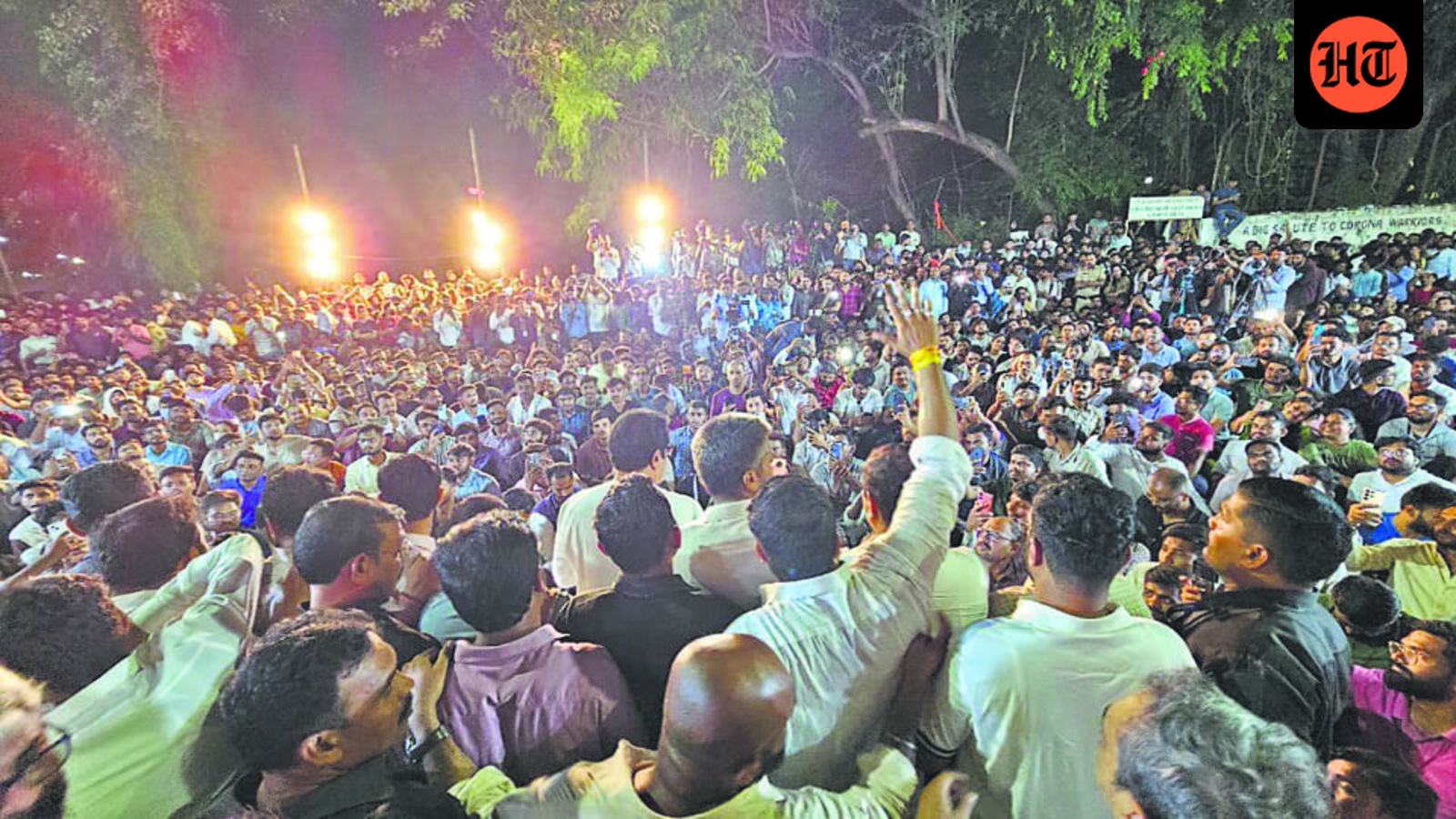
The five-day MPSC agitation in Pune has turned into a political contest as aspirants struggle with the high cost of pursuing government jobs. Protesters demand the MPSC chairman resign and recruitment for 70,000 posts. "We won't leave this place until the MPSC chief chairman resigns," said MLA Rohit Pawar.
The five-day Maharashtra Public Service Commission (MPSC) agitation in Pune has increasingly turned into a political contest even as thousands of aspirants continue to grapple with a more immediate problem -- the rising financial and personal cost of pursuing a government job amid postponed examinations, changing patterns and allegations of paper leaks.
The protest at SM Joshi Bridge, backed by NCP (SP) MLA Rohit Pawar, has made MPSC chairman Vivek Bhimanwar's resignation its principal demand, along with recruitment to 70,000 posts, offline examinations, an impartial inquiry into alleged irregularities and a Rajasthan-style examination-card system.
Pawar has refused to withdraw from the agitation. "We won't leave this place until the MPSC chief chairman resigns," he said, warning that the protest could become more aggressive.
The government and BJP leaders, however, have questioned the continuation of the protest after a student delegation met chief minister Devendra Fadnavis on September 30.
Union minister and Pune BJP MP Murlidhar Mohol accused Rohit Pawar of using the students' agitation for political purposes and appealed to protesters to call off the stir after the government's assurances. "The agitation has taken the form of a Congress convention," Mohol said, while arguing that the issue concerned students' futures and should not be politicised. He also said the state government could not directly remove the MPSC chairman because the post is constitutional.
BJP spokesperson Navnath Ban went further, alleging that the protest at SM Joshi Bridge was a "political sponsored programme" and claiming that only about 20% of those there were students while the rest were political workers. He alleged that workers had been brought from Baramati and elsewhere to swell the crowd.
Pawar rejected the charge, saying, "Students will answer these baseless allegations," and maintained that people were coming from across the country to support the aspirants.
The political sparring has not, however, erased the underlying grievance.
For thousands of aspirants, MPSC preparation is no longer a two- or three-year pursuit. For many, it has stretched to five, seven or even eight years, with each examination cycle bringing additional rent, food, study material and test-series expenses.
Every postponement means more months of preparation and living expenses. A cancellation can force candidates to start again, while a change in examination pattern can make years of preparation redundant. Allegations of malpractice raise an even more basic concern -- whether years of hard work will be judged on a level playing field.
The latest controversy followed the cancellation of the Drug Inspector Group-B recruitment process after a police investigation into an alleged question-paper leak. Six people, including three MPSC officials, were arrested.
But the anxiety predates the case.
Several MPSC examinations have been deferred multiple times since 2025 because of administrative issues, protests and other disruptions. Between 2020 and 2026, examinations have been postponed five times. The Drug Inspector recruitment is the second instance in which a paper leak has been established.
The latest cycle has seen the State Services, Civil Engineering and Group-B main examinations pushed back, while the Group-C preliminary examination has also been rescheduled. More than 11 lakh candidates have applied for 5,707 Group-C posts.
For candidates who have already spent years preparing, a postponed examination is not merely a new date. It means another month of accommodation costs, another round of study material and test series, and another period away from regular employment.
Rushikesh Lungare, 27, from Nanded, has spent nearly five years preparing for MPSC examinations. The son of a farmer, he has appeared for the mains three times, largely through self-study.
"Preparing in Pune itself is financially demanding. A student needs at least ₹15,000 to ₹30,000 a month for accommodation, food and other expenses. Whenever there is no examination, I take up part-time work to support myself," he said.
The paper-leak controversy has also shaken his confidence.
"Learning about the paper-leak network was deeply shocking and made me question the entire system. There is a complete lack of certainty in the way these examinations are being managed," he said.
Shriram Hangargekar from Tuljapur in Dharashiv district has been preparing for nearly seven years. His family owns a farm and his mother continues to manage the agricultural work while he stays in Pune.
"I have begun to feel ashamed of depending entirely on my family, and I have now started working as a gig worker simply to meet my expenses in Pune," he said.
Hangargekar has appeared for the mains three times. The prolonged pressure, he said, had at one point become overwhelming and led him to experience suicidal thoughts.
Mahesh Patil from Loha taluka in Nanded has been preparing for competitive examinations for nearly eight years. His parents are farmers and drought has severely affected the family's agricultural income.
Patil has appeared for Group B, Rajyaseva, Group C, PSI, Forest and ASO examinations, in some cases more than once. He studies for 12 to 13 hours a day.
"When you hear allegations that some candidates were able to clear examinations by paying money or obtaining papers illegally, it destroys your faith in the system," he said.
"I have not merely lost years of my life; I have lost trust in the MPSC system."
That trust deficit is particularly significant because the present controversy is not the first serious examination-related scandal to hit the commission.
In 2002, then MPSC chairman Shashikant Karnik was arrested in connection with an alleged multi-crore recruitment scam. The Anti-Corruption Bureau alleged manipulation of answer sheets in examinations for posts including police sub-inspectors and sales tax inspectors, with hundreds of answer sheets suspected to have been tampered with.
More than two decades later, the Drug Inspector controversy has again put examination safeguards and accountability under scrutiny. The commission initially said it had found no evidence that the original paper had been leaked and referred the matter to the police. The recruitment was subsequently cancelled after the investigation found evidence of malpractice.
The political divide has also spilled into the examination pattern.
At one protest site, students want MPSC to return to the objective, multiple-choice-question pattern. At another, aspirants are opposing any reversal of the descriptive pattern introduced in 2025, arguing that they have already spent two years preparing for it.
Opposition leaders have largely backed the protesters. NCP (SP) MP Supriya Sule has urged the government to introspect on why student agitations are repeatedly taking place across Maharashtra and asked Fadnavis to personally engage with the protesters. She has also backed the demand for the MPSC chairman to take moral responsibility.
Shiv Sena (UBT) MP Sanjay Raut has attacked the government over the agitation, while Congress state president Harshvardhan Sapkal backed the demand for Bhimanwar's resignation and urged students to continue their agitation peacefully.
Congress leader Balasaheb Thorat has sought identification of the alleged masterminds behind the paper leak, while Congress MLA Vijay Wadettiwar highlighted the financial difficulties of aspirants, particularly those from drought-hit Marathwada.
BJP MLA Gopichand Padalkar, while saying the students' agitation should remain apolitical, has called for greater transparency in the commission's functioning, including a five-year projection of vacancies and a fixed calendar for examinations, results, interviews and appointments.
For aspirants, however, the government job remains attractive because it represents stability, social status and financial security, particularly for families facing uncertain agricultural incomes or limited employment opportunities in smaller towns and villages.
That is why candidates keep returning to Pune. They work part-time between attempts, share rooms to reduce costs and continue to depend on parents. Some postpone regular employment, marriage and other life decisions while waiting for the next recruitment cycle.
The longer the process continues, the greater the cost of staying in it.
The political leaders may be debating who is using the agitation and which demand should take priority. For the aspirants, the question is simpler: after spending years preparing for one chance at a government job, can they trust the system to give them a fair chance when that opportunity finally arrives?
For many, that trust is now the real demand.