
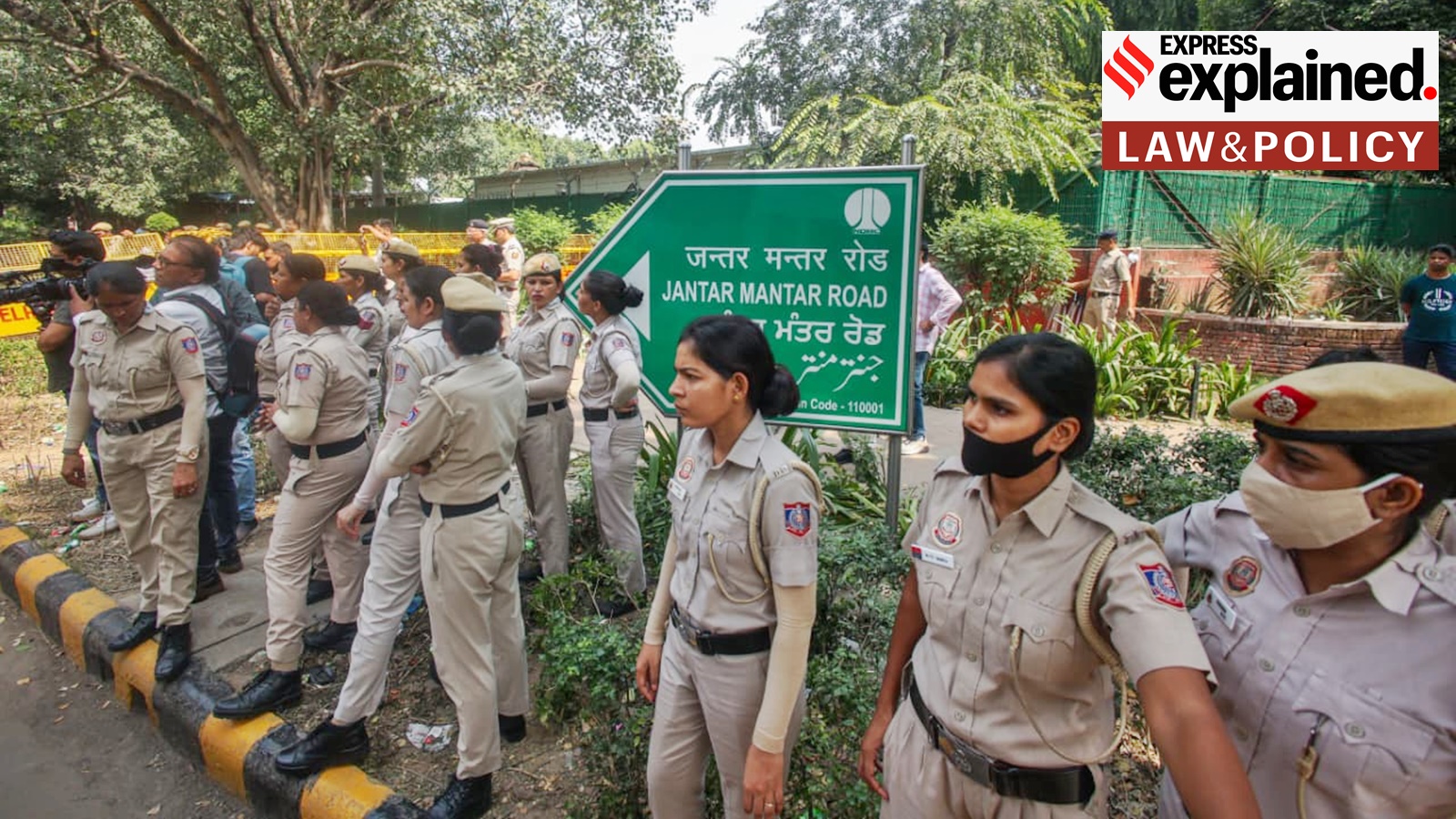
Delhi Police imposed Section 163 of the BNSS in New Delhi ahead of the Cockroach Janta Party protests planned for October 9 and 10. Authorities denied permission for the gathering, citing rule violations and late applications. This order restricts public assemblies to prevent potential disturbances in the city this weekend.
Ahead of the Cockroach Janta Party (CJP) protests planned in Delhi this Saturday and Sunday (October 9 & 10), demanding the resignation of Chief Election Commissioner Gyanesh Kumar, Delhi Police has denied permission for the gathering.
The reasons cited on Friday included late submission of the application and rule violations during a previous demonstration, PTI reported. Authorities have imposed Section 163 (prohibitory orders) of the Bharatiya Nagarik Suraksha Sanhita (BNSS), which empowers them to issue orders to prevent potential disturbances, in New Delhi district.
Back in July, too, Section 163 was imposed when thousands of protestors in Delhi marched for the resignation of then Education Minister Dharmendra Pradhan. The provision is often associated with restrictions on protests and public assemblies. What does it mean for residents of that area? And why did the Supreme Court earlier state that its precursor, Section 144 of the Criminal Procedure Code (CrPC), was an exceptional preventive power?
Emergency power
In 2024, with the BNSS replacing the CrPC, Section 163 of the BNSS replaced Section 144 of the CrPC, which empowers an Executive Magistrate to act where "there is sufficient ground for proceeding under this section and immediate prevention or speedy remedy is desirable".
It had its origins in the colonial era and was believed to generally bar gatherings of more than three people. Section 144 CrPC was also often used to clamp down on telecommunication services and order Internet shutdowns.
Explained | Rahul Gandhi detained again: How does detention differ from arrest, what rights do detainees have?
It is enforced through a written order, directing "any person to abstain from a certain act or to take certain order with respect to certain property", where the direction is likely to prevent "obstruction, annoyance or injury to any person lawfully employed, or danger to human life, health or safety or a disturbance of the public tranquillity, or a riot, or an affray".
The provision assumes that a magistrate is responding to something specific and immediate, that the order is specific to that threat, and that it lapses within two months once the threat has passed.
What the numbers show
Public familiarity with the provision comes almost entirely from its use against protests and gatherings. Data on how it functions in Delhi tells a different story.
In March 2023, Advocates Vrinda Bhandari, Abhinav Sekhri, Natasha Maheshwari, and Madhav Aggarwal filed RTI applications and carried out manual inspections at police stations across Delhi's 18 districts and units. The report, titled "The use and Misuse of Section 144 CrPC", examined around 5,400 of the 6,100 orders passed under Section 144 of the CrPC between January 2021 and 2022.
They found that only 81 orders (1.5%) prohibited unlawful assemblies. Five of Delhi's 18 police districts and units did not issue a single assembly restriction order during the study period.
What filled the space were orders with no obvious emergencies -- 25.6% of orders directed hotels, banks, ATMs, liquor vends, and cinema halls to install CCTV cameras; 43% required businesses from courier services to cyber cafes and secondhand goods dealers to maintain customer or employee records; smaller batches banned metallic kite strings or "manjha", paan shops near schools, and drones and hot air balloons.
The report states that "far from an exceptional measure resorted to for addressing emergencies, orders under Section 144 of the CrPC have become a part of the regular legal framework such that they are periodically re-issued at the expiry of two months".
It further characterises the provision as having been transformed into a "tool for micro-level governance in the hands of today's district administrators -- the police -- to unimaginable lengths".
Repeated renewals
The study also examined how long these orders had remained in force. It was found that almost every order in the sample had been reissued the moment the two-month statutory limit expired, characterising it as "city-wide mechanical process of issuing cyclostyled orders", including during Covid-19 lockdowns when the conditions that justified the original order no longer held.
Take, for instance, CCTV orders for girls' schools, PGs, liquor vends, and ATMs were renewed on schedule even during Covid-19 lockdowns when many institutions were shut.
Tenant verification orders requiring landlords to furnish tenant details to the police were reissued the most consistently. This was despite the Delhi High Court's ruling in the Bhanwar Singh case that Section 144 "cannot be repeatedly extended" and must lapse within two months.
Cyber cafe operators were made to keep visitor logs and photograph customers on a rolling basis, lockdown or not. And prohibitions on flying kites with metallic manjhas or carrying tiffin boxes into public parks were cycled through the same two-month renewal.
The study describes this as a city-wide mechanical process of issuing cyclostyled orders to keep the underlying legal regime in place, the language of an emergency power operating on autopilot.
What courts have said
The Supreme Court has repeatedly held that Section 144 is an exceptional preventive power, not a tool for routine administration.
In Babulal Parate v. State of Maharashtra (1961), the court upheld the constitutional validity of the provision but stressed that it can be invoked only in an emergency to prevent specific threats to public order. It held that the power is conditioned by the circumstances set out in the statute and is not "unlimited or untrammelled".
In 2012, the Supreme Court came down heavily on the government for imposing Section 144 against a sleeping crowd in Ramlila Maidan in New Delhi, amid protests against the Congress-led UPA government. "Such a provision can be used only in grave circumstances for maintenance of public peace. The efficacy of the provision is to prevent some harmful occurrence immediately. Therefore, the emergency must be sudden and the consequences sufficiently grave," the court said.
The Supreme Court, in Mazdoor Kisan Shakti Sangathan v. Union of India (2018), set aside a National Green Tribunal order that banned all protests along Jantar Mantar Road, holding that a blanket prohibition went further than necessary. It noted that the "solution was not to ban the demonstrations altogether" and directed authorities to frame a regulated permission mechanism instead.
On a related challenge to Section 144 orders restricting assembly near Parliament, the court found the orders valid on their face but held that police had, in practice, turned a permission-based restriction into an outright ban by never actually granting permission and directed that this too be corrected through proper guidelines.