
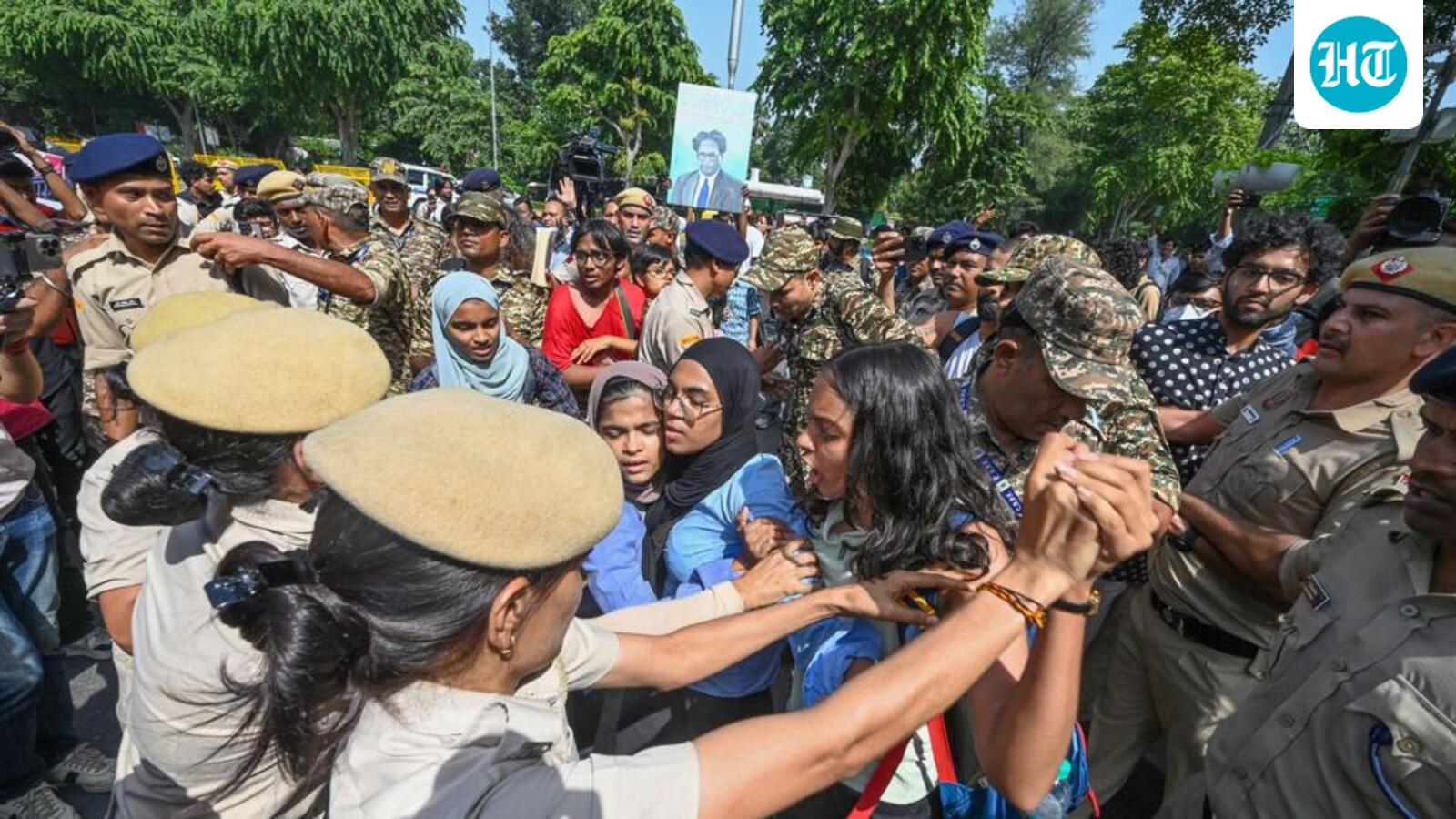
Delhi police detained 1,000 people on Friday to stop a protest at Jantar Mantar against CEC Gyanesh Kumar. Protesters demanded his resignation over alleged electoral roll irregularities. Officers blocked roads and enforced prohibitory orders across the city. Many leaders got detained as police moved them to stations in buses.
Around 1,000 people were detained across Delhi on Friday as police and security forces foiled attempts by student organisations and political parties to gather at Jantar Mantar and demand the resignation of chief election commissioner (CEC) Gyanesh Kumar over alleged irregularities in the Special Intensive Revision (SIR) of electoral rolls.
With hundreds of security personnel deployed and roads leading to central Delhi sealed with layers of barricades, protesters were prevented from reaching the designated protest site. Several hundred protesters instead staged fragmented demonstrations at different locations, while others were detained and taken to police stations across the city.
A senior police officer, who asked not to be named, said nearly 750 people were detained from areas around Jantar Mantar and another 400 from other parts of Delhi during the day. Around 200 people were also placed under house arrest in the morning. Those detained from the streets were taken away in buses arranged by Delhi Police and taken to different police stations.
Among those detained were former chief minister and senior Aam Aadmi Party (AAP) leader Atishi, All India Students' Association (AISA) president Neha Bora and Swaraj India leader Yogendra Yadav. The detainees also included AAP leaders, civil society activists, members of left-backed student organisations and workers of the Congress youth wing.
The protest was called for 11am at Jantar Mantar by the AAP, AISA, Students' Federation of India (SFI), National Students' Union of India (NSUI), Indian Youth Congress (IYC) and other student and youth organisations. They were demanding Kumar's resignation over allegations of irregularities in the SIR exercise and mass deletion of voters.
Police had made it clear ahead of the protest that no permission had been granted for the gathering. Prohibitory orders under Section 163 of the Bharatiya Nagarik Suraksha Sanhita (BNSS) were also in force across the New Delhi district.
The orders prohibit, without prior written permission, public gatherings of five or more people, processions, demonstrations, picketing and dharnas, as well as shouting slogans or making speeches and carrying items such as banners, placards, sticks and other objects, police said. The restrictions were imposed to ensure public safety, maintain public order and facilitate traffic movement.
Meanwhile, Mumbai saw massive gatherings as a wall of police barricades failed to halt protesters from gathering at Shivaji Park. Abhijeet Dipke, chief of the Cockroach Janta Party (CJP), which spearheaded the July 20 "Chalo Sansad" march, was at the protest, joined by thousands of protesters, actors, and activists.
By Friday morning, Jantar Mantar and roads leading to it had been heavily barricaded, including the lane from Janpath market and the rear access near Kerala House. Entry to the protest site was completely blocked. Police and Rapid Action Force personnel, along with a riot-control vehicle, were deployed in the area.
The security restrictions spilled into the wider central Delhi area. Internet services were suspended in parts of central Delhi, while entry and exit gates of 12 metro stations were closed, according to the Delhi Metro Rail Corporation. These included Rajiv Chowk, Central Secretariat, Janpath, Patel Chowk, Mandi House, Seva Teerth and Lok Kalyan Marg. The stations were opened around 8.20pm, as per an announcement by DMRC.
Unable to reach Jantar Mantar, protesters held smaller demonstrations at several locations. NSUI members gathered near the Congress headquarters on Raisina Road, while AISA activists marched from Patel Chowk metro station.
"It took us around three hours to figure out how to reach Jantar Mantar. Finally, we decided to gather at Patel Chowk metro station and march for at least a few minutes," said AISA activist and former Jawaharlal Nehru University Students' Union president N Sai Balaji. "By restricting us, the police have actually spread the protest across Delhi. People were left with no option but to protest wherever they could -- on the streets and outside various police stations where protesters were detained," he said.
AISA national president Neha said in a video posted on X: "How many times will the Delhi police detain us? We will come again to protest."
The restrictions also disrupted commuters. HT visited Mandi House, Rajiv Chowk, Barakhamba and Patel Chowk metro stations, where entry and exit had been barred. Several commuters complained that they had not received adequate advance information.
Robin Bhatnagar, 69, said he was trying to travel to Vaishali but had been forced to move between closed stations. "I first went to Barakhamba metro station, police told me to go to another station as that one was closed, I came to Mandi House, and this is also closed. I can't book a cab, that's also frustrating," he said. He added that such advisories should have been issued a day earlier.
For protesters, meanwhile, the heavy restrictions made simply reaching the protest difficult. Ishita Srivastava, 21, said she had been unable to share her location with her parents because of the internet shutdown. "Every time I asked a police personnel where Jantar Mantar was, they told me to go back home," she said.
At Patel Chowk, 27-year-old Prashant Rawat, preparing for competitive examinations, said he had come despite the restrictions. "I am only here to register my dissent and want the government to listen to us," he said. Another 21-year-old student from Jamia Millia Islamia said she had been unable to contact most friends who had planned to attend from different parts of Delhi.
Police, meanwhile, said they are looking into an alleged incident of a policeman punching a protester, which was reportedly seen in a purported video clip.
Deployment of security personnel was also made at Delhi borders. Personnel placed barricades on the DND Flyway carriageway towards south Delhi from Noida and Mayur Vihar, and conducted random checking of vehicles, and asked from drivers and other occupants their personal details as well as residential addresses apart from their destinations.