
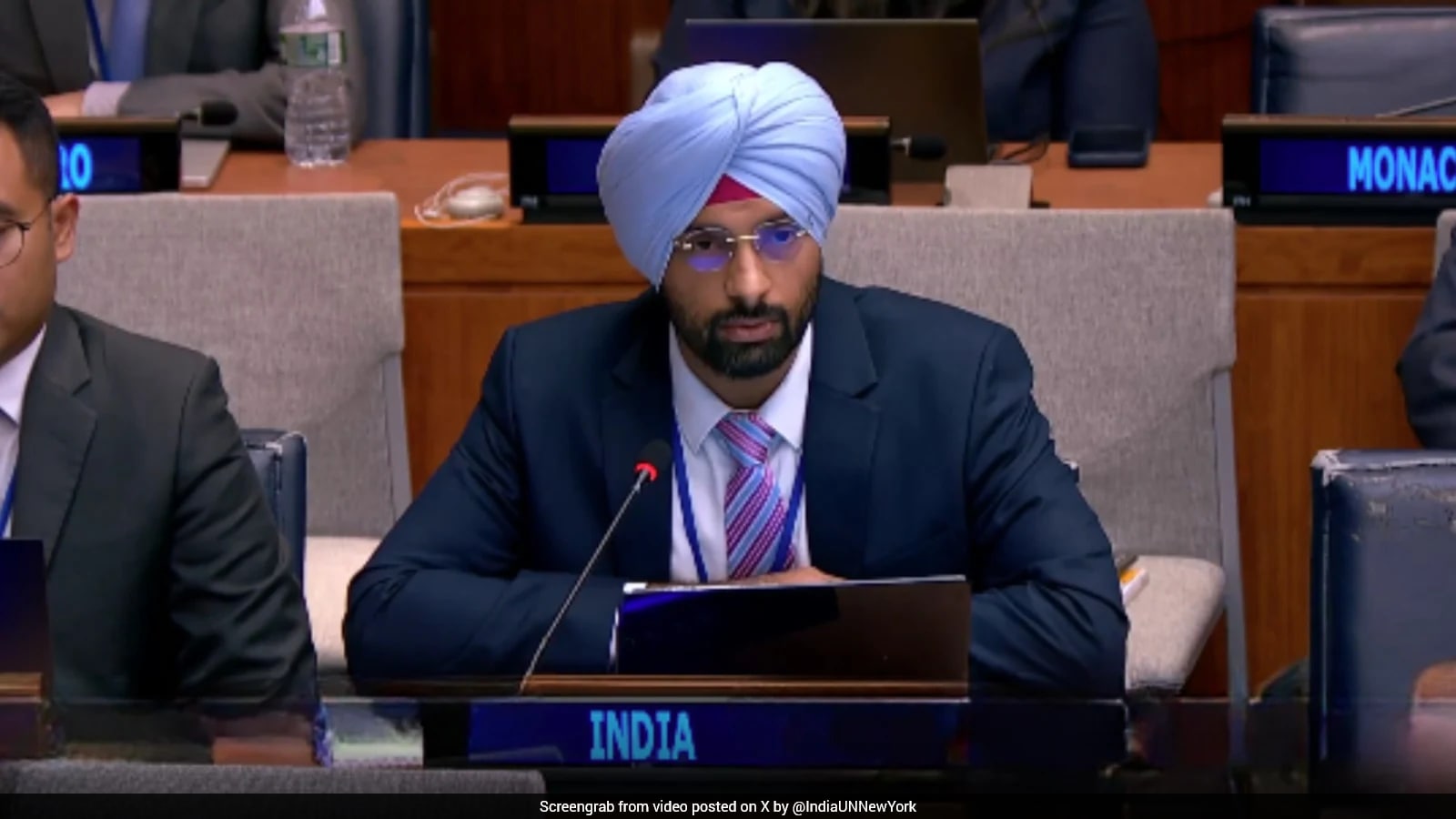
India’s diplomat Anmol Sher Singh Bedi rebutted Pakistan at the 81st United Nations General Assembly session. He addressed terrorism, nuclear proliferation, and regional stability. Bedi asserted India’s right to defend itself against cross-border attacks. "India does not seek conflict," he said, but warned that peace needs accountability for reckless actions.
India rebuts Pakistan at UNGA, addressing terrorism, nuclear proliferation, and regional stability.
New York:
India's young diplomat Anmol Sher Singh Bedi delivered a pointed rebuttal to Pakistan at the ongoing 81st session of the United Nations General Assembly's First Committee, challenging Islamabad over terrorism, nuclear proliferation and regional instability while asserting New Delhi's right to defend itself against cross-border terror attacks.
Exercising India's right of reply, First Secretary Bedi addressed remarks made by Pakistan's delegation, outlining India's position on the Pahalgam terror attack, the Indus Waters Treaty, nuclear cooperation and the responsibility of states for violence carried out through non-state actors.
His intervention combined a defence of India's security policies with a broader warning that nuclear weapons must not become a shield for activities that threaten regional peace. Bedi also argued that calls for restraint cannot be separated from accountability for the actions that trigger a crisis.
"India does not seek conflict," he said, concluding his remarks. "However, if there is no accountability for reckless actions, then peace merely becomes a pause between crises."
India's Response To Pahalgam Attack
"As you're aware, India's actions in May last year followed a grave provocation. India acted in self-defense after Pahalgam terror attack, where twenty-six civilians were killed. These actions were measured, targeted, and designed to be non-escalatory," he told the committee.
The remarks reflect New Delhi's position that its response to terrorism was intended to address the threat without triggering a wider military confrontation.
India and Pakistan have long faced tensions over terrorism, Kashmir and competing security concerns. The Pahalgam attack further intensified those tensions, bringing questions of counterterrorism, deterrence and escalation back into international diplomatic discussions.
Bedi maintained that India's right to self-defence remained intact and rejected the suggestion that the threat of nuclear escalation should constrain its response to terrorist violence.
Indus Waters Treaty And Nuclear Proliferation
The Indian diplomat also raised questions about the Indus Waters Treaty, the water-sharing agreement signed by India and Pakistan in 1960 with the World Bank's involvement.
"The Indus Water Treaty, when it was signed, rested on good faith and goodwill. A state cannot undermine those foundations of trust and cooperation and at the same time insist that the privileges flowing from the relationship remain untouched," Bedi said.
His remarks framed the treaty dispute as part of a wider argument about mutual obligations, trust and accountability between the two countries.
On nuclear proliferation, Bedi invoked the history of the AQ Khan network, which supplied nuclear technology and expertise to overseas programmes and became a major international proliferation concern.
He linked that history to United Nations Security Council Resolution 1540, adopted in 2004, which requires states to prevent non-state actors from acquiring weapons of mass destruction and related materials.
"We urge all states and all responsible suppliers to exercise the highest degree of vigilance, not because of India, but for their own security," he said, cautioning against unquestioning nuclear cooperation and transfers of advanced military capabilities.
'Nuclear Blackmail' Will Not Deter India
Bedi rejected suggestions that India's military capabilities were directed against another country, describing them instead as defensive and shaped by its security environment.
He also challenged the reliance on nuclear deterrence to limit the consequences of activities below the threshold of conventional war.
"Nuclear weapons must not be treated as routine instruments of statecraft," he said. "A posture that relies on nuclear overhang to limit the consequences of subconventional activity raises the risk of escalation and not the prospect of restraint."
He argued that regional crises repeatedly follow a pattern of provocation, denial of responsibility and subsequent appeals for restraint after a response has been made.
"The use of force by states under the garb of non-state actors does not erase the state's responsibility," Bedi said.
He then laid out three principles guiding India's position: any terrorist attack against India would receive a fitting response; India would not bow to nuclear blackmail; and New Delhi would make no distinction between those who sponsor terrorism and those who mastermind it.
Kashmir And India's Call For Accountability
Bedi reiterated India's position on Jammu and Kashmir, describing the region as an integral and inalienable part of the country. He called for territories under what India terms illegal occupation to be vacated and returned.
In his closing remarks, the diplomat said India remained committed to peace but argued that durable stability required accountability for actions that endangered it.
"India has always stood for peace and continues to seek peace with one and with all," he said.
The central message of Bedi's intervention was that diplomatic restraint must be accompanied by responsibility. For New Delhi, preventing future crises requires not only dialogue but also action against terrorism, vigilance over proliferation and recognition that the use of non-state actors cannot absolve states of responsibility.
Got a follow‑up question on this article? Go on
How may i help you today
Show full article
Track Latest News Live on NDTV.com and get news updates from India and around the world