
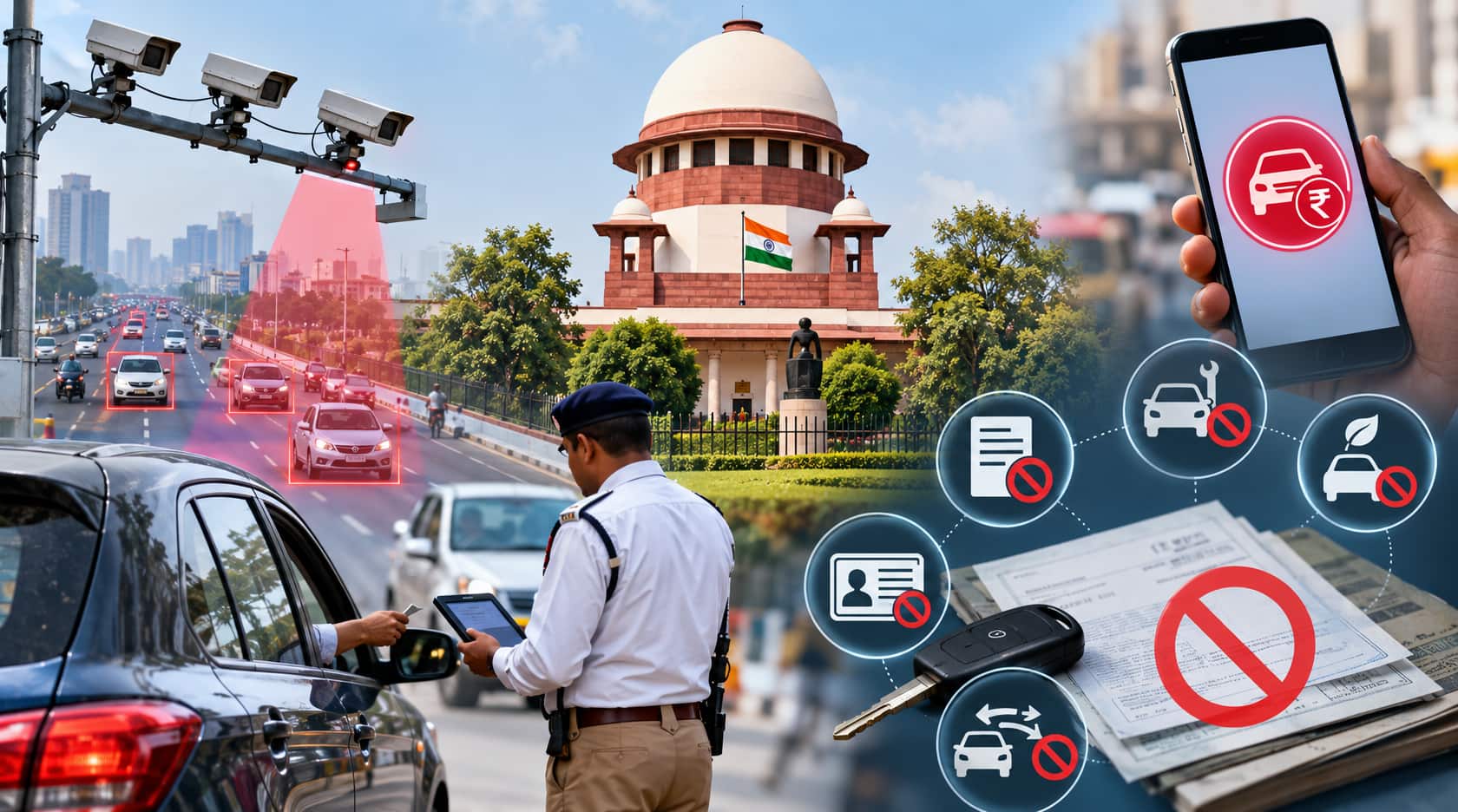
The Supreme Court directed authorities to impound vehicles with unpaid e-challans and restrict essential services. In an order dated September 28, the court questioned how to recover Rs 49,194 crore in fines. Justices said, “It is not just sufficient to keep issuing e-challans to the person who is alleged to have violated.”
Market Mastery
Webinar by Vishal Malkan
Find the weak links
in your portfolio by Vishal Malkan
A vehicle owner who ignores an electronic traffic challan could face consequences beyond paying a fine. The Supreme Court has directed authorities to consider impounding vehicles found with unpaid e-challans during random checks and to restrict essential online vehicle-related services until outstanding dues are cleared.
The measures are part of a wider push to improve road safety enforcement and recover unpaid traffic fines across India. In a 21-page order dated September 28 and uploaded on Thursday (October 1), seen by Moneycontrol, in S Rajaseekaran v Union of India, a case being monitored since 2012, the Supreme Court questioned the effectiveness of issuing challans when authorities fail to collect the fines.
The figures before the court underline the scale of the problem. Approximately Rs 49,194.05 crore was cited as the amount recoverable towards e-challans issued over time, while Rs 26,175.05 crore had been recovered. The difference is approximately Rs 23,019 crore, indicating the scale of dues yet to be collected on that basis.
But the court’s response goes beyond recovery. Its directions seek to link compliance with traffic rules to vehicle registration, fitness certification, pollution checks and, in cases involving multiple violations, driving licence renewal and suspension.
‘Thousands and lakhs’ of challans, but how are fines recovered?
The bench of Justices JB Pardiwala and KV Viswanathan said authorities must focus on what happens after a challan is issued.
“It is not just sufficient to keep issuing e-challans to the person who is alleged to have violated the provisions of the Act,” the court observed. “Police may issue thousands and lakhs of such e-challans, but the question is how do you recover the fine as sought to be imposed by way of those e-challans.”
The figures were brought to the court’s attention by amicus curiae Gaurav Agrawal and applicant KC Jain, who appeared in person.
Ordinarily, an e-challan is sent to the relevant territorial court for recovery. The person against whom it is issued is required to appear and pay the fine, including through e-Courts where applicable. The Supreme Court said this mechanism alone would not be sufficient given the mounting number of unpaid challans.
Its directions seek to make outstanding fines harder to ignore by connecting payment to services vehicle owners may need to use.
What happens to vehicles with unpaid e-challans?
The court directed authorities to freeze online services for vehicles carrying outstanding dues. Until the fines are cleared, authorities have been told not to renew a vehicle’s registration certificate, issue a duplicate registration certificate or entertain requests to update the owner’s address.
Fitness certification is also to be denied until pending traffic fines are paid in full. The court directed that the vehicle concerned be blacklisted on the Parivahan Portal, which could create an obstacle if its owner wants to sell it.
Authorities must also take steps to block ownership transfers. For multiple violations, the directions provide for suspension of driving licence renewal and measures to suspend a licence that is already in force.
The court specifically said that no centre should be permitted to issue a pollution under control (PUC) certificate while the relevant dues remain unpaid.
These measures could affect routine transactions, from renewing registration documents to selling a vehicle or obtaining a fitness certificate. The intention is to ensure that an unpaid challan does not remain merely a digital record without consequences.
The bench also ordered random vehicle checks. If a vehicle is found to have an e-challan that has not been honoured, “necessary steps shall be taken to impound the vehicle itself”.
Five violations in a year: the rule on repeat offenders
The court drew the authorities’ attention to Rule 21(25) of the Central Motor Vehicles Rules, 1989, which came into force in its amended form in 2026.
The provision treats five or more offences or contraventions of the Motor Vehicles Act or the rules within a one-year period beginning January 1, 2026, as conduct constituting nuisance or danger to the public.
It also specifies that offences recorded in an earlier one-year period cannot be counted when determining violations in a subsequent one-year period.
The reference to the rule sits alongside the court’s directions on driving licences, including suspension of renewal and steps to suspend an existing licence in cases involving multiple violations.
AI cameras, national databases and a public dashboard
The court’s order also addresses how authorities detect violations and monitor enforcement. It directed States and Union Territories to implement the Standard Operating Procedure issued by the Ministry of Road Transport and Highways (MoRTH) on October 28, 2025, and comply with Section 136A of the Motor Vehicles Act, 1988, read with Rule 167A of the Central Motor Vehicles Rules.
States and Union Territories must notify electronic enforcement sites and finalise the procurement, deployment and calibration of devices. MoRTH must file an affidavit explaining compliance and setting out a specific timeline. The National Road Safety Board has been directed to monitor electronic enforcement.
The court also asked States and Union Territories, the National Highways Authority of India and other road-owning agencies to ensure that installed electronic enforcement systems are AI-enabled and capable of detecting the 12 categories of traffic violations specified under Rule 167A(3), followed by the generation of e-challans in accordance with law.
These include violations such as improper lane driving and stopping or parking at unauthorised locations.
MoRTH must also examine how recommendations in the National Crime Records Bureau’s October 2023 Concept Paper or Plan can be incorporated into a supplementary action plan to strengthen nationwide electronic enforcement.
The proposed framework includes a National Road Safety System, an institutional and funding mechanism, and interoperable integration of VAHAN-4, SARATHI, e-Challan, e-DAR, iRAD and State and Central Traffic Control Rooms for real-time exchange of enforcement and road-safety data.
For public scrutiny, the court directed MoRTH to establish an online dashboard tracking implementation of Section 136A, Rule 167A and the October 2025 SOP. The dashboard must provide State- and Union Territory-wise, as well as National Highway corridor-wise, information on designated enforcement corridors, the number and functioning status of devices, categories of violations monitored, and violations detected compared with e-challans generated.
The information must be updated at least monthly. Annual data may also be included in MoRTH’s “Road Accidents in India” report.
Separate bus-related proceedings in the road-safety case
The Supreme Court’s directions on unpaid e-challans come amid broader concerns about road safety and enforcement. In the same ongoing S Rajaseekaran case, the court also considered a separate application concerning a double-decker bus involved in a fatal fire near Jewar in Greater Noida on September 23, which killed nine passengers.
The incident raised questions about how vehicles continue to operate despite outstanding traffic challans and whether their owners comply with road-safety requirements. The court directed the Chief Secretary of Uttar Pradesh, the Union of India and the Secretary of the Ministry of Road Transport and Highways (MoRTH) to respond to the application and the reliefs sought.
It sought details of the action taken against the bus driver and registered owner, including whether they had been arrested, and asked whether the owner had complied with all applicable rules and regulations before operating the double-decker bus. The court directed the authorities to submit the information through an affidavit by the next hearing.
The Registry was also directed to forward a copy of the order to the Chief Secretary of the Delhi government. The matter was listed for November 25 at 2 pm.
What about recovering fines through electricity bills?
The written order contains directions on impounding vehicles, restricting online vehicle services, blocking ownership transfers, withholding fitness and PUC certificates, blacklisting vehicles, and suspending driving licence renewals in cases involving multiple violations. It also sets out requirements for electronic enforcement, monitoring, and public reporting.
The possibility of recovering unpaid e-challan dues through electricity bills was discussed orally during the proceedings. However, this measure is not included in the written order dated September 28.
The formal measures recorded in the order focus on vehicle-related services and enforcement systems.
The court also warned that repeated judicial directions would mean little if authorities did not implement them on the ground. “We may keep issuing directions for an indefinite period of time,” it said, but cautioned that if they remained on paper, the court might eventually have to take “some stern action which may not be liked by the authorities”.