
Bangladesh is building a new military-drone industry with help from Turkey and China. A proposed joint-venture factory in Bogura could use the nation’s textile base to make drones. A drone manufacturer said, "Reinforcement fibres are woven into fabrics." This development near the Siliguri Corridor poses a new strategic challenge.
India-Bangladesh ties are back on a delicate wicket. New Delhi and Dhaka are working to revive high-level engagement, with official-level talks underway to schedule Bangladesh prime minister Tarique Rahman's visit to New Delhi in the third week of November. Yet the diplomatic thaw is being tested by another irritant: repeated addresses by former Bangladesh prime minister Sheikh Hasina from New Delhi, which have continued to annoy the establishment in Dhaka.
But the bigger strategic story may be unfolding beyond the diplomatic sparring. Even as India and Bangladesh navigate their uneasy relationship, Dhaka is building a new military capability -- with Turkey and China emerging as key technology partners in its drone ambitions.
For decades, Bangladesh's industrial strength has rested on textiles. Now, that vast manufacturing base could provide the foundation for something far more consequential: a domestic military-drone industry. Dhaka's proposed joint-venture drone factory with Turkey at Bogura has the potential to transplant a defence-composites industry onto Bangladesh's mature textile ecosystem, with Turkish technology, design expertise and quality systems accelerating a transition that could otherwise take decades.
For India, the geography makes the development particularly significant. Bogura is 100-200 km from the Siliguri Corridor, the narrow land mass connecting mainland India with its Northeast. The proposed factory is also located beside an upgraded airport and Bangladesh's first northern air force base.
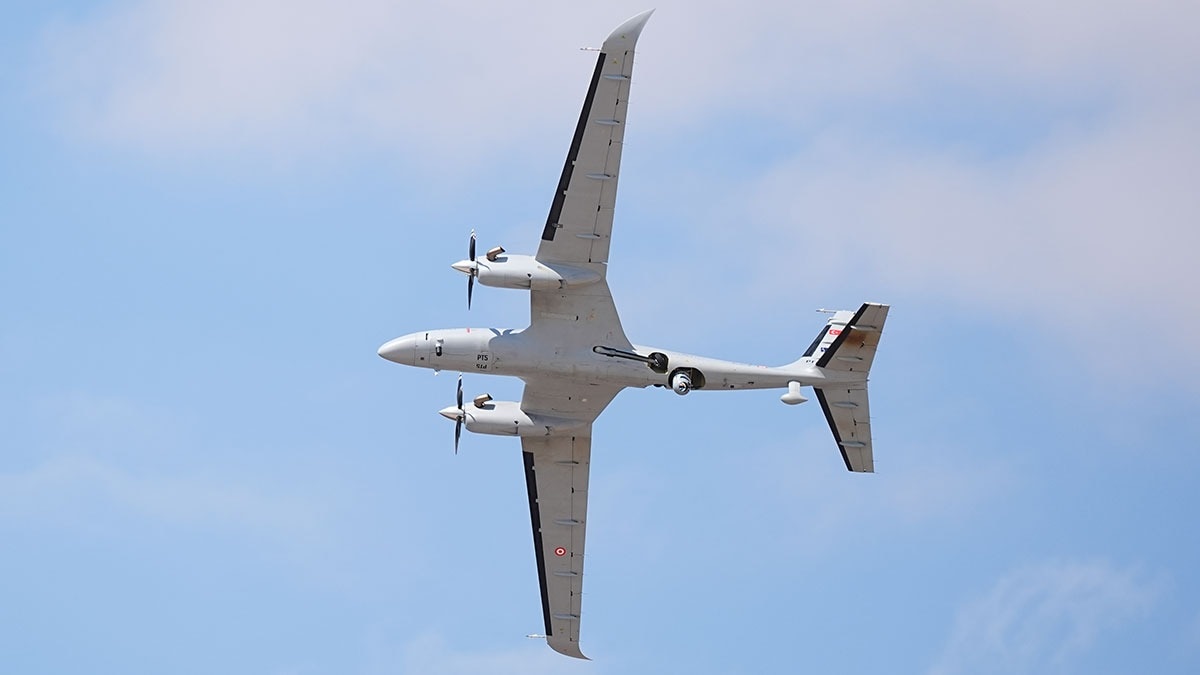
The transformation is already underway. Bangladesh contracted for Turkish Bayraktar TB2 drones in 2022 and now operates 12 of these, along with Turkish Roketsan TRG-300 Kaplan guided rockets. By late 2025, Dhaka was reportedly negotiating with Baykar to manufacture TB2 airframe parts, sensor housings and ground-control modules locally, with Turkish engineers training Bangladeshi personnel. Dhaka reportedly made an investment estimate of Rs 25,000 crore and export ambitions towards Indonesia and Malaysia.
What makes the Bogura project important is, therefore, not simply what Bangladesh is buying from Turkey. It is what Bangladesh could learn to manufacture. A drone manufacturer explained that modern mass-produced drones derive much of their structure from composite materials. And technical composites have their roots in textile engineering.
Reinforcement fibres, the drone manufacturer said, are woven into fabrics; plies are cut to precise patterns and layers are assembled through tightly controlled layup processes. For small and attrition-worthy drones, the increasing use of glass fibre, foam cores and out-of-autoclave curing has further lowered the entry barrier.
Bangladesh currently has no established technical-composites industry. But it has one of the world's largest and most disciplined textile workforces, estimated at around four million garment workers. Skills such as precision cutting, pattern discipline and repetitive handwork can translate into composite ply cutting, kitting, layup and stitched-preform manufacturing, say military observers.
The observers pointed out that there is an Indian precedent for such industrial migration. Over 15-20 years, Indian auto-component manufacturers moved into aerospace and defence by building on transferable skills, securing anchor customers, such as the Hindustan Aeronautics Limited (HAL), and global primes, benefiting from policy support through offsets and procurement reforms, and investing time in capability development.
For Bangladesh, the corresponding building blocks are already emerging: textile skills can provide the manufacturing foundation; the Turkish joint venture and Bangladeshi armed forces can serve as anchor customers; Forces Goal 2030 (Bangladesh military's modernisation programme) and the Bogura project provide policy support; and, unlike India's largely self-built aerospace journey, a Turkish partner can potentially provide the technology.
That last factor could be decisive. India developed much of its aerospace capability through its own companies over a prolonged period. Bangladesh could instead receive design authority, material specifications, production processes and quality-assurance systems from a Turkish partner with a combat-proven product line. This is why the projected transition could be compressed from 15-20 years to an estimated five to eight years.
The potential trajectory is relatively clear. In years two to four, Bangladesh could move into fairings, secondary structures and small-drone airframes, largely using glass fibre. By years five to eight, it could potentially manufacture primary airframe structures for TB2-class platforms under Turkish quality oversight. Beyond that, domestic fibre and prepreg production could follow if Turkey undertakes deliberate technology transfer. In other words, what took India two decades could potentially take Bangladesh less than one.
Turkey, however, is not the only technology partner in Dhaka's drone strategy. This January, Bangladesh signed a Tk (Bangladeshi Taka) 608 crore, or about $50 million, agreement with China's CETC International to produce the XY-I drone locally. The platform has been widely described as resembling the TB2. The emerging dual-track strategy gives Dhaka access to competing Turkish and Chinese technology sources while potentially increasing its bargaining leverage over both.
The alliance picture is evolving at the same time. Pakistan, Saudi Arabia and Turkey signed the Mecca Defence Alliance on August 7, committing to treat an attack on one as an attack on all. Bangladesh's foreign minister has described the pact positively while noting that membership depends on existing members. A foreign ministry source has also indicated that Saudi Arabia had extended an invitation to Dhaka.
The convergence is difficult to ignore. A founding member of a collective-defence pact could potentially be involved in producing combat drones on the territory of a country openly considering accession. Even without formal Bangladeshi membership, a Turkish production and repair facility at Bogura could give the alliance an industrial foothold close to India's eastern border.
For India, the issue is therefore not Bangladesh acquiring composite-manufacturing capability. The larger strategic concern is the emergence of a surge-capable drone production and repair base close to the Siliguri Corridor. India shares about 4,096 km of border with Bangladesh, its longest land boundary. A production facility within striking distance of the Siliguri Corridor would place potential drone manufacturing close to one of India's most sensitive chokepoints.
Local production could fundamentally change the sustainment equation. Imported drones depend on foreign spares and repair cycles. A domestic manufacturing and repair ecosystem could shorten turnaround times, enable rapid replacement of attrition losses during a crisis and reduce dependence on external supply routes that India could potentially pressure.
Then comes the question of numbers. Low-cost labour combined with relatively inexpensive drone platforms can create production at scale. In contemporary drone warfare, mass can frequently matter as much as sophistication. A country that can rapidly replace losses and sustain large numbers of platforms acquires a different operational capacity from one dependent entirely on imported systems.
New Delhi's ability to shape the Turkish-Bangladeshi project may also be constrained by geopolitics. Turkey lies outside India's usual levers of influence while India-Turkey relations are already strained. That could limit India's ability to influence the project's scope or trajectory.
There is also the possibility of a two-front counter-drone challenge. Pakistan already operates Turkish drones on India's western front. A Turkish-backed production and repair facility in the east could potentially stretch India's air-defence resources across both flanks simultaneously.
Industry experts pointed out that India, however, has an industrial advantage Bangladesh does not: an established technical-textile ecosystem. The immediate policy challenge is to convert that advantage into drone-manufacturing capacity before the Bogura project matures. Glass- and carbon-fibre weaving clusters in Surat and Coimbatore, along with the National Technical Textiles Mission, could be linked with Indian drone manufacturers to create a mass-scale airframe-production ecosystem.
At the same time, India could strengthen layered counter-UAS (unmanned aerial systems) detection and interception across West Bengal, Assam and the Siliguri sectors, ensuring that defensive preparations keep pace with the projected Bogura production timeline.
New Delhi would also need to watch for signs that Bangladesh is moving from assembly towards genuine industrial capability. Key indicators would include Turkish composite or technical-textile companies entering Bangladeshi economic zones, new reinforcement-fabric mills and imports of industrial equipment such as autoclaves, curing ovens and non-destructive testing systems.
Experts pointed out that the diplomatic response could be equally important. India could compete through industrial and defence partnerships with Dhaka, offering an alternative to the space currently being occupied by Ankara and Beijing. The argument is that some of this space exists because India has left it open.
The Bogura project should consequently not be viewed as a routine arms transfer. It represents the potential transplantation of a defence-composites industry onto a mature textile base, accelerated by a partner capable of supplying design, materials, processes and quality systems.
The outcome, however, is not predetermined. Much will depend on the identity of the Turkish partner, the precise scope of local production, the eventual investment scale and the pace and depth of technology transfer. These remain variables to be established as the project unfolds.
For India, the strategic planning question is, therefore, not what Bangladesh can manufacture today but what it could manufacture tomorrow. New Delhi would need to plan for the higher-capability scenario: not an assembly shed but the emergence of a regional drone production and repair ecosystem on India's eastern flank.