
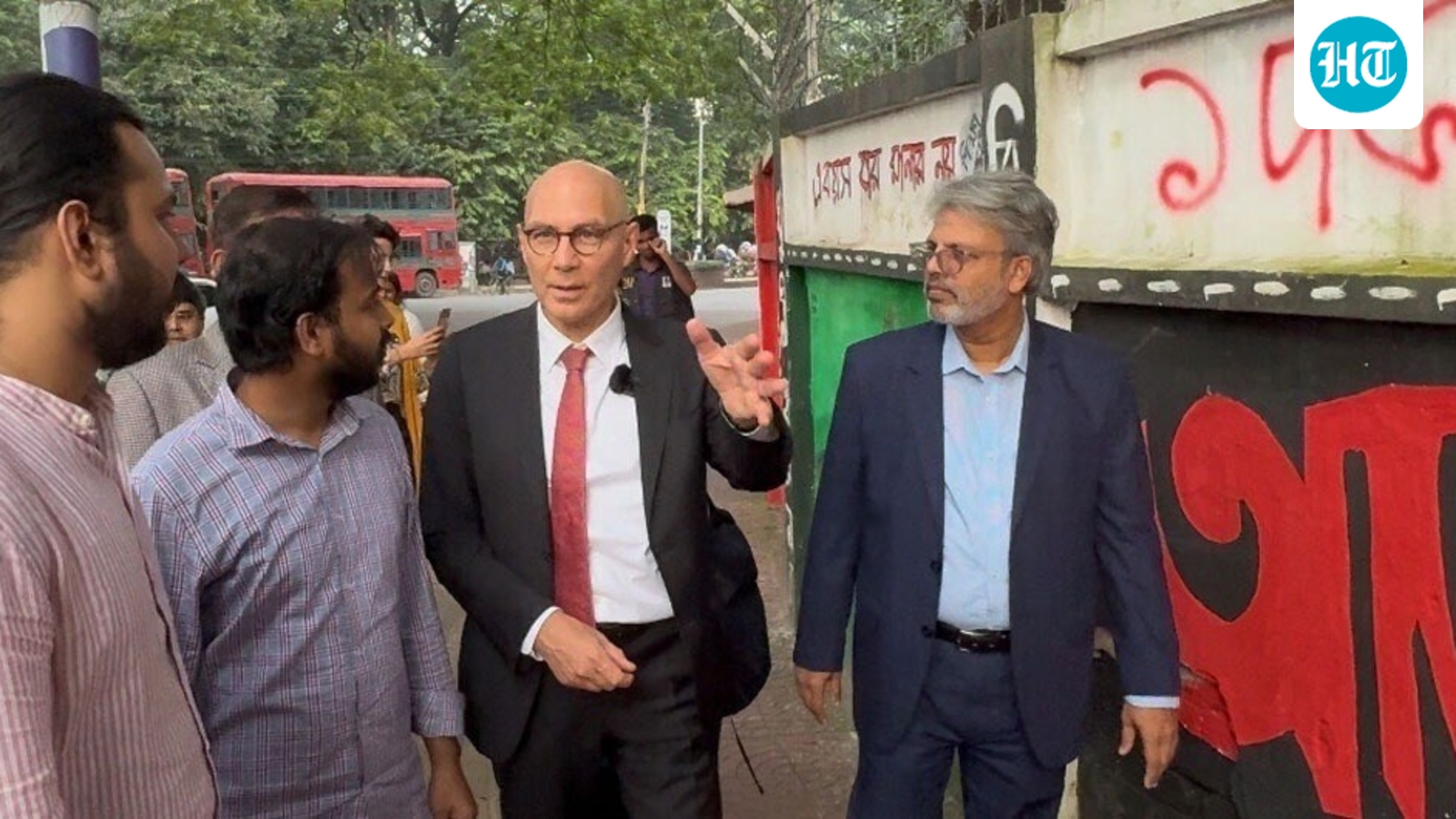
Volker Türk, the UN rights chief, faced criticism from India after his remarks on Delhi detentions on Saturday. He previously interfered in Bangladesh during 2024 student protests. Türk said, "I was in Bangladesh last year. The students were so grateful for us taking a stand and for us speaking out."
Volker Türk, director of the Office of the United Nations High Commissioner for Human Rights, whose remarks on the detentions in Delhi on Saturday sparked sharp criticism from India, had earlier similarly thrown his weight around in Bangladesh, where he threatened to ban the army from UN peacekeeping missions if they intervened during the 2024 student-led protests.
He also asserted that the political transition following the ouster of then premier Sheikh Hasina be peaceful, transparent, inclusive and grounded in human rights, and called for the release of what he called arbitrarily detained individuals.
Just like he did during the Bangladesh protests, it is evident that Turk is trying to push through his agenda, through his remarks on the Delhi protests, while serving in the supposedly non-political United Nations. His comments are selective - he did not, for instance, comment on the murders and rapes of countless minorities in Bangladesh. Türk is clearly overstepping his brief with India, as with Bangladesh.
In an interview with Dhaka Tribune in March 2025, Türk said: "I'll give you the example of Bangladesh last year. During July, August, you know, there were massive demonstrations of students. They had enough of the previous government under Sheikh Hasina."
He added: "There was massive repression happening. The big hope for them was actually our voice, was my voice, was also what we were able to do. And we put the spotlight on the situation. And we actually gave the warning to the Army that if they get involved, it means that they may not be able to be a troop-contributing country anymore. As a result, we saw changes."
Türk continued: "When Muhammad Yunus took over as the new chief adviser of the interim administration, he asked me immediately, can you send us a fact-finding mission to put the spotlight on the situation and to investigate what was happening, which is what we did. And it actually helped."
In July-August 2024, the OHCHR director condemned the violent Bangladesh government crackdown on student-led protests against the then Sheikh Hasina-led regime that resulted in over 170 deaths and thousands of injuries.
Months later in October, he visited Bangladesh and met with Yunus, the Chief Justice, the army chief, student movement leaders, and civil society representatives to discuss human rights priorities.
"I was in Bangladesh last year. The students were so grateful for us taking a stand and for us speaking out and for supporting them," the Dhaka Tribute quoted Mr Turk as saying during the interview.
Türk has also consistently urged the establishment of a robust and independent national institution to exercise strict oversight over Bangladesh's security forces.
The United Nations human rights office on Saturday urged the immediate release of anyone arbitrarily detained during the mass protests against Chief Election Commissioner (CEC) Gyanesh Kumar in the national capital, even as India dismissed the body's concerns as "misplaced" and "unwarranted interference" in its internal affairs.
In a statement, OHCHR spokesperson Thameen Al-Kheetan said the office was "concerned by reports of mass detentions in India of demonstrators, protest leaders, members of civil society organisations, lawyers and journalists, before and during today's large-scale demonstrations in Delhi".
"We call on the authorities to ensure that the right to peaceful assembly is fully respected and fulfilled," it said.
In response to the remarks, the Permanent Mission of India at Geneva said India is the world's largest democracy, where the right to peaceful assembly is guaranteed by the Constitution and safeguarded by robust institutions. "The OHCHR's concerns are therefore misplaced and constitute an unwarranted interference in the internal affairs of India," it said on X.
According to information available on the OHCHR website, Türk earlier served as the Under-Secretary-General for Policy in the Executive Office of the United Nations Secretary-General, where he coordinated global policy work.
He also ensured UN system-wide coordination in the follow-up to the Secretary-General's "Call to Action for Human Rights" and his report, Our Common Agenda, which sets out a vision to tackle the world's interconnected challenges on foundations of trust, solidarity and human rights.
He also served as Assistant Secretary-General for Strategic Coordination in the Executive Office of the Secretary-General (2019-2021) in the past.
Over the course of his career, he held a number of key positions, including at UNHCR headquarters where he served as Director of the Division of International Protection (2009-2015); Director of Organizational Development and Management (2008-2009); and Chief of Section, Protection Policy and Legal Advice (2000-2004). Mr. Türk also served UNHCR around the world, including as Representative in Malaysia; Assistant Chief of Mission in Kosovo and in Bosnia and Herzegovina, respectively; Regional Protection Coordinator in the Democratic Republic of the Congo; and in Kuwait.
With a doctorate in international law from the University of Vienna and a Master of Laws degree from the University of Linz, Austria, he has published widely on international refugee law and international human rights law.