
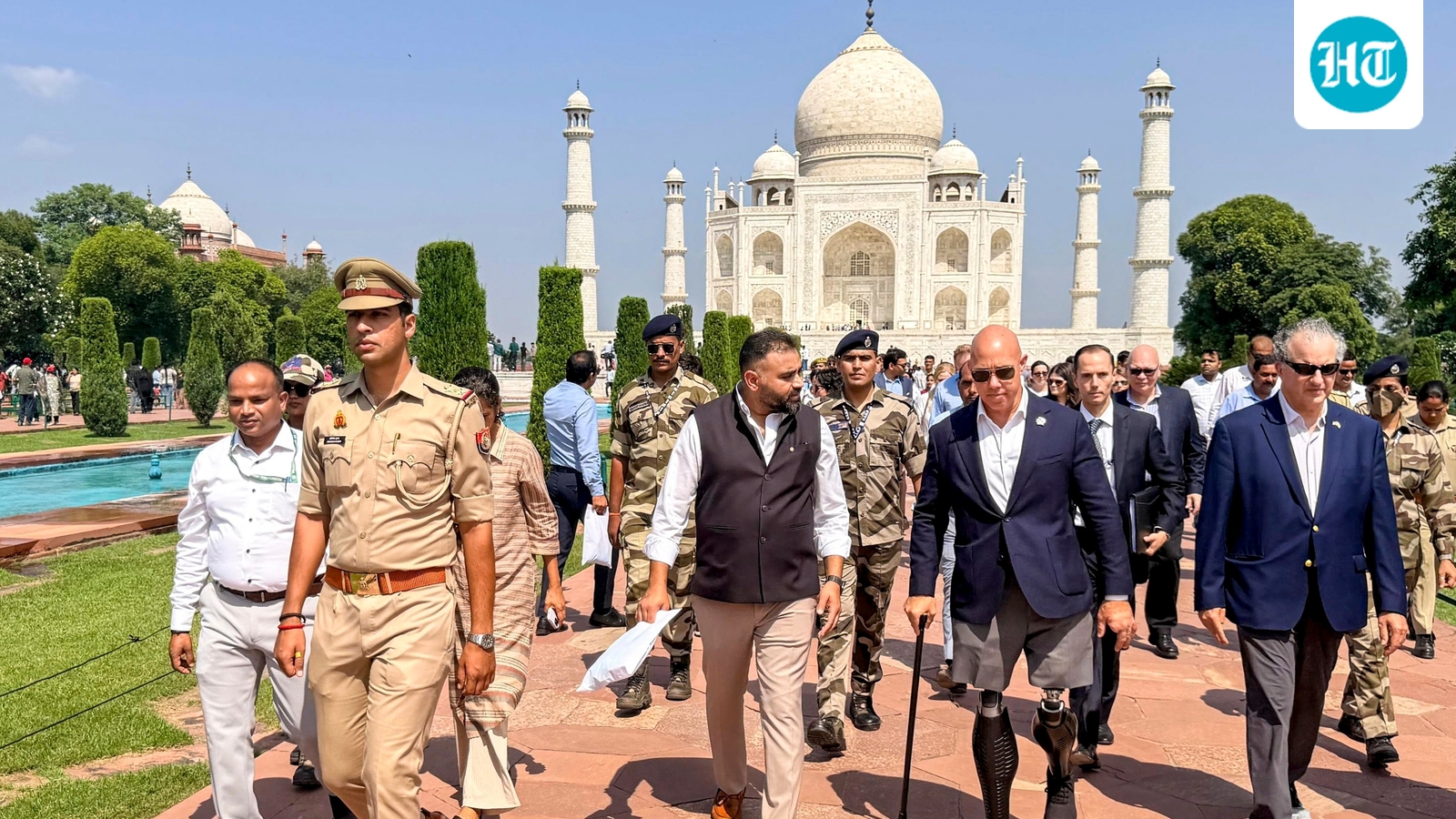
A US delegation led by Congressman Brian Mast visited India after President Donald Trump signed the Sanctioning Russia and Iran Act on September 18. The law allows Washington to impose tariffs on top buyers of Russian energy. Lawmakers met senior officials in Delhi before travelling to meet the Dalai Lama.
A delegation of US lawmakers visited India and met senior officials shortly after President Donald Trump signed the Sanctioning Russia and Iran Act into law.
The law allows Washington to impose tariffs of up to 100% on the five largest buyers of Russian oil and gas, a list that by current import volumes would include India if the President so decides.
HT breaks down the visit and its significance.
The delegation was led by Congressman Brian Mast, chair of the House of Representatives' Foreign Affairs Committee, and included lawmakers from both the Republican and Democratic parties. The group met foreign secretary Vikram Misri and defence secretary Rajesh Kumar Singh and was hosted by US Ambassador to India Sergio Gor.
After its meetings in Delhi, the delegation travelled to Dharamshala in Himachal Pradesh to meet the Dalai Lama. Congressional delegations visit India fairly regularly, but this one came at a sensitive point in the relationship.
Trump signed the Lindsey O Graham Sanctioning Russia and Iran Act of 2026 (SRIA) into law on September 18, two days after it passed the House of Representatives. The law is named after Senator Lindsey Graham, the Republican who introduced an earlier version with Democratic Senator Richard Blumenthal in April 2025 and pushed it for more than a year before his sudden death in July.
That first version proposed tariffs as high as 500% on buyers of Russian energy. The final law caps them at 100% and limits them to the five largest purchasers.
The law does not name a country. The US Trade Representative, in consultation with the secretaries of state and energy, identifies the five largest importers of Russian crude oil and natural gas by volume over the preceding 12 months, and reassesses the list every 180 days. The US President decides whether to impose tariffs and at what rate, up to the 100% ceiling.
Countries whose Russian gas imports account for less than 15% of Russia's gas exports, and which are taking significant steps to reduce them, are exempt. That provision shields several European nations, not India and China.
The 12-month lookback period captures a surge in India's purchases of Russian oil. India scaled back those purchases under US pressure through much of 2025, but after the war in West Asia effectively closed the Strait of Hormuz, Washington issued a series of general licences temporarily allowing countries including India to buy Russian oil to cover the shortfall. India's Russian crude imports rose 34% month-on-month to a record in June, according to the Centre for Research on Energy and Clean Air, and Russia supplied 51.1% of India's crude imports in July, according to the Global Trade Research Initiative.
So far, no tariffs have been imposed under the law. Most Indian exports to the US currently face a 10% duty under Section 301 of the US Trade Act, on top of standard import duties, and a bilateral trade agreement remains unsigned.
The SRIA formed a key part of the delegation's meeting with Misri. "Discussions covered the entire gamut of India-US relations, including the recently enacted SRIA legislation and the future trajectory of the relationship. They also exchanged views on international issues of mutual concern, energy security, counter-terrorism and freedom of navigation," the MEA said in a statement on Tuesday.
The ministry had set out India's position on September 17, a day after the US House vote.
It said the law's "potential implications for not just the bilateral relationship but also the international energy market have been very clearly articulated by the Indian side" to US interlocutors at high levels in recent months, and that India was determined "to take all necessary measures to protect its trade and economic interests".
On September 19, minister of state for external affairs Kirti Vardhan Singh told ANI: "We have our own independent foreign policy. We will not follow any country."
The delegation's talks with the defence secretary focused on defence technology.
The trip to Dharamshala was meant to express support for the Tibetan community, a cause with long-standing backing in the House of Representatives. Mast has supported Tibet-related causes and met the head of the Tibetan government-in-exile in 2025. A congressional delegation that included former House Speaker Nancy Pelosi met the Dalai Lama in Dharamshala in June 2024, a visit China's foreign ministry had criticised at the time.
The visit gives New Delhi a chance to gauge the mood in Congress after a drawn-out political battle over the SRIA. Key members of the US Congress had gone after India hard in public over its purchases of Russian energy, a senior US official acknowledged to HT recently.
"To China and India: You better clean up your act. Buy your oil and gas somewhere else," Blumenthal had said after the House passed the bill.
Conveying India's energy security priorities to lawmakers is key because the law gives the US Congress a formal role in how it is applied. The President can waive tariffs on a country only by certifying to Congress that the waiver serves the national interests of the United States. To lift them permanently, he must certify that the country has stopped buying Russian energy and has provided "reliable assurances" it will not resume.
Conveying New Delhi's concerns on Pakistan and counter-terrorism at a sensitive period in the relationship also remains important.