
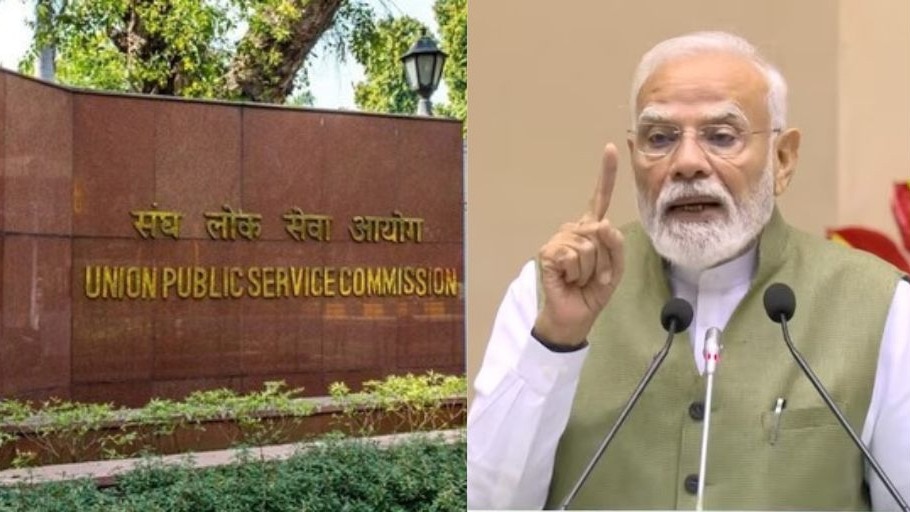
Prime Minister Narendra Modi will release a commemorative coin and stamp on October 1, 2026, to mark the UPSC’s centenary. The two-day event started today at Bharat Mandapam in New Delhi. The commission, established in 1926, has played a key role in India’s public service recruitment for one hundred years.
The Union Public Service Commission (UPSC) will complete 100 years on October 1, 2026, marking a century since its establishment in 1926 as India's first Public Service Commission. The centenary celebrations will conclude on October 1 at Bharat Mandapam in New Delhi, where Prime Minister Narendra Modi will address the gathering at 11 am.
During the event, PM Modi will also release a UPSC Centenary Commemorative Coin, a commemorative stamp and a book titled '100 Landmark Judgements - Shaping the Policies of UPSC and Public Service Commissions in India'.
The two-day centenary programme at Bharat Mandapam began today, September 30, with 'Shatabdi Samaroh - Manthan', featuring addresses by eminent speakers and panel discussions on public service and recruitment.
FROM PUBLIC SERVICE COMMISSION TO UPSC
The Public Service Commission was established on October 1, 1926, following recommendations made by the Royal Commission on the Superior Civil Services in India, chaired by Lord Lee.
The first Public Service Commission was headed by Sir Ross Barker. In its initial form, the Commission had a limited advisory role.
The institutional framework subsequently evolved. The Government of India Act, 1935 provided for the establishment of the Federal Public Service Commission. Following Independence, the Federal Public Service Commission became the Union Public Service Commission.
The Constitution of India, which came into force on January 26, 1950, gave the Commission constitutional status.
UPSC'S CONSTITUTIONAL STATUS
The UPSC is a constitutional body whose provisions are contained in Part XIV, Chapter II of the Constitution of India. Article 315 provides for Public Service Commissions for the Union and the States, while Articles 316 to 323 deal with matters including the appointment and tenure of members, removal and suspension, functions, expenses and submission of reports.
This constitutional framework provides the institutional basis for the Commission's role in recruitment and other matters concerning public services.
WHAT ARE THE FUNCTIONS OF UPSC?
The functions of the Union Public Service Commission (UPSC) are primarily defined under Article 320 of the Constitution. It conducts examinations for recruitment for Union services and undertakes direct recruitment through selection and interviews.
The UPSC also advises the Government on promotions, deputation, absorption, recruitment rules and disciplinary matters concerning civil servants. It may also advise on matters referred to it by the President.
UPSC AND CIVIL SERVICES EXAMINATION
The Civil Services Examination (CSE) is one of the UPSC's major examinations. It is conducted in three stages --- preliminary examination, main examination and personality test/interview, for recruitment to various Central Government services.
The Commission also conducts examinations including the Engineering Services, Combined Defence Services, NDA and Naval Academy, Combined Medical Services, CAPF, Indian Forest Service and Indian Economic/Statistical Services examinations.
100 YEARS OF UPSC
From the establishment of the first Public Service Commission in 1926 to becoming a constitutional body under independent India's Constitution, the UPSC has played a key role in public service recruitment.
As it completes 100 years, the centenary celebrations will highlight its institutional journey and evolving role in India's public administration. A commemorative coin, stamp and book are scheduled to be released on October 1.