
Prime Minister Narendra Modi said on Monday that India supports all meaningful peace efforts in Ukraine and West Asia. India started these conversations in July after attacks on civilian ships. External Affairs Minister S Jaishankar said, "India has got a little more involved beyond advocacy" to help ensure global stability.
In his first remarks since India initiated a proposal to end the war between Russia and Ukraine, Prime Minister Narendra Modi said on Monday that India has "consistently supported every meaningful effort towards peace".
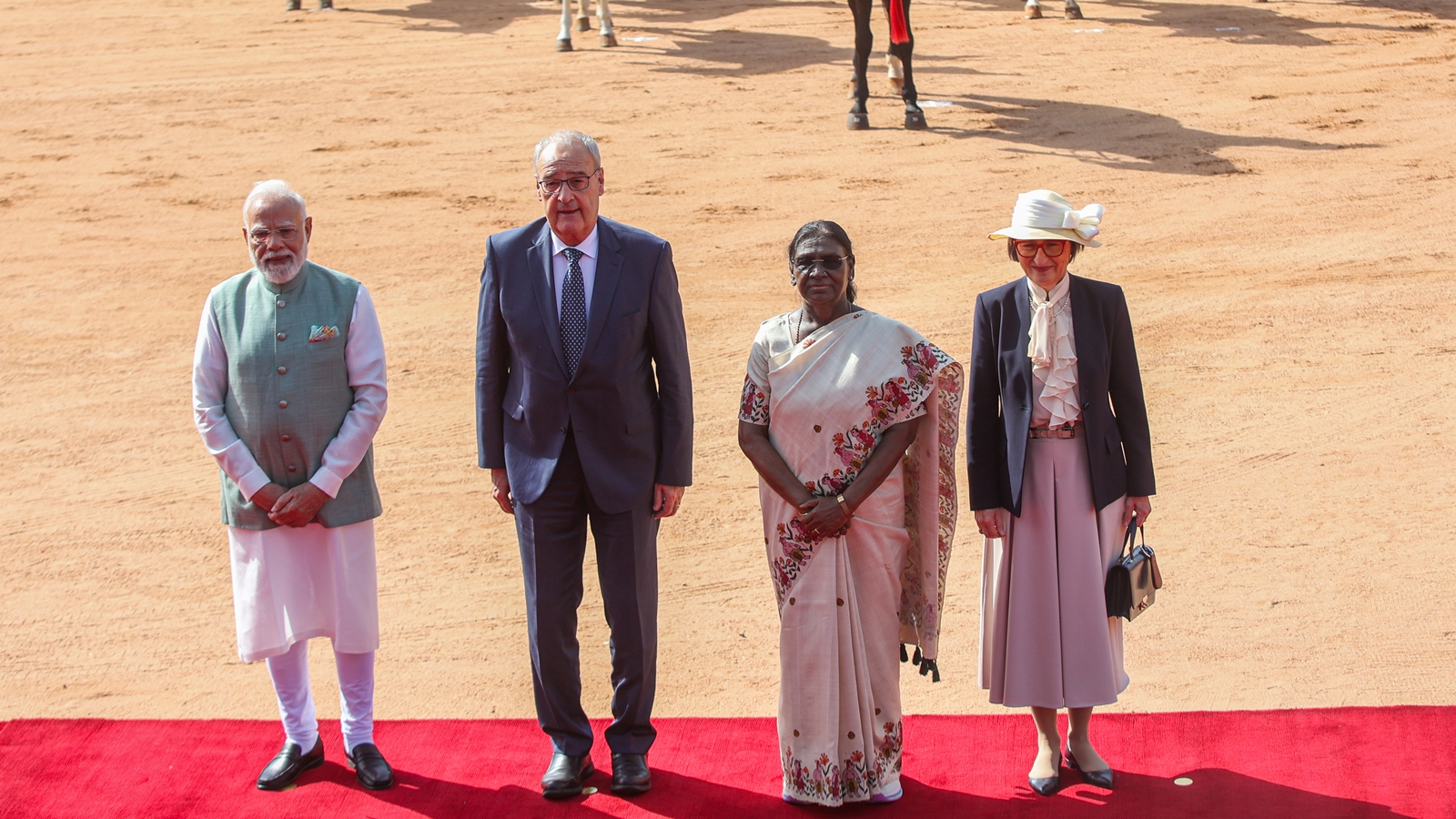
In his statement after the bilateral meeting with visiting Swiss President Guy Parmelin, Modi said: "Both India and Switzerland believe in democratic values, the rule of law, dialogue and diplomacy. We will continue to work together for global peace and stability. Whether it is Ukraine or West Asia, India has consistently supported every meaningful effort towards peace".
His statement came a day after External Affairs Minister S Jaishankar said that India has got a "little more involved beyond advocacy" and is having conversations with both Russia and Ukraine, trying to be "helpful" on the safety of shipping in the Black Sea, grain and energy exports and on "non-attack possibilities".
Last week, Ukraine's Foreign Minister Andrii Sybiha had said that India has put forward a "comprehensive" and "broad" proposal to end the war, for the first time since the war began in February 2022.
Read | When did India begin latest round of talks with Russia, Ukraine? Jaishankar reveals
Elaborating on the context and rationale behind India's move, Jaishankar said on Monday that Delhi started the latest round of conversations with Russia and Ukraine in July this year, after commercial ships came under attack from both sides in the Black Sea.
Speaking at an interactive session at the Kautilya Economic Conclave in New Delhi, Jaishankar said: "In the month of July, there were attacks on civilian shipping by both Russia and Ukraine. And in the course of those attacks, some Indian sailors were killed, some were injured. We regard these attacks as completely unacceptable, whether it is in the Black Sea, the Red Sea, or the Gulf. So we protested very strongly to the Russians, to the Ukrainians. I myself took it up with the foreign ministers of both countries. And we started getting active initially to secure the maritime shipping and the mariners involved in that."
Jaishankar said those conversations brought out the nature of the cargo being carried. And there was concern over grain exports which had come to a halt in the Black Sea. "So the conversation developed into whether non-attack on shipping is good, but is there a possibility of facilitating the shipment of grain... So it got linked to energy. So it became a somewhat broader conversation," he said.
He said "those conversations are ongoing" -- including during Modi's meeting with Russian President Vladimir Putin in Bishkek on August 31, after which Jaishankar went to Kyiv to meet Ukrainian President Vlodymyr Zelenskyy in early September, followed by another discussion between Modi and Putin in New Delhi on the sidelines of the BRICS Summit on September 11-12.
"We still keep in touch with both sides. It's obviously not an easy situation. It's not something which anybody can say with a high degree of confidence that something is going to come out. But it seems definitely an effort worth making," Jaishankar said, adding that resolving concerns pertaining to grain, fertiliser and fuel are in the interest of India, as well as the Global South.
"We have the interests of the parties themselves, that if they can even agree on something of a limited nature, we feel that in the given circumstance that's a big positive," he said.
From the very beginning, he said, India has held the view that this conflict is unlikely to be resolved on the battlefield. "Therefore, it was important to have negotiations between the parties... there were actually negotiations in the early stages of the conflict."
"Though we have been maintaining for some time that both parties should come to the table, and there were a number of conferences where countries gathered to express their support for peace, but often they would gather in the absence of Russia," he said, in a reference to initiatives like the Swiss peace conference.
However, he said, India has always believed that there wasn't any point "of having a gathering dealing with the Ukraine conflict where Russia is not there".
On October 1, Putin had said that Modi "constantly raises the question about putting an end to the conflict" and has "very good ideas".
Later that day, speaking to reporters in Kyiv, Ukraine's Foreign Minister Sybiha had said, "We have four proposals. The most comprehensive is India's proposal. For the first time, India has signalled its willingness to play a role." He had said Ukraine was prepared to agree to an energy and agricultural truce in the Black Sea, and was also considering an unconditional ceasefire along the line of contact.
Besides India, Ukraine has received proposals for a possible ceasefire from Turkey, Egypt and the United States.
According to Sybiha, Ukraine will agree to a ceasefire on the condition that it covers not only combat operations, but also an end to attacks on energy and port infrastructure, as well as the situation in the Black Sea.
Modi has been raising the issue with Putin since 2022, when he first said "this is not the era of war". In a meeting with Putin in Moscow in July 2024, Modi said "peace talks do not succeed amid bombs, guns and bullets", and a "solution cannot be found on the battlefield".
On August 31 this year, Modi had urged Putin to move from "endless war" to "end of war", when they met in Bishkek on the sidelines of the summit of SCO leaders.