
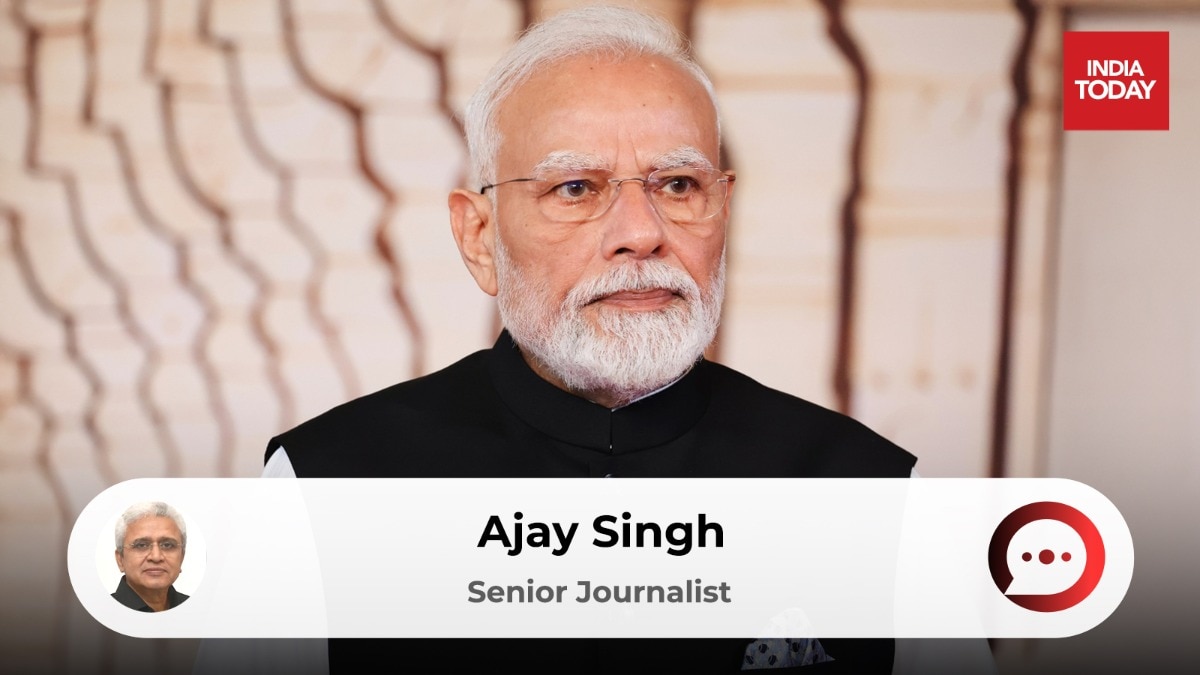
Narendra Modi’s political path changed after the 2001 Bhuj earthquake and the 2002 Godhra train fire. While the earthquake helped him replace Keshubhai Patel as Gujarat Chief Minister, the 2002 riots brought intense controversy. He faced these challenges and later built a development-focused image through his successful Brand Gujarat campaign.
Every 25-year period brings a complete transformation to a human life with its mix of triumphs and tribulations. No one is immune to the vicissitudes of this law of nature.
Prime Minister Narendra Modi is no exception. His evolution from a rookie administrator in 2001 to an astute statesman with considerable global influence has been remarkable. Like any human being, he has known pleasure and pain, success and failure. But eventually he emerged as a leader of conviction and courage, helped by plenty of good fortune.
The story of Narendra Modi would have been different had the earthquake not devastated Bhuj and parts of Saurashtra in 2001. The then Gujarat Chief Minister, Keshubhai Patel -- then the tallest BJP leader in the state -- was widely seen to have mishandled the relief operation. This angered the central leadership, namely, Prime Minister Vajpayee and Union Home Minister LK Advani.
In sharp contrast to Keshubhai's botch-ups, Modi, then general secretary of the BJP, ran efficient relief operations, albeit in limited areas. The contrast was too evident to ignore. Keshubhai's removal became a prerequisite for rebuilding Kutch and Saurashtra, and Modi was seen as the only person who could take up that onerous task. His elevation to the chief minister's chair came against a backdrop of natural devastation, human tragedy and the perceived failure of the state government.
From day one, Modi was cautious about the complexity of governance. He launched a vigorous programme of relief, rehabilitation and rebuilding in Kutch and Saurashtra, and at the same time set about familiarising himself with the machinery of government. As a politician he knew Gujarat's problems well, but he had never had to address them as an administrator. That learning might have taken him on a different course had the Godhra train fire and the riots that followed in 2002 not occurred. They altered his trajectory. He was vilified by many and lionised by some, often on preconceived assumptions that suited the political discourse on either side. His supporters argue that his own agony was lost in the din of a fierce campaign against him.
He faced the turbulence stoically and, after the 2002 Assembly elections, focused on the development of Gujarat. He carefully conceived a "Brand Gujarat" campaign around the slogan "Aapnu Gujarat, Aagvu Gujarat" (Our Gujarat, Unique Gujarat). The implicit message was that the state would become a role model for development. His single-minded aim was to make Gujarat's model of governance an ideal for the rest of the country.
At meetings of the National Development Council (NDC) in Delhi, Modi's speeches were, by many accounts, the star attraction; admired more for their content than their rhetoric. He changed the urban landscape of Ahmedabad, reformed the notoriously difficult power sector and took water to distant parts of the state. He delivered on much that had earlier been considered unachievable.
What is particularly interesting is that Modi built Gujarat's image at a time when, his supporters say, the Union government -- led by Manmohan Singh and Sonia Gandhi -- was viscerally hostile to him. They allege that cases were brought against him and his associates for political reasons, that his then home minister Amit Shah was jailed, and that the Centre encouraged a section of the state bureaucracy to rebel against the state government. Whatever one makes of those allegations, it is true that he built "Brand Gujarat" under markedly adverse political circumstances.
Modi began to show national ambitions only after winning the 2012 state Assembly elections. There was an apparent vacuum at the national level. While the UPA government was discredited by corruption charges, the RSS-BJP badly needed a powerful rallying figure who could mobilise voters. Modi was the natural choice for the 2014 Lok Sabha elections.
His more than 12 years as Prime Minister have seen many ups and downs. The BJP winning a majority on its own in 2014 came as a surprise. In 2019 the party improved its performance, a sign of Modi's rising acceptance as a leader. The loss of its own majority in 2024 left little doubt that his popularity had taken a hit, but thereafter he produced a string of massive victories in five states.
The past is just a prologue, and Modi is not unmindful of the future. He has been setting the agenda for 2047, envisioning an India that ranks among the developed nations. The headwinds he faces from international developments with a direct bearing on the domestic economy will make that task extremely difficult. As in the past, he shows no hesitation in confronting adversity head-on.
Twenty-five years of sustained governance is a remarkable feat, and the tendency to lend an aura of divinity to Modi only undermines it. His strength is better understood in humbler terms: over the years he has built a "reservoir of trust" through hard work, courage and conviction, and it remains intact.