
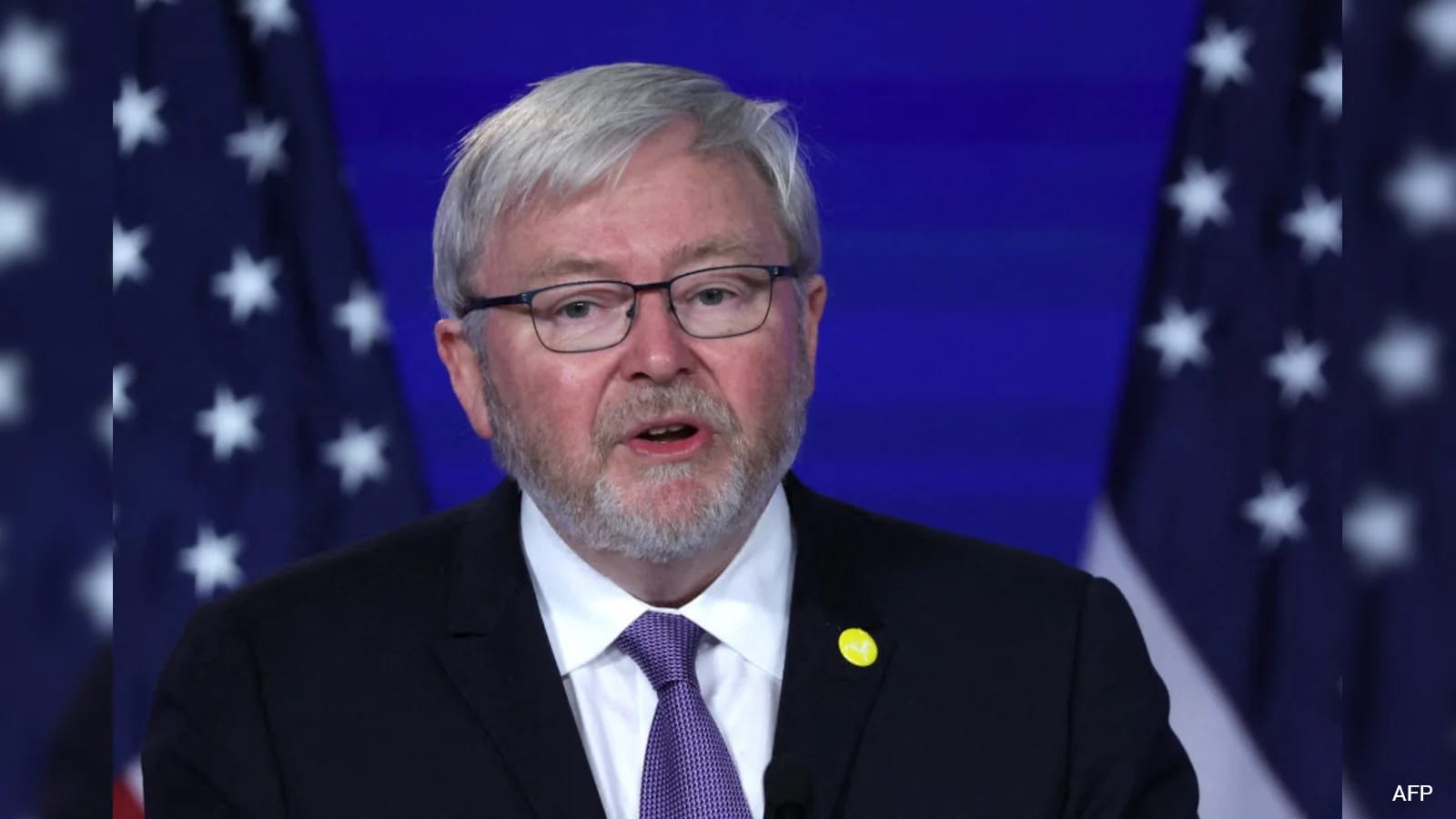
Former Australian Prime Minister Kevin Rudd said US President Donald Trump has an extraordinarily positive view of India and Prime Minister Narendra Modi. Rudd noted that this strong political relationship helps India in trade talks. He also backed PM Modi’s efforts to push Russia and Ukraine towards a diplomatic solution.
Rudd said a sustainable peace would require more than a ceasefire.
Canberra:
Former Australian Prime Minister and Asia Society Global President and CEO Kevin Rudd has said India is in a relatively strong position in its ongoing trade negotiations with the United States, despite the difficult talks over tariffs and market access. In an exclusive interview with NDTV, Rudd said US President Donald Trump has an "extraordinarily positive" view of India and Prime Minister Narendra Modi, making the broader political relationship an important advantage for New Delhi.
Rudd, who recently completed his tenure as Australia's ambassador to the United States, said negotiations between India and the Trump administration remain active and that the outcome will ultimately be a political decision between the two leaders.
"Negotiators will have their day in the sun. They will push, and they will shove, as they always do. At the end of the day, it'll be a political decision between the two principals," Rudd said.
His comments come amid prolonged negotiations between India and the US on a trade agreement, with tariffs and market access emerging as some of the key sticking points. Rudd argued that India is better positioned than many other countries because of the positive view of India within the Trump administration.
India's Russia-Ukraine Peace Push
On the Russia-Ukraine war, Rudd strongly backed PM Modi's efforts to push Moscow and Kyiv towards diplomacy. He said the scale of casualties in the conflict has reached a level not witnessed in decades and welcomed India's efforts to contribute to a diplomatic solution.
Rudd said PM Modi was right to raise the issue directly with Russian President Vladimir Putin, arguing that Putin's willingness to pursue a diplomatic settlement will be central to ending the conflict.
"The core determinant on whether we can bring this to conclusion diplomatically and peacefully lies in President Putin's preparedness to do so," Rudd said.
He also welcomed Foreign Minister S Jaishankar's engagement with Russia, Ukraine and other international players, describing him as a foreign minister who is "well-wired around the world".
However, Rudd said a sustainable peace would require more than a ceasefire. Ukraine, he argued, would need credible external security guarantees to prevent it from becoming vulnerable to another conflict. Such guarantees could involve NATO membership or alternative bilateral security arrangements.
Middle East Crisis
On the escalating US-Iran conflict and disruption around the Strait of Hormuz and Red Sea, Rudd struck a cautious note. He said the conflict has entered a "difficult and protracted stage", with Iran demonstrating its determination not only to survive but to fight back.
According to Rudd, diplomacy remains the only realistic path forward, but he warned that there is "no relief in sight in the immediate term."
He said the US has already deployed senior negotiators for discussions with Iranian counterparts, but the conflict will require patience before any meaningful breakthrough can be expected.
Quad's Importance for Washington
Rudd also rejected the perception that the Quad -- India, the US, Australia and Japan -- has slipped down the Trump administration's priority list.
He pointed to continuing cooperation between the four countries on maritime surveillance, defence engagement, critical minerals and rare earths. Rudd said the next major milestone would be a Quad leaders' summit involving President Trump.
He expressed optimism that such a meeting could take place in the coming months, although he acknowledged that the US midterm elections and a crowded political calendar could affect the timing.
India-Australia Ties
On India-Australia relations, Rudd said bilateral ties are moving "from strength to strength", with trade now standing at around A$50 billion and combined investments at approximately A$75 billion.
He identified trade, investment, technology, uranium and critical minerals as key areas for further cooperation. He also praised the relationship between PM Modi and Australian Prime Minister Anthony Albanese, saying the chemistry between the two leaders is "in first class working order".
Rudd added that the positive sentiment towards India extends beyond Australia's large Indian-origin population, saying the wider Australian public and political establishment also have a favourable view of India and PM Modi.
flydubai incident
The interview also touched on the recent FlyDubai cockpit incident and the broader global counterterrorism challenge. Rudd praised the bravery and skill of the pilot and passengers who helped bring the dangerous situation to a safe conclusion.
He warned, however, that terrorism remains a persistent threat and that governments cannot afford to become complacent.
Rudd said aviation regulators would need to examine the incident and learn lessons to prevent similar episodes. More broadly, he called for closer intelligence and security cooperation between India, Australia, the US, UK, European countries and Gulf states.
He was also critical of the United Nations' ability to deal effectively with terrorism, saying political compromises within the UN system often prevent decisive action.
China-US Rivalry
On China, Rudd rejected suggestions that recent high-level US-China engagement signals the emergence of a broader strategic rapprochement.
He said competition between Washington and Beijing remains intense across the military, economic, technological, investment and ideological spheres.
The objective, according to Rudd, is increasingly to manage strategic competition rather than end it, reducing the risk of an accidental crisis or conflict.
He pointed to artificial intelligence as one of the most important arenas of future US-China competition, noting President Trump's recent assertion that "he who wins AI wins".
For India, Rudd's assessment underlines a complex geopolitical landscape: New Delhi is simultaneously deepening its strategic partnership with Washington and Canberra, maintaining its diplomatic role on Russia-Ukraine, strengthening the Quad and navigating an enduring trust deficit with China.
Got a follow‑up question on this article? Go on
How may i help you today
Show full article
Track Latest News Live on NDTV.com and get news updates from India and around the world