
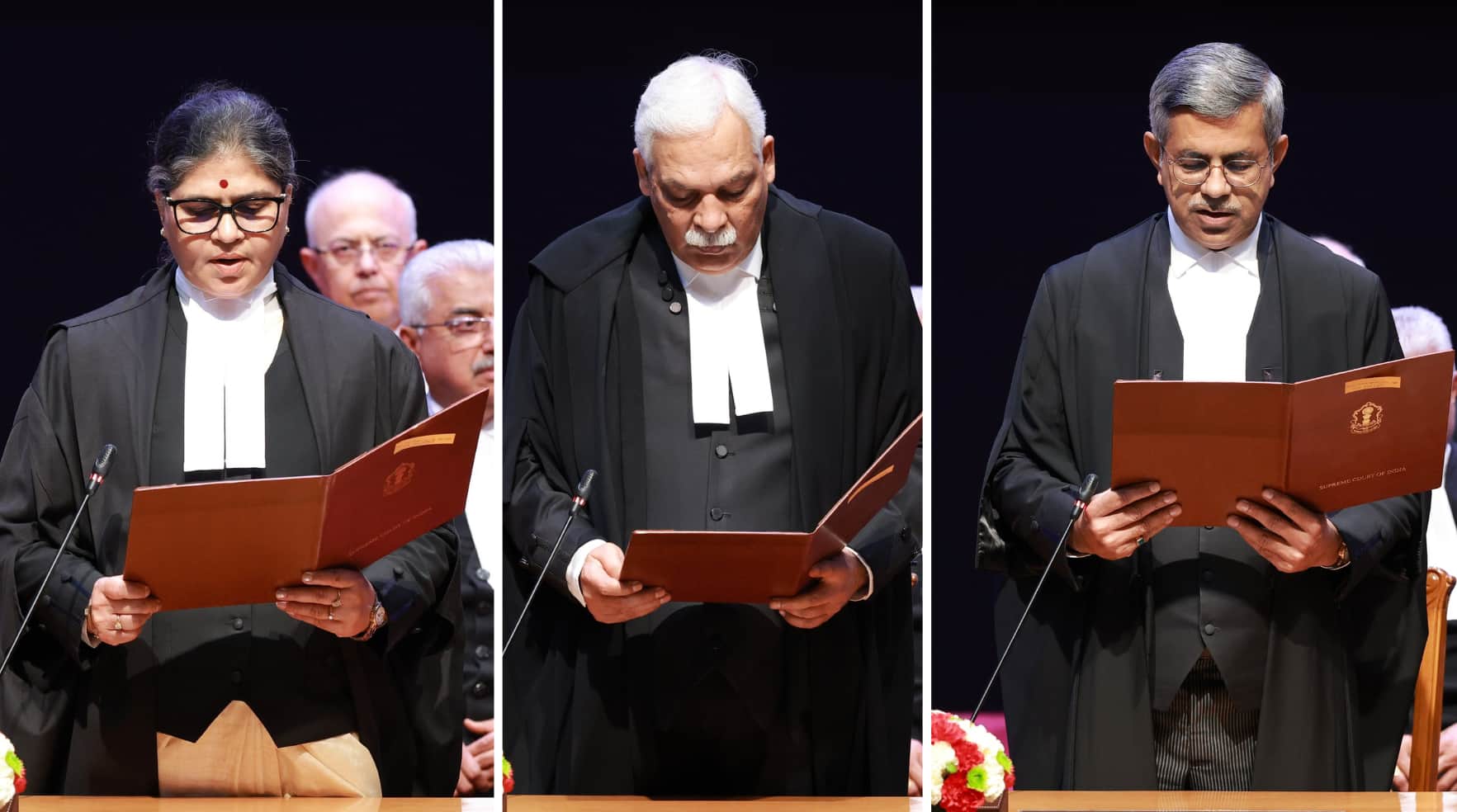
Justices Sunita Agarwal, DK Upadhyaya and Aparesh Kumar Singh took oath as Supreme Court judges on October 6. These three Chief Justices joined the top court after the government notified their appointments. Their arrival brought the working strength to 37, leaving only one vacancy against the sanctioned strength of 38.
Market Mastery
Webinar by Vishal Malkan
Find the weak links
in your portfolio by Vishal Malkan
The Supreme Court's latest appointments bring three Chief Justices with markedly different judicial journeys to the country's highest court. Justice Sunita Agarwal, Justice Devendra Kumar Upadhyaya and Justice Aparesh Kumar Singh -- the Chief Justices of the Gujarat, Delhi and Telangana High Courts respectively -- took oath on Tuesday (October 6), taking the Supreme Court's working strength to 37 against a sanctioned strength of 38.
For Justice Agarwal, the elevation also means the number of women judges on the Supreme Court has risen to three, alongside Justices BV Nagarathna and V Mohana.
The Supreme Court Collegium, headed by Chief Justice of India (CJI) Surya Kant, recommended the three names on September 28. The government notified their appointments on October 5, a day before they took oath.
All three had headed High Courts that deal with some of the country’s most politically and legally consequential disputes. Their records include cases involving preventive detention, the Right to Information Act, anti-defection law, public contracts, education, institutional accountability, elections, criminal proceedings and administrative decisions.
Agarwal leaves Gujarat after dealing with cases ranging from university accountability and public safety to RTI and preventive detention. Upadhyaya leaves Delhi after overseeing one of the judiciary’s most closely watched internal controversies and handling politically sensitive litigation. Singh leaves Telangana after decisions on anti-defection, public projects and administrative law.
Their elevation also changes the leadership of the High Courts they leave behind. The three appointments take the Supreme Court’s working strength to 37, leaving one vacancy against its sanctioned strength of 38.
Justice Sunita Agarwal: From Allahabad to Gujarat
Justice Sunita Agarwal’s judicial career began at the Allahabad High Court, where she had practised for 21 years after enrolling as an advocate on December 16, 1990. She completed her BSc from Lucknow University and her law degree from Awadh University before entering practice, primarily on the civil side.
She was appointed an Additional Judge of the Allahabad High Court in November 2011 and became a permanent judge in August 2013. During her tenure, she handled civil and criminal appeals, service matters, land acquisition disputes, commercial litigation, constitutional cases and intra-court appeals.
She also served on several administrative committees, including those dealing with workplace sexual-harassment complaints, family courts, criminal-case disposal, recruitment, judicial infrastructure and jail reforms. In April 2023, she became Executive Chairperson of the Uttar Pradesh State Legal Services Authority.
Agarwal was appointed Chief Justice of the Gujarat High Court in July 2023. Her tenure there included several suo motu interventions involving institutional accountability.
In September 2023, following a report about alleged sexual harassment of two students at Gujarat National Law University, a bench led by Agarwal took suo motu cognisance. The court questioned the university’s response and observed that its in-charge registrar had made an “overt anxious effort” to dilute the issue through a summary inquiry. A high-level committee was later constituted to examine the university’s academic, administrative, financial and student-safety record. The court eventually said the university director had “utterly failed in discharge of his duty”.
She also headed proceedings arising from the January 2024 Harni Lake boat tragedy in Vadodara, in which 12 schoolchildren and two teachers died. The court questioned the Vadodara Municipal Corporation about its supervision of the contractor. In June 2024, it made a prima facie finding against two former municipal commissioners over alleged dereliction of duty and misuse of position.
Another case that became particularly significant because of its timing was the dispute over Prime Minister Narendra Modi's educational records.
On September 29, a day after the Collegium recommended Agarwal for the Supreme Court, a bench headed by her dismissed former Delhi Chief Minister Arvind Kejriwal’s appeal against an earlier Gujarat High Court order concerning disclosure of Modi’s degrees.
The dispute originated in a 2016 Central Information Commission direction asking Gujarat University to provide information relating to degrees in Modi’s name. A single judge later held that the information was protected under Sections 8(1)(e) and 8(1)(j) of the RTI Act and imposed a Rs 25,000 cost on Kejriwal. Agarwal’s bench upheld the decision, holding that the larger public interest required to justify disclosure had not been established.
Her earlier Allahabad record also includes a 2021 decision involving six anti-CAA-NRC protesters detained under the National Security Act. A bench comprising Agarwal and Justice Sadhna Rani quashed the detention orders and their extensions, finding that the authorities had relied on vague and misconceived grounds.
In 2023, she was part of a seven-judge bench that initiated contempt proceedings against members of the Kanpur Bar Association and Lawyers’ Association for continuing a strike despite court directions. The court described the strike as “illegal and paralysing judicial work”.
Her Gujarat tenure was not without controversy. In February 2025, the Gujarat High Court Advocates' Association passed a resolution seeking her transfer and raised concerns about judicial administration and roster changes. Senior advocate Asim Pandya had also written to question changes involving the roster. Agarwal subsequently went on leave, while Justice Biren Aniruddh Vaishnav was appointed Acting Chief Justice.
Justice DK Upadhyaya: Three High Courts and a Delhi tenure
Justice Devendra Kumar Upadhyaya’s career has taken him from the Lucknow Bench of the Allahabad High Court to the Bombay and Delhi High Courts.
Born on June 16, 1965, he graduated in law from Lucknow University in 1991 and enrolled as an advocate the same year. He practised principally in civil and constitutional matters and became Chief Standing Counsel for Uttar Pradesh in May 2007, a position he held until his elevation to the Bench.
He became an Additional Judge of the Allahabad High Court in November 2011 and a permanent judge in August 2013. He later became Chief Justice of the Bombay High Court in July 2023 and moved to Delhi as Chief Justice in January 2025.
His Delhi tenure was marked by the controversy surrounding Justice Yashwant Varma after burnt and unaccounted cash was found at Varma’s official residence following a fire in March 2025.
Upadhyaya conducted a preliminary inquiry and submitted his report to then CJI Sanjiv Khanna. The report recorded a “prima facie opinion that the entire matter warrants a deeper probe”. The Supreme Court Collegium subsequently decided to repatriate Justice Varma to the Allahabad High Court.
Upadhyaya also presided over cases involving major government decisions and public institutions.
During his Bombay tenure, a bench led by him upheld Maharashtra’s award of the Dharavi Redevelopment Project to Adani Properties. The court found no “arbitrariness, unreasonableness or perversity” in the tender process. Adani’s bid stood at Rs 5,069 crore and three bidders had participated.
In another case involving an Adani Group-linked power contract, his bench dismissed a challenge to the Maharashtra government’s decision and imposed a Rs 50,000 cost on the petitioner, describing the plea as “unsubstantiated and reckless”.
In July 2024, his bench struck down a Maharashtra notification that exempted certain private unaided schools from the 25 per cent quota under the Right to Education Act where a government or aided school existed within one kilometre. The court held that the exemption was inconsistent with Article 21-A and the RTE Act.
His bench also dismissed challenges to Maharashtra’s decision to rename Aurangabad as Chhatrapati Sambhajinagar and Osmanabad as Dharashiv.
In Delhi, Upadhyaya dealt with a case concerning climate activist Sonam Wangchuk’s health during a prolonged hunger strike. After Wangchuk was moved to Safdarjung Hospital, a division bench headed by Upadhyaya ordered his transfer to Medanta Hospital for treatment of his choice, with specialist monitoring and visitation rights for his wife.
Another important matter involved the excise policy case. In March 2026, Kejriwal and other accused sought administrative transfer of the CBI’s challenge to their discharge from Justice Swarana Kanta Sharma to another judge. Upadhyaya declined the request, holding that Sharma was hearing the matter according to the roster and that there was no reason for administrative intervention. He also made clear that any decision on recusal had to be taken by the judge concerned.
The case came after a trial court had discharged Kejriwal, Manish Sisodia and 21 others. Justice Sharma subsequently issued notice on the CBI’s challenge and stayed the trial court’s recommendation concerning departmental action against the investigating officer.
As Upadhyaya left the Delhi High Court, he offered an insight into how he viewed judging. At his farewell on October 6, he said: “As a judge, I have always tried to bind law, justice and compassion together.”
He added that when the law appeared incapable of delivering a just result, “I tried to softly bend the law towards justice for the deserving litigant”.
Justice Aparesh Kumar Singh: From Jharkhand to Tripura and Telangana
Justice Aparesh Kumar Singh’s career has taken him through the Patna and Jharkhand Bars and the Jharkhand, Tripura and Telangana High Courts.
Born on July 7, 1965, he completed his B.A. Honours and LL.B. from the University of Delhi and enrolled as an advocate in 1990. He practised at the Patna High Court until 2000 and then at the Jharkhand High Court from 2001 until his elevation as a judge.
He became an Additional Judge of the Jharkhand High Court in January 2012 and a permanent judge in January 2014. He also served as Executive Chairman of the Jharkhand State Legal Services Authority and Acting Chief Justice of Jharkhand from December 2022 to February 2023.
He became Chief Justice of the Tripura High Court in April 2023 and was transferred to the Telangana High Court, where he took oath as Chief Justice in July 2025.
Singh’s record includes several cases involving elections, criminal law, service matters and government decision-making.
In Jharkhand, he sat on a bench monitoring allegations of horse trading in the Rajya Sabha elections. The proceedings involved allegations of “money power, horse trading and influence”, with the court criticising investigative delays and directing further CBI action.
In 2021, a bench involving Singh granted bail to former Bihar Chief Minister Lalu Prasad Yadav in the Dumka treasury fodder-scam case after he had served half of his 14-year sentence in that case.
His judgments have also stressed the limits of judicial review. In a departmental dismissal matter in 2022, he declined to interfere, holding that judicial review examines the decision-making process and does not permit the court to function as an appellate authority reassessing evidence.
In contempt proceedings in 2018, he stressed the importance of natural justice and Supreme Court guidelines, including the requirement that a person facing contempt proceedings must receive material necessary to defend themselves.
In Telangana, his bench delivered one of his most consequential recent judgments when it set aside the Speaker’s rejection of disqualification petitions against Congress MLA Danam Nagender. The court declared Nagender disqualified from the Telangana Legislative Assembly and the seat vacant. The dispute centred on his contesting the 2024 Lok Sabha election as a Congress candidate while continuing to be a BRS MLA.
Singh’s bench also upheld a Telangana law restricting people with more than two children from contesting certain local-body elections, rejecting challenges based on Articles 14 and 19 of the Constitution.
In April 2026, his bench upheld the Telangana government’s authority to constitute the Justice P.C. Ghose Commission to investigate alleged irregularities in the Kaleshwaram Lift Irrigation Project. At the same time, it set aside adverse findings against former Chief Minister K. Chandrashekar Rao, former minister T. Harish Rao, IAS officer Smita Sabharwal and former Chief Secretary S.K. Joshi, holding that the findings had breached principles of natural justice and statutory safeguards.
His Telangana record also includes a January 2026 ruling with Justice GM Mohiuddin in which the bench rejected the government’s attempt to increase a disciplinary penalty already accepted against a junior stenographer.