
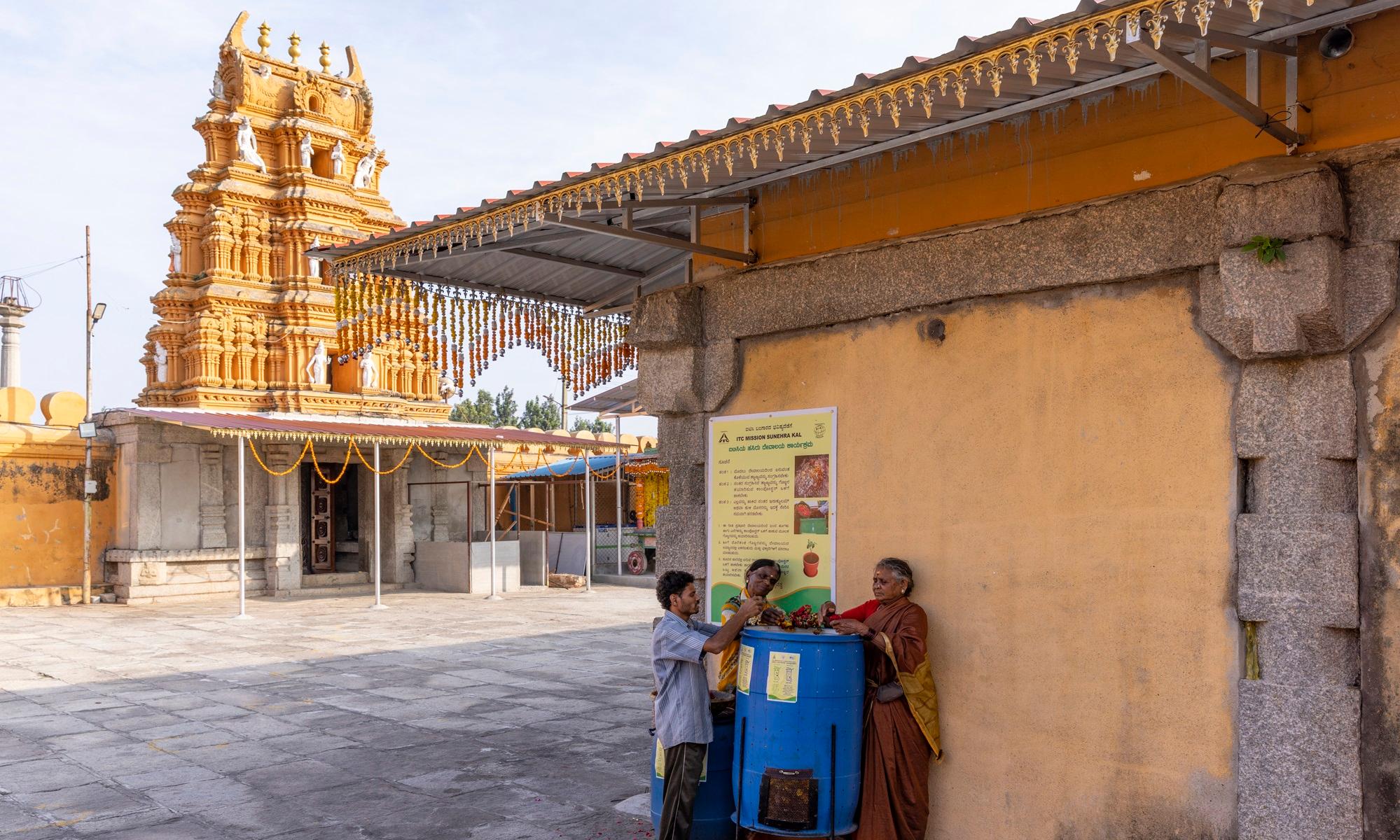
ITC expanded its Green Temples initiative to 2,300 places of worship across seven states to support the Swachh Bharat Mission. The programme turns floral offerings and waste into compost or energy. By training staff and devotees, ITC helps temples manage materials responsibly, making cleanliness a collective effort for a greener India.
New Delhi: In support of the Swachh Bharat Mission, ITC Limited is advancing integrated waste management solutions across places of worship, households and communities. As part of its broader strategy of circular waste management, ITC's Green Temples initiative has expanded from an initial three-temple pilot to more than 2,300 places of worship across seven States.
Over the years, the programme has covered revered temples across Uttar Pradesh, Uttarakhand, Maharashtra, Andhra Pradesh, Karnataka, Tamil Nadu and Telangana — promoting source segregation, responsible waste management and resource recovery from floral offerings and other biodegradable materials, pivoting houses of worship into models of green transformation.
With sustainability embedded across its businesses and community programmes, ITC has adopted a multi-dimensional and integrated approach to waste management, resource recovery and circularity at scale. This aligns with the priorities of Government's Swachh Bharat Mission, which in 2026 places greater emphasis on source segregation, scientific waste management, citizen participation and resource recovery. It is also aligned with the theme of Government's 'Swachhata Hi Seva 2026' campaign - "Swachhata Mein Sahbhag; Swachh Bharat, Viksit Bharat", which seeks to make cleanliness and responsible resource use a collective endeavour.
When Waste Turns into a Resource
ITC's Green Temples initiative follows a scalable hub-and-spoke model, with a lead temple anchoring shared systems for segregation, processing and resource recovery across surrounding places of worship. The approach embeds circularity within high-footfall spiritual and community spaces while enabling replication through institutional partnerships.
Waste is managed close to its source through segregation and resource recovery systems. Floral offerings are channelled into appropriate processing streams, while plastics enter formal recycling chains. At locations where biogas and composting facilities have been established, organic waste is converted into clean energy and compost for productive use. Participating temples manage more than 90% of collected materials through closed-loop systems; biogas units installed in few temples generate the equivalent of around 8 to 20 LPG cylinders a month, while compost can create an additional value stream.
The success of the initiative is driven by comprehensive behavioural change and institutional capacity-building. The initiative goes beyond establishing waste-processing infrastructure. Temple executives and district officials are trained to operate and sustain the systems, while devotees, staff and local vendors are encouraged to segregate waste and reduce waste generation at source. The initiative has also promoted the use of environmentally responsible alternatives, including biodegradable materials such as banana leaves.
Mr. Prabhakar Lingareddy, Executive Vice President and Head - Social Investments, ITC Limited, said, "The journey to circularity starts with a simple yet powerful shift in mindset, where not only the need to manage waste responsibly gets embedded at a citizen and household level, but also that waste can be reimagined as a valuable resource. Whether it is organic waste from temple offerings, dry and biodegradable waste from households or waste generated through operations, the focus is on creating sustainable community anchored systems and interventions that enable recovery and productive reuse. Such transformation requires the collective participation of communities, waste collectors, civil society, institutions, businesses and Government machinery."
An Integrated Approach: From Households and Communities to Places of Worship
The principles of segregation, resource recovery and circularity promoted through the Green Temples initiative is core to ITC's large-scale community waste management programmes.
ITC orchestrates this integrated waste management approach through decentralised waste-management programmes implemented in communities under the Mission Sunehra Kal intervention. During FY 2025-26, the programme operated across 35 districts in 14 States, reaching over 7.13 lakh additional households and cumulatively covering 8.23 million households. The programme also has a Waste collector well-being initiative that has covered 23,000 waste collectors till date. During FY 2025-26, over 6.87 Lakh MT of waste was collected, including around 4.23 Lakh MT of wet waste that was composted and 1.65 Lakh MT of dry waste that was recycled. As a result, approximately 86% of the waste was managed instead of it going to landfills. ITC has been working very closely with Panchayats and State Mission Directors to amplify the agenda, apart from actively engaging with both Phase I and Phase II of the Light House Initiative (LHI) of Department of Drinking Water and Sanitation orchestrated by India Sanitation Coalition.
Besides, ITC's Well-Being Out of Waste (WOW) initiative strengthens municipal waste systems through citizen-led source segregation, organised collection and recycling. This approach supports sustainable livelihoods for over 18,200 waste collectors and also facilitates participation of social entrepreneurs within the dry-waste value chain. Since inception, the programme has reached another 8.12 million households.
Together, the Green Temples initiative and the decentralised programme under Mission Sunehra Kal, coupled with WOW, represent complementary elements of ITC's broader circularity agenda. This comprehensive approach has contributed to ITC remaining Solid Waste Recycling Positive for 19 years and Plastic Neutral for five years as of FY 2025-26.
From promoting segregation and resource recovery in places of worship, including biogas wherever feasible and composting systems at select locations, to enabling household segregation, recycling and decentralised waste processing, ITC's interventions connect behaviour change, local institutions, waste-collector livelihoods and resource recovery. Together with sustainable packaging and recycling initiatives, they contribute to India's Swachh Bharat journey and support the transition towards a circular economy.