
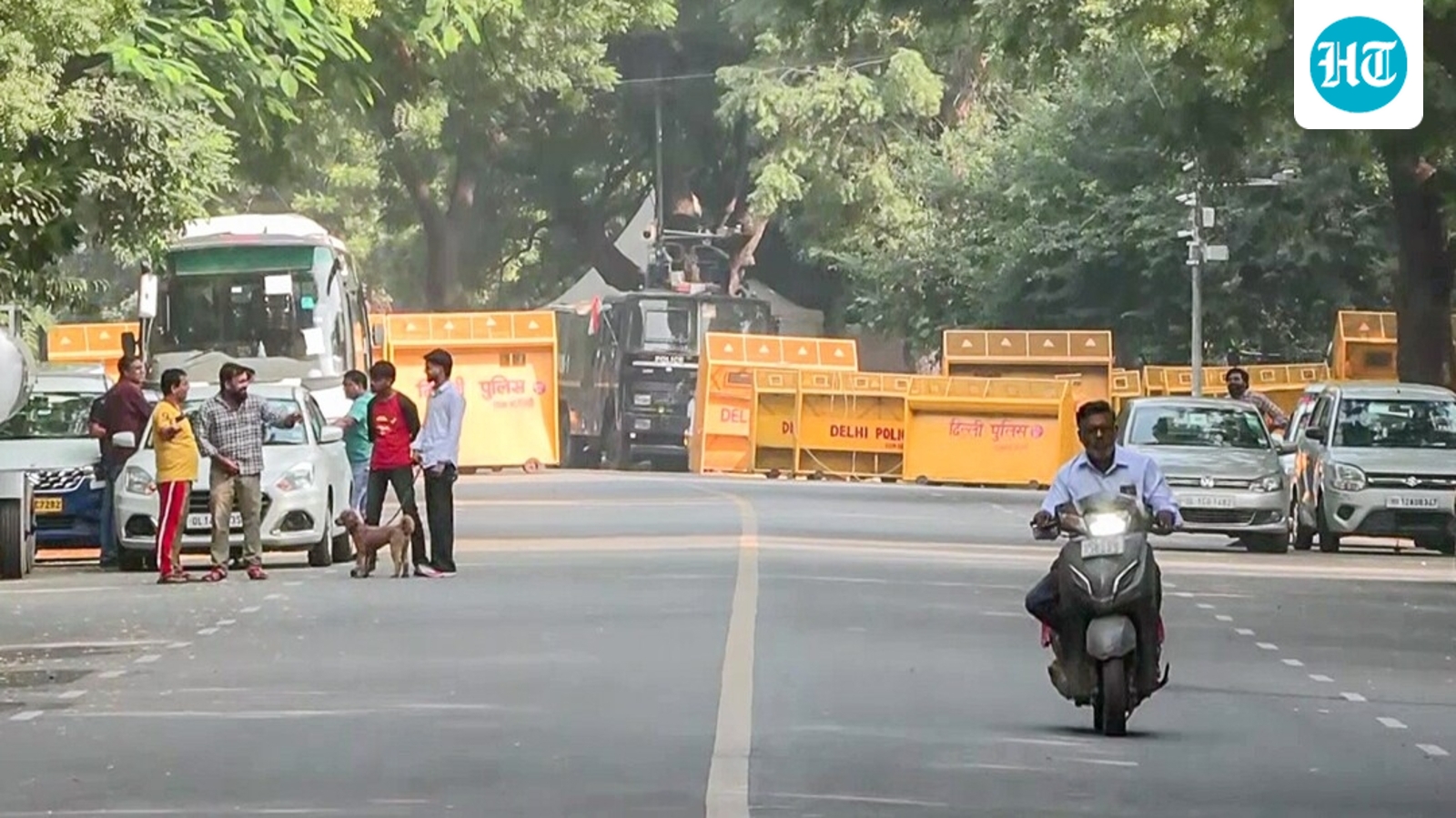
The Supreme Court on Friday asked organisers of the October 10 protests in Delhi to appear at 2pm. The bench sought to balance the right to peaceful assembly against the disruption of essential services. "You cannot shut down an entire city because you are incapable of handling a peaceful protest."
The Supreme Court on Friday asked the organisers of the proposed October 10 protests in Delhi to appear before it at 2pm, as it sought to balance the right to peaceful assembly against the disruption of essential services for millions of residents amid sweeping security restrictions imposed ahead of the demonstrations.
A bench, comprising Chief Justice of India Surya Kant and justices Joymalya Bagchi and V Mohana, hearing concerns over the closure of 57 metro stations and other curbs in the national capital, said it needed details of the proposed gathering, including the expected number of participants, to determine whether the protest could be regulated without imposing disproportionate hardship on the public.
"We can injunct them and at the same time, we can injunct the protest. Will it be a fair?" asked the bench, underlining the need to hear both sides before deciding on the competing claims.
Senior advocate Kapil Sibal, appearing for Communist Party of India (Marxist) general secretary Mariam Alexander Baby, told the court that railway stations, metro stations and other public facilities were being shut and hotels had been asked not to accept fresh bookings for October 10. He maintained that the proposed demonstration was peaceful and questioned the need for restrictions of such a scale.
"The whole of Delhi has been shut down," advocate Prashant Bhushan said, while senior advocate Gopal Sankaranarayanan pointed out that the Delhi high court had deferred a related petition until Monday, potentially rendering the relief meaningless.
"You cannot shut down an entire city because you are incapable of handling a peaceful protest," Sankaranarayanan told the bench.
Solicitor general Tushar Mehta, who appears for the Centre and Delhi police in a batch of related matters, defended the measures, saying they were intended to prevent unlawful acts. He argued that an otherwise peaceful gathering could turn unlawful.
Sibal countered that authorities could take appropriate action if the situation turned violent, rather than impose sweeping restrictions in anticipation of possible disorder.
The bench, however, stressed that the right to protest had to be exercised within the framework of applicable laws and permissions. It said citizens could assert their right to protest even if a gathering was not authorised, but would then be liable to face prosecution in accordance with law.
At the same time, the court emphasised that the rights of demonstrators could not be considered in isolation from those of ordinary residents.
"There is a citizenry before us who press for larger rights but the group that wants to protest is not before us," observed the bench, explaining why it wanted the organisers to provide concrete details of the planned gathering.
The court said it needed to know how many people were expected, the proposed duration of the demonstration and the conditions under which it would be held before deciding how the state could regulate it.
It also indicated that the Delhi high court could be asked to take up the pending petition on Friday afternoon instead of Monday. The bench noted that postponing the hearing until Monday could make the challenge partly infructuous, given that the protest was scheduled for Saturday.
The immediate dispute originates from the proposed demonstration at Jantar Mantar by the Cockroach Janta Party (CJP) and student organisations, which have called for the resignation of chief election commissioner Gyanesh Kumar over alleged irregularities in the revision of electoral rolls. The Election Commission and the BJP have denied allegations of wrongdoing. Opposition parties and student groups have also held demonstrations over the issue in recent days.
The Delhi Police has asked the Delhi Metro Rail Corporation to consider closing entry and exit gates at 57 stations from 9pm on Friday and reducing train frequency at the affected stations, citing concerns about crowd movement towards sensitive locations. The proposed restrictions are to remain in place until the situation normalises.
Separately, the Indian Youth Congress (IYC) has challenged the police's refusal to permit its proposed demonstration against Kumar. The organisation had sought permission for a peaceful gathering of around 100-150 people at Jantar Mantar, undertaking to comply with conditions relating to security, traffic management and public order. The police rejected the request on October 1.
The Delhi high court on Friday declined to hear the IYC petition urgently and listed it for Monday, prompting lawyers to seek the Supreme Court's intervention.
The bench made clear that it was not questioning the fundamental right to protest but was seeking a workable balance between that right and the interests of the much larger population affected by restrictions on transport and other public services. Sibal agreed to return at 2pm with further details.