
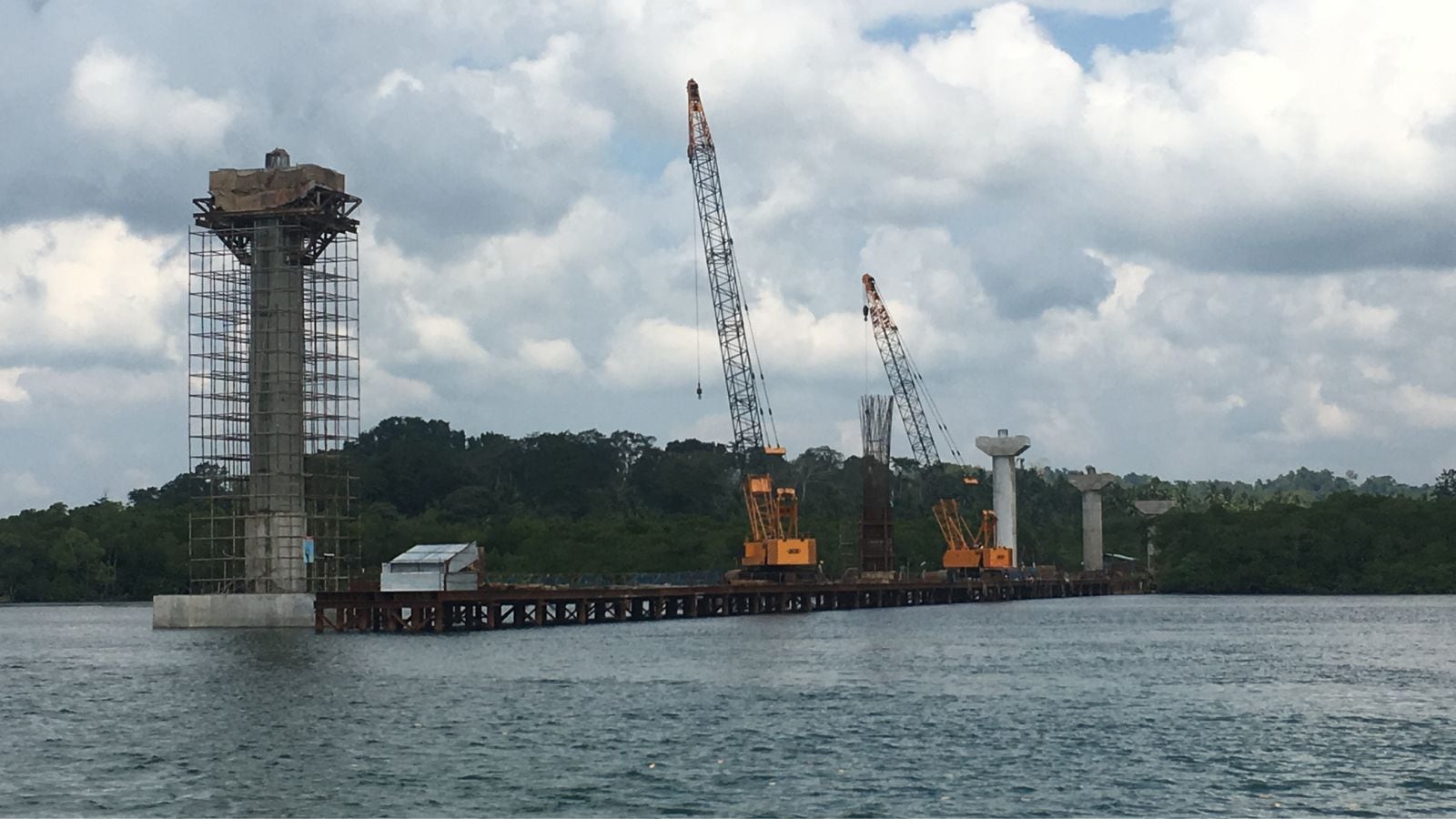
The Supreme Court Monday refused to intervene in a Calcutta High Court order allowing pleas against the Great Nicobar Project. The bench said the matter is pending before the high court for hearings on November 25 and 26. Justice Bagchi noted that the preservation of culture is a fundamental right.
The Supreme Court Monday refused to intervene in a Calcutta High Court order, that allowed PILs challenging alleged Forest Rights Act violations in the Great Nicobar Project to proceed, saying the matter was already pending before the high court.
A bench comprising Chief Justice of India Surya Kant and Justices Joymalya Bagchi and V Mohana also pointed out that the main case is pending for final arguments and is listed for hearing on November 25 and 26.
The Centre argued that the project was "of great national importance" and the maintainability of such Public Interest Litigations "goes to the root of the matter."
"If I am able to place something more regarding maintainability, please allow us to place that submission... Do not close the door on maintainability because something very important turns on that," Attorney General of India R Venkataramani, appearing for the Centre, submitted before the court.
Explained | As NGT clears Great Nicobar project, a look at its strategic importance and ecological fallout
Justice Bagchi observed that the high court had already ruled on maintainability and that the question now was on "how far public interest survives," which would be considered there.
"Do they become integrated completely with the mainstream, or do we keep them with their unique identity and the identity of their culture? Preservation of culture is a constitutionally protected fundamental right," Justice Bagchi said, referring to the project's impact on indigenous communities.
"Let the high court take necessary steps to complete pleadings in the other matters and make an endeavour to hear the cases on the date fixed," the bench noted.
What Calcutta High Court said
The Centre had approached the top court challenging the Calcutta High Court's May 6 judgement, which rejected its objection to PILs filed by retired IAS officer Meena Gupta.
Gupta's petitions challenge decisions linked to the Great Nicobar Project, including alleged violations of the Forest Rights Act in obtaining consent from tribal communities and notifications reducing eco-sensitive buffer zones around Galathea and Campbell Bay National Parks.
The Centre had argued that Gupta, a resident of Hyderabad, lacked legal standing and that a project involving a proposed port, airport, power plant, and defence infrastructure could not be challenged through a PIL.
Rejecting the objection, the Calcutta High Court held, "There is no thumb rule regarding the aspect of locus standi... It would not be expedient to lay down any general rule which would govern all cases under all circumstances."
The high court also said that merely because a project involves substantial public expenditure, it is not insulated from judicial review, observing that "a project involving huge expenditure must proceed in accordance with governing laws holding the field."
What is the Great Nicobar Project
The Great Nicobar Project is a proposed large-scale development programme that involves building a major transhipment port, airport, power plant, and other infrastructure, along with associated roads and development, at an estimated cost of around Rs 72,000 crore.
Explained | Forest Rights and the Great Nicobar Mega-Project: The case before the Calcutta High Court
The project has faced criticism over its potential impact on tribal communities and their rights; alleged violations of the Forest Rights Act and environmental clearance norms; changes to protections around ecologically sensitive areas such as Galathea Bay and Campbell Bay; and the large-scale diversion of forest land and its impact on wildlife and biodiversity.
The Centre's position is that the project is of major strategic and national importance, including because of Great Nicobar's location near major international shipping routes.