
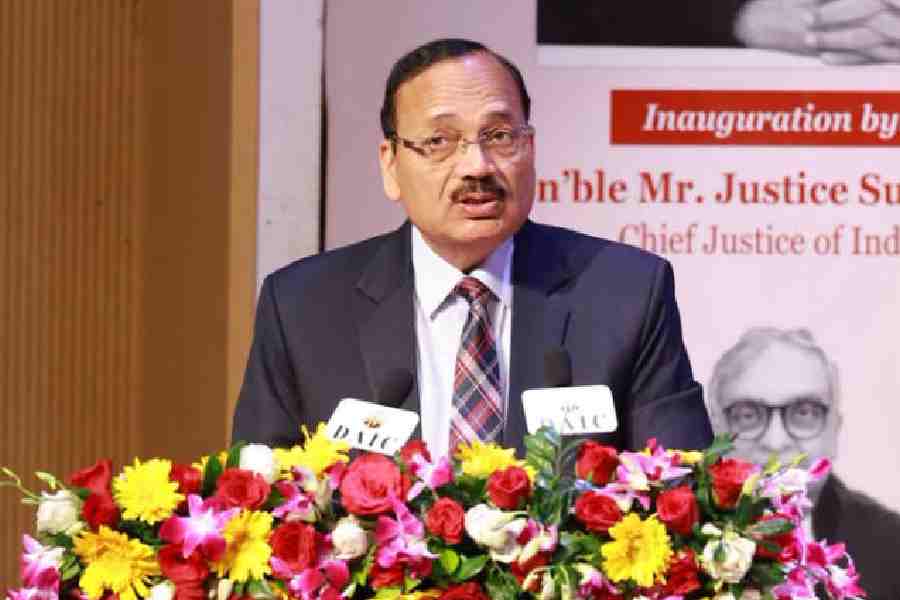
CJI Surya Kant told Opposition leaders on October 11 that the Supreme Court lacks administrative powers to address their memorandum. He said, “The Supreme Court of India is not endowed with any administrative powers to deal with the issues.” He advised them to file a formal petition for judicial review instead.
The Supreme Court of India does not have “any administrative powers to deal with the issues addressed in your letter,” Chief Justice of India Surya Kant wrote to the leaders of Opposition in Parliament who had asked for a meeting.
Instead, CJI Kant advised the Opposition to invoke the judicial powers of the Supreme Court rather than the administrative side and file a petition instead of submitting a memorandum.
The CJI wrote that the issues raised by Mallikarjun Kharge and Rahul Gandhi – leaders of Opposition in the Rajya Sabha and Lok Sabha respectively – were outside the remit of the Supreme Court.
“I also wish to remind you that within our constitutional framework, the Supreme Court of India is not endowed with any administrative powers to deal with the issues addressed in your letter,” the CJI wrote.
“However, in the exercise of our jurisdiction under Article 32 of our Constitution, along with other plenary powers, including that of judicial review, we are duty-bound to consider on judicial side the gravamen of issues affecting the citizens of India,” the CJI wrote.
He wrote that the apex court was committed to preserve and protect the fundamental rights of every citizen of India.
The CJI’s letter dated October 11 was released by the Congress on social media minutes before the INDIA bloc leaders were to assemble at Barakhamba Road in New Delhi for a march to the Supreme Court, around 1.8 km away, and submit a memorandum to the CJI.
In their letter sent on October 10, Rahul and Kharge wanted a discussion with the CJI on the Chief Election Commissioner/Election Commission of India; arbitrary arrest of several students; closure of metro stations and cancellation of trains among other issues.
The arrests, closure of Metro stations in the national capital of Delhi and cancellation of Delhi-bound trains were measures taken by the central government to foil the protests held on October 10.
In a video message on Sunday, Rahul had announced that INDIA bloc leaders would march to the Supreme Court and submit a memorandum to the Chief Justice of India on behalf of the nation, demanding an “end to vote theft, halting of the SIR and the resignation of Gyanesh Kumar, the chief election commissioner”.
Referring to the four main issues mentioned in the letter sent to the CJI by the two top opposition leaders, CJI Surya Kant wrote: “The issues referred to are already sub judice before the Supreme Court of India. Therefore, convening a meeting to discuss pending cases would wholly contravene the principle of Separation of Powers, an intrinsic facet of the basic structure doctrine of the Constitution of India and would be incompatible with the established ethics and judicial propriety.”
The CJI has assured that any petition filed would be heard at the earliest opportunity.
After Kant’s reply, Rahul has said the march to the Supreme Court would be to submit a petition as suggested by the CJI.