
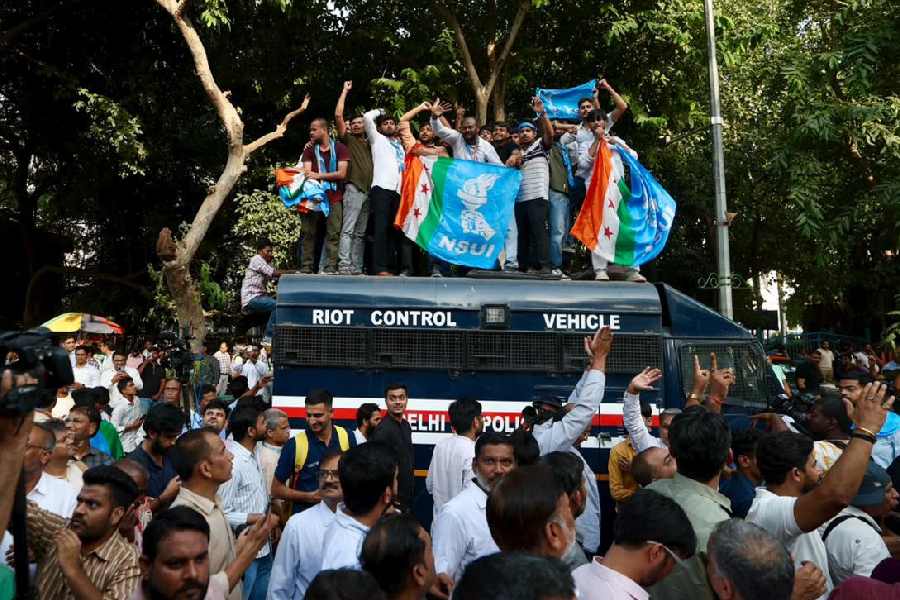
The Supreme Court on Sunday directed the Centre to restore internet and Metro services in Delhi after mass detentions during protests. The court ordered the removal of barricades and lifted Section 163. It remains to be seen if the government follows these directives to protect the democratic right to dissent.
One of the peculiar features of Indian democracy is that the ruthlessness of the State has, more often than not, been challenged and shamed by the principled position of the Supreme Court. This difference has played out, once again, in the context of the second round of protests at Jantar Mantar by the Cockroach Janta Party and its allies. On Friday, a bench of the highest court — it included the chief justice of India — had directed the Centre to ensure that public transport is not impeded in light of the agitation planned against the chief election commissioner the next day. Yet, the Centre acted with defiance. Metro stations were ordered shut, long-distance trains cancelled, and a clampdown ordered on mobile internet in a specific location of Delhi. An unwarranted security crackdown on the protesters led to mass detentions: four former chief ministers were among the detainees. On Sunday, in a special sitting, the highest court heard petitions concerning the disproportionate response from the State and directed that Metro services should resume, internet services be restored, public movement should be smooth, barricades removed, and illegal detentions scotched. It also lifted Section 163 of the Bharatiya Nagarik Suraksha Sanhita that had been imposed around the Supreme Court’s premises so as not to disrupt access to justice. Each of these steps would, however, be operative according to existing legal stipulations and regulations. Even the United Nations Human Rights office expressed concern about the detainment of students, journalists, and politicians in the capital. This is likely to embarrass New Delhi on the international stage.
It remains to be seen whether the Centre honours the court’s directives not only in terms of the judicial letter but also in the spirit of democracy. This is because despite the constitutional protection for the rights to protest and assemble peacefully, they are not absolute in nature. In fact, the restraints can be dexterously exploited by ruling regimes to undermine these very rights. The larger question pertains to the shrinking scope of dissent in democracy. By baring its talons repeatedly against dissenters — and not just on the issue at hand — this government has reaffirmed its authoritarian impulses. The protests are likely to continue. The responses of the State and the judiciary would be crucial for democracy’s cause.