
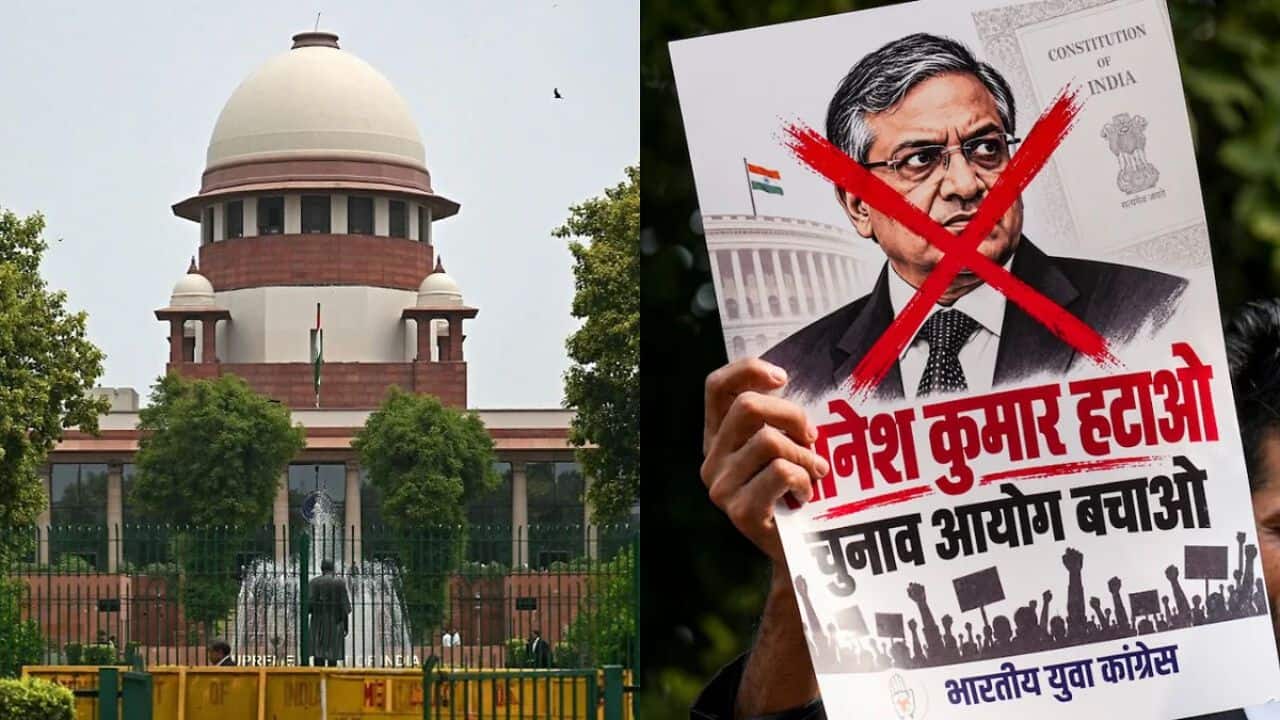
The Supreme Court on October 5 heard a plea against Chief Election Commissioner Gyanesh Kumar. Senior Advocate Vikas Singh questioned if the Election Commission followed legal rules for unanimous decisions. Justice Suryakant said the court needed authenticated information first. The bench did not act immediately on the serious allegations raised.
Why deactivating Aadhaar number of deceased persons is important? Report death of family members on THIS portal
New Delhi: The Supreme Court on Monday (October 5) heard the plea seeking action against Chief Election Commissioner (CEC) Gyanesh Kumar. The hearing raised questions about how the Election Commission (EC) is taking decisions and whether the law is being followed.
So here is everything that stood out from the hearing.
First, Senior Advocate Vikas Singh questioned the way decisions are being taken by the EC. He referred to Section 18 of the Chief Election Commissioner and other Election Commissioners Act.
In simple terms, the law says that the commission should try to take decisions unanimously. If the three members do not agree, the decision is to be taken by a majority.
Singh alleged that this requirement was not followed in some decisions. He also referred to Section 16, which gives the chief election commissioner legal protection for acts done in the discharge of official duties. He argued this gives the chief election commissioner a level of protection that even the Supreme Court judges do not have.
He then asked the court to suspend Kumar or at least take away his authority to function as the CEC.
Justice Joymalya Bagchi asked here, "Who will conduct the elections?"
But the bench was not ready to act on these allegations immediately. Chief Justice of India, Justice Suryakant, said that the court first wanted authenticated information. He pointed out that the petition was relying on a news report and said that the court wanted the respondents to respond first.
The Indian Express had earlier reported that Election Commissioners Sukhbir Singh Sandhu and Vivek Joshi recorded at least 14 objections over 10 months to decisions they said were taken without their knowledge. Their objections were related to changes to Form 6, voter deletions and restorations under SIR, appeals filed against restored voters in West Bengal and the centralisation of electoral-roll software.
Justice Bagchi then said that if the records show that a decision was not taken unanimously or by the required majority, the court could stop that decision from operating and hold it legally invalid.
There was then another important submission on the SIR exercise. Senior Advocate Dr. Menaka Guruswamy asked the court to look at how the special intensive revision was conducted in Delhi. This led to an important exchange over Form 6, which is used to register as a new voter.
The CJI said that no modified Form 6, which asks new voter applicants whether their name or that of their parent/grandparent appeared in an earlier electoral roll, had been approved by the Supreme Court after the EC claimed last week that the new declaration added to the form for the ongoing special intensive revision had been approved by the apex court.
"Let's be very clear. Any modified Form 6 has not been approved by us. When the record is produced, we would like to see who has modified it," he said.
Dismissing the allegations that CEC Kumar "illegally and unilaterally" changed the Form 6 and termed the accusations "misleading, the Election Commission in a press statement issued on September 26 asserted that the additional declaration added to Form 6 was "valid" and had been "approved/upheld by the apex court".
The Chief Justice of India said that the court would want to see who had modified the form. The new declaration asks applicants whether they or their parents were mapped in the previous special intensive revision process, a detail not sought in the earlier version of Form 6.
She also questioned the functioning of the next election cycle and alleged that the chief election commissioner's functioning was biased.
CJI Suryakant said that Dr Guruswamy's prayers appeared to be jumbled up. But the senior counsel maintained that she stood by all her prayers. She argued that an unconstitutional law was being used to protect an "illegal action".
The court then issued notice to the respondents that includes the Union of India, the Election Commission of India and the election commissioners, including Gyanesh Kumar. The bench has also said that if the statutory requirements were not followed, it can examine and act against the decisions in question.
The Supreme Court's next move on these serious allegations surrounding the Election Commission of India's integrity will be worth watching.
Stay informed on all the latest news, real-time breaking news updates, and follow all the important headlines in india news and world news on Zee News.