
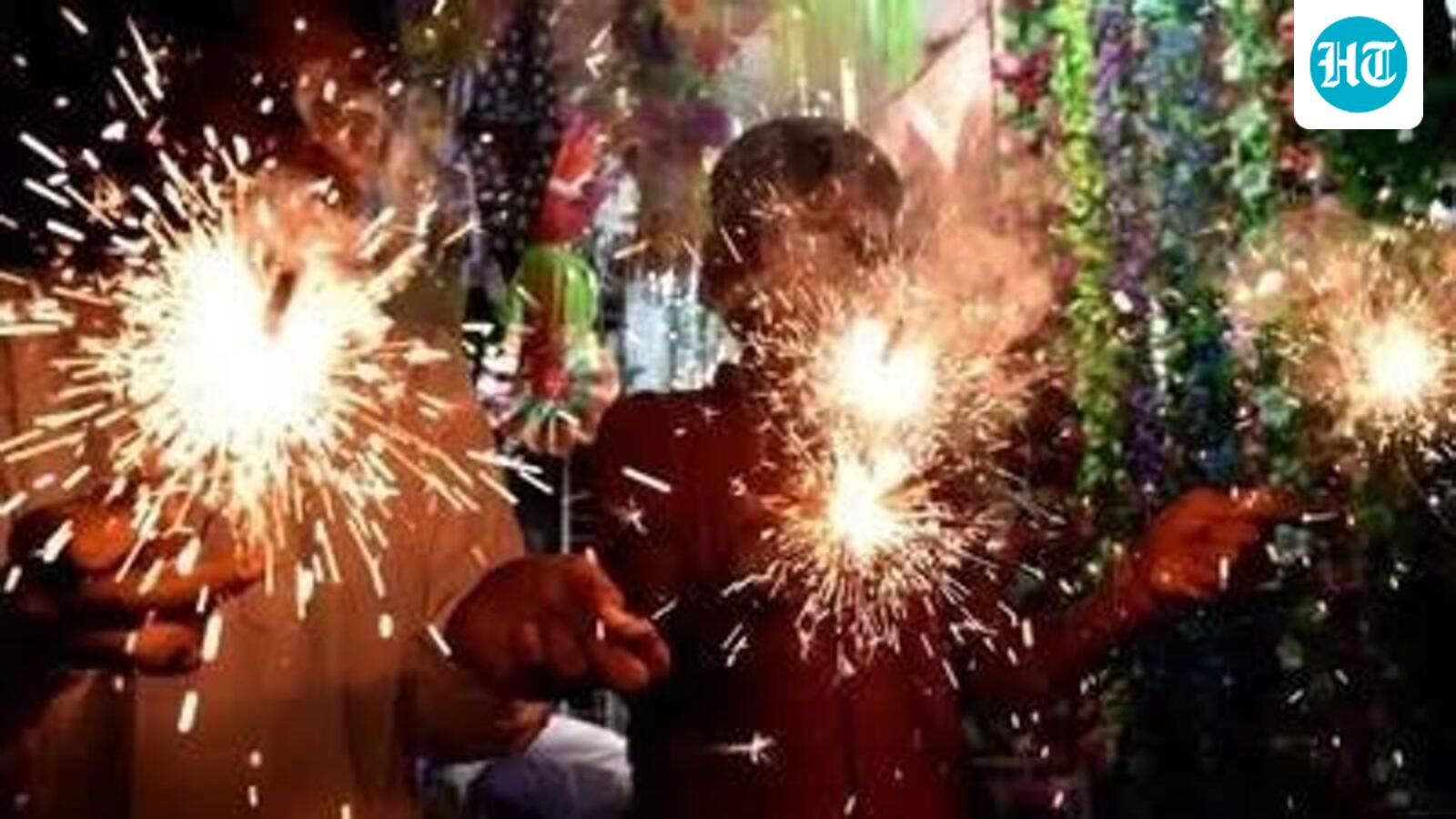
The Supreme Court permitted next-gen joint green crackers while giving the Centre until October 15 to assess barium variants. Justices MM Sundresh and PB Varale said, “We will neither allow a total ban nor will we allow 24 hours bursting of crackers everywhere.” The court seeks balance regarding environmental concerns.
A bench of justices MM Sundresh and PB Varale said the court would neither permit a blanket ban on firecrackers nor allow their unrestricted use for 24 hours, stressing the need to strike a balance between environmental concerns and public sentiment.
“We will neither allow a total ban nor will we allow 24 hours bursting of crackers everywhere. A total ban will hurt certain sentiments and allowing 24 hours will have a huge impact on people, including old people, sick persons and children,” it observed.
The court’s order came on a petition filed in 2015 by three minors, including Arjun Gopal, seeking a complete ban on firecrackers across the country on account of their impact on air quality and the consequent health risks, particularly for children and senior citizens.
The bench accepted the Centre’s position, based on consultations with experts from the Council of Scientific and Industrial Research-National Environmental Engineering Research Institute (CSIR-NEERI), Petroleum and Explosives Safety Organisation (PESO) and Central Pollution Control Board (CPCB), that specified next-generation joint crackers, or “laris”, could be permitted subject to prescribed safeguards.
The experts, however, have prescribed conditions for manufacturers relating to the “shell number, shell size, and time between burst”, which will have to be adhered to for such crackers to qualify for use.
The court’s permission for the next-generation joint crackers comes after it had, earlier this month, asked the Centre to examine whether a limited exemption from the existing restrictions could be worked out ahead of the festive season.
The more contentious issue of barium-containing green crackers, however, remains open.
Bhati told the court that open-ground tests were required to assess the actual impact of barium content on ambient air quality. The Centre and the expert bodies have now been given time till October 15 to complete the assessment.
The issue assumes significance as the Supreme Court had in 2018 imposed a blanket ban on crackers containing barium and barium salts after scientific studies by CSIR-NEERI indicated that their ignition released pollutants harmful to respiratory health.
On September 2, the court had allowed the Centre three weeks to specify the conditions under which new-generation green crackers could be permitted, observing that courts should give due credence to expert opinion in environmental matters.
“We may have a particular view that crackers are bad. But we need to have a balanced approach,” the bench had said, adding that courts should be “extremely slow” in substituting their own views for those of experts on environmental issues.
The Centre had then informed the court that controlled laboratory tests conducted by NEERI on new-generation green crackers containing barium showed a 45% to 60% reduction in PM10 emissions. It had, however, proposed open-ground tests at four locations -- Delhi, Bhopal, Kolkata and Chennai -- to assess their impact under actual conditions.
The court’s latest order follows the Centre’s consultations with the expert bodies on the formulation and use of green crackers. The expert assessment on joint crackers has now resulted in the court permitting their specified next-generation variants, while the barium issue has been kept pending for further scientific evaluation.
The court also made clear that permitting specified crackers would not translate into unrestricted bursting. “We will neither allow a total ban nor will we allow 24 hours bursting of crackers everywhere,” observed the bench, indicating that the final regulatory framework would have to specify both the category of crackers permitted and the duration for which they could be burst.
Firecracker manufacturers and retailers, represented through senior counsel K Parameshwar and Pranav Sachdeva, among others, had approached the court citing urgency, pointing out that formulations approved by the Centre would need to be manufactured, distributed and sold ahead of Dussehra and Diwali.
The pan-India proceedings also intersect with a separate case concerning restrictions on firecrackers in Delhi-NCR pending before a bench headed by Chief Justice of India Surya Kant. The court noted that the issues in the two proceedings overlap and permitted the parties to approach the CJI for their possible hearing together.
Last October, a bench, led by then CJI BR Gavai, had partially modified its ban-on-crackers order of April 3, 2025, in Delhi-NCR by permitting the sale and bursting of crackers between October 18 and 20, coinciding with Diwali, under specified timings. Referring to its 2018 judgment in the Arjun Gopal case, which first introduced the concept of green firecrackers, this bench held that the complete ban had to be revoked for balancing the “sentiments of individuals during the festive season, livelihood concerns of the industry, and the right to clean air.”