
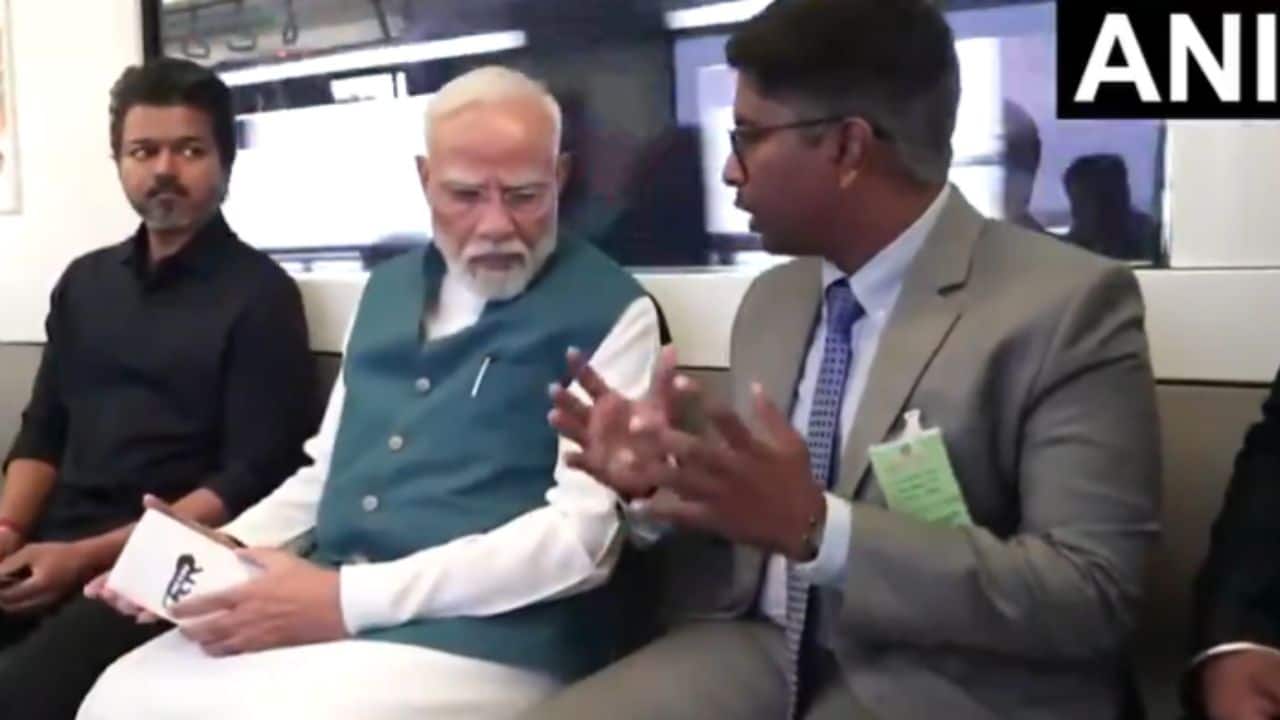
Prime Minister Narendra Modi inaugurated the Poonamallee-Vadapalani stretch of the Chennai Metro on Sunday. He travelled on the train with Chief Minister C Joseph Vijay. Modi also launched various infrastructure projects worth thousands of crores, including highways, railways, and port facilities, to improve connectivity and boost industrial growth across Tamil Nadu.
Market Mastery
Webinar by Vishal Malkan
Find the weak links
in your portfolio by Vishal Malkan
Prime Minister Narendra Modi on Sunday inaugurated the Poonamallee-Vadapalani stretch of Phase II of the Chennai Metro Rail Project, developed at an investment of around Rs 4,900 crore. He also travelled on the Metro between Porur Bypass and Poonamallee Bypass stations and back, accompanied by Tamil Nadu Chief Minister C Joseph Vijay.
During his visit to the state, the Prime Minister is scheduled to inaugurate and lay the foundation stone for a series of infrastructure projects spanning highways, railways, ports and energy, with the aim of improving connectivity and expanding industrial capacity.
The road infrastructure projects are valued at around Rs 3,700 crore. These include the inauguration of the 36-km, four-laned Vadugapatti-Therkuvenganallur section of NH-744 and the 30-km, four-laned Madurai Ring Road section of NH-744A.
The Vadugapatti-Therkuvenganallur stretch is expected to improve access to pilgrimage destinations, industrial hubs and commercial centres, while the Madurai Ring Road project is intended to ease traffic congestion within the city and improve the movement of vehicles around it.
Modi will also lay the foundation stone for a four-lane bypass at Thiruvarur on the Nagapattinam-Thanjavur section of NH-83. The bypass is expected to provide an alternative route for traffic passing through the town and strengthen regional road connectivity.
Railway infrastructure projects worth more than Rs 750 crore will also be dedicated to the nation. These include the Karaikal-Peralam railway line and three rail flyovers in Coimbatore and nearby areas. The flyovers are expected to reduce delays at busy level crossings, improve road safety and ease congestion.
Five railway stations, Palani, Vellore Cantonment, Ambasamudram, Paramakkudi and Namakkal, will also be inaugurated following their redevelopment under the Amrit Bharat Station Scheme.
The Prime Minister's programme also includes several projects aimed at upgrading Tamil Nadu's maritime infrastructure and improving cargo handling and logistics at major ports.
At Chennai Port, four facilities will be inaugurated: a paved storage yard, four export-import godowns, an upgraded cruise terminal and a Seafarers Club. The projects are intended to increase cargo storage and warehouse capacity, modernise cruise passenger facilities and provide improved welfare and recreational amenities for seafarers and maritime personnel.
At VO Chidambaranar Port, Modi will inaugurate and lay the foundation stones for eight major development projects. These initiatives are aimed at expanding cargo and container-handling capacity, supporting the transition to cleaner maritime energy and improving cargo evacuation and logistics within the port.
He will also inaugurate the Coal Berth-3 project at Kamarajar Port and lay the foundation stone for capital dredging works for Container Terminal Phase-I, Stage-II.
In the energy sector, the Prime Minister will lay the foundation stone for a Group II/III Lube Oil Base Stocks (LOBS) project at the existing Manali Refinery of Chennai Petroleum Corporation Limited in Chennai. The project involves an investment of around Rs 1,620 crore and will have a production capacity of 270 thousand metric tonnes per annum.
The facility is intended to manufacture Group II and Group III lube oil base stocks, which are used in the production of premium-quality lubricants in India.
Modi will also dedicate the Sudha Gopalakrishnan Brain Centre (SGBC) at IIT Madras to the nation. The centre will launch a global scientific initiative to map more than 100 human brains into three-dimensional atlases at cellular resolution, covering different stages of life, from the foetal stage to old age.
Another research initiative to be launched is C-STROKE, described as a human ischaemic stroke atlas featuring more than 1,000 annotated microscopic sections from a stroke-affected brain. The resource is expected to help researchers around the world identify new therapeutic targets.
The Prime Minister will conclude his programme in Chennai by participating in the golden jubilee celebrations of Jaigopal Garodia Hindu Vidyalaya Matriculation Higher Secondary School. The occasion marks 50 years of the institution's contribution to education, with an emphasis on academic achievement, discipline, cultural values and holistic development.
The school follows the motto “Sa Vidya Ya Vimuktaye”, meaning “Knowledge that liberates”, reflecting its stated aim of preparing students to contribute meaningfully to society.