
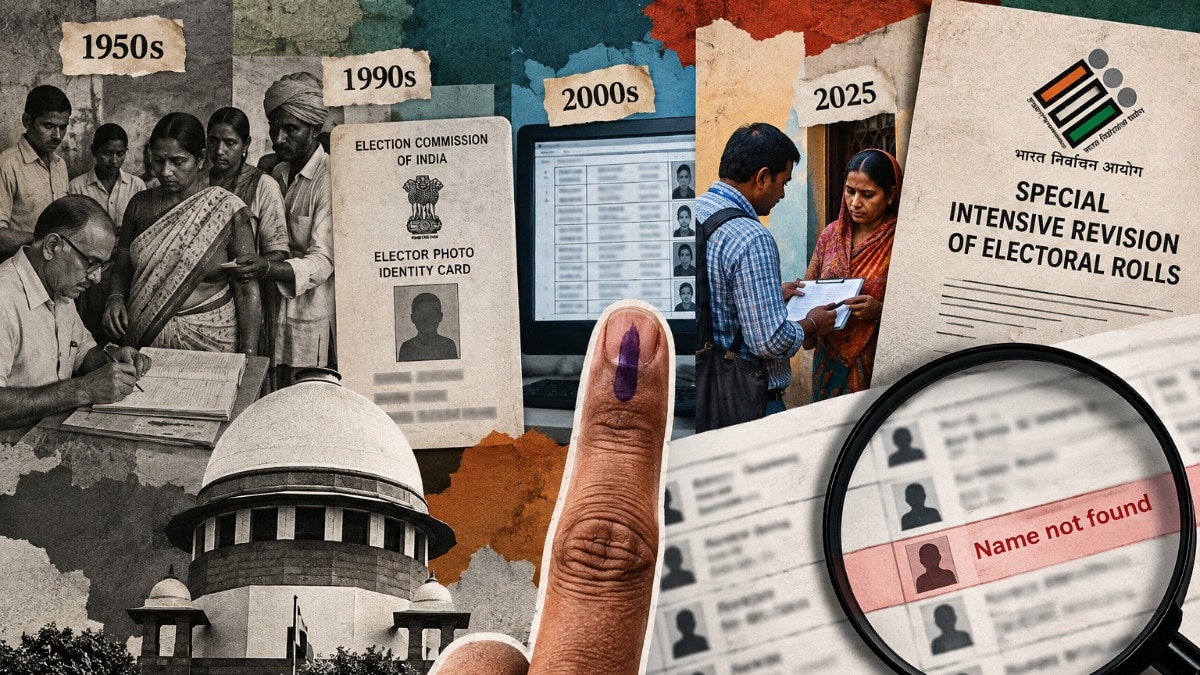
The Special Intensive Revision of electoral rolls started on September 25, sparking a bitter fight between the Opposition and the Election Commission. Congress workers protested across many states, demanding the resignation of Gyanesh Kumar. The process showed how India’s electoral records evolved from paper-based lists to modern, computerised verification systems.
A name on an electoral roll is easy to overlook -- until it disappears.
The Special Intensive Revision (SIR) of electoral rolls has fuelled an increasingly bitter confrontation between the Opposition and the Election Commission. Since September 25, Congress workers have protested across several states, demanding Chief Election Commissioner Gyanesh Kumar's resignation over the exercise.
The Opposition claims that genuine voters are being disenfranchised, a charge the Election Commission has rejected.
For me, the argument became personal.
During West Bengal's SIR, my name was flagged under "logical discrepancy". My father's name was missing from the 2002 electoral roll after he moved from one Assembly constituency to another.
Since I was working in Delhi, I sent the required documents home. My father then video-called me with the Booth Level Officer (BLO) beside him. I showed my documents, answered questions and established my identity. My name was eventually included in the roll of Rajarhat-Gopalpur Assembly Constituency.
A BLO, a set of documents and a video call helped resolve the issue. But how did a decades-old electoral record become part of a modern verification exercise?
India's electoral rolls have been revised repeatedly since the first general election. The process has evolved from paper-based enumeration to computerised records and checks against historical rolls. The latest SIR brings that evolution into focus.
1950s-60s: BUILDING THE LIST, THEN REBUILDING IT
For the 1951-52 general election, officials enrolled around 17.32 crore electors, excluding Jammu and Kashmir. According to the Election Commission of India's Leap of Faith: Journey of Indian Elections, Volume II, without computerised databases or photographic voter IDs, they relied on paper records and physical enumeration.
The exercise exposed gaps in identification and inclusion. Some women were registered as someone's wife or daughter rather than by their own names. Missing entries and inaccurate details made maintaining the rolls a continuing challenge.
To address these shortcomings, the Commission adopted a phased approach to intensive revision.
In its Election Law Reports, Vol. X, ECI stated that one-fifth of each state's area would undergo detailed, house-to-house verification annually over five years, ensuring that every part of the state received intensive revision at least once before the next general elections.
An intensive revision involved preparing the roll afresh through house-to-house enumeration. Officials recorded the details of eligible residents, compiled a draft roll and invited claims and objections before publishing the final list.
A summary revision, by contrast, updated an existing roll without fresh house-to-house enumeration. These established procedures offered two ways to address different problems: rebuilding a list or correcting it.
1980s-90s: FROM ENUMERATION TO IDENTIFICATION
By the 1980s, electoral-roll revision was becoming as much a question of accuracy as one of coverage. Concerns over foreign nationals, duplicate entries and the identification of eligible voters have sharpened scrutiny of electoral rolls, particularly in parts of the Northeast.
The Election Commission undertook intensive revisions in rural constituencies in 1983 and urban constituencies in 1984, followed by another round across constituencies in 1987-88 and a special revision in 1989. In its Manual on Electoral Rolls, the ECI said that these exercises relied on systematic verification and fresh enumeration to improve the accuracy of existing lists.
The next shift was towards making voters easier to identify. The Election Commission launched its nationwide Electors Photo Identity Card (EPIC) programme in 1994, followed by a major push to computerise electoral rolls in August 1997.
As per ECI's Leap of Faith, the change was significant: electoral rolls could now be managed as searchable databases rather than merely printed lists. Entries could be standardised, updated and shared more efficiently, while EPIC helped establish a visual link between a voter and their identity.
The two systems were also integrated, allowing electors to retain their identity card when moving between constituencies.
Yet digitisation was not the same as verification. A photograph could help establish who a person was, and a database could make an entry easier to locate, but neither automatically established whether the person was registered in the correct constituency or whether their details matched older records.
The challenge was shifting from maintaining a list of names to keeping those names accurate as people moved, aged and changed their circumstances.
2002-04: OLD ROLLS BECOME A REFERENCE POINT
The early 2000s brought another round of intensive revisions, with exercises conducted in different states in 2002 and 2003.
The distinction between intensive and summary revision remained important. Intensive revision involved preparing electoral rolls afresh through enumeration, while summary revision focused on updating an existing list through additions, deletions and corrections.
Sourced from the Press Information Bureau, in 2004, the Election Commission ordered intensive revision in several northeastern states and Jammu and Kashmir, while special summary revision was scheduled for most other states and Union territories. The exercises were therefore not a single nationwide revision of the same kind.
These revisions would acquire a new significance years later. When the Election Commission launched Bihar's SIR in 2025, it designated the state's 2003 electoral roll as a reference for establishing eligibility.
West Bengal's 2002 roll similarly became relevant during its SIR. The exercise thus brought historical records into a present-day verification process: an elector's details could be checked not only against the current roll but also against an earlier one.
That approach created a practical challenge for people whose families had moved between constituencies or whose details had changed over time.
In my case, my father's name was absent from the 2002 roll after he moved constituencies, triggering a discrepancy during my own SIR verification two decades later.
The broader shift was clear: older electoral rolls were no longer simply records of past elections.
Under the latest SIR, they became reference points against which present-day entries could be examined. That made the quality and accessibility of historical records consequential for voters decades after those records were first compiled.
2025-26: MATCHING VOTERS AGAINST THE PAST
West Bengal's SIR retained a familiar feature of intensive revision: house-to-house enumeration by BLOs. Under the state's instructions, officials distributed pre-filled enumeration forms in duplicate. Voters whose names appeared in the previous intensive roll - from 2002 in West Bengal or the relevant earlier year in other states - were asked to provide their details on the form and return it.
The process then moved beyond collecting information. Officials sought to establish links between current electors and historical rolls. Voters who could not be mapped to the earlier records, or whose details triggered "logical discrepancies", entered a further verification process. Such discrepancies could include mismatches in a father's name or inconsistencies in family details.
The Election Commission's procedure required cases to be examined rather than treating every mismatch as automatic proof of ineligibility. Notices and opportunities to submit supporting documents formed part of the adjudication process.
That was a key difference in practice from the basic task of compiling an electoral roll: historical matching could determine which voters needed to provide further evidence. The use of old records was not entirely new to electoral administration, but the current exercise made that linkage central to verification.
The process also required additional safeguards. In January 2026, the Supreme Court directed that people flagged for logical discrepancies be allowed to submit documents or objections through authorised representatives and at designated local offices.
Claims in the unmapped and logical-discrepancy categories were subsequently subject to adjudication, with appeals also becoming part of the West Bengal process.
The scale of the exercise intensified the controversy. In West Bengal, 60.06 lakh electors were referred for adjudication over logical discrepancies. Following adjudication, 27.16 lakh were declared ineligible and excluded from the final rolls.
The central question is therefore not simply whether technology can identify inconsistencies. It is what happens next: how a case is examined, what evidence is accepted and whether a voter has a meaningful opportunity to challenge an adverse decision.
THE PROCESS BEHIND THE NAME
Over seven decades, India has moved from paper-based enumeration to photographic identity cards, computerised rolls and checks against historical records. The underlying task remains familiar: identify eligible voters, correct inaccurate entries and remove those not entitled to be on the list.
What has changed is the complexity of verification. A mismatch can now prompt questions about a record from another constituency or a previous revision. Better databases can identify inconsistencies, but a flagged entry is not, by itself, proof that a voter is ineligible.
My name made it onto the list after I supplied documents and spoke to the BLO. Not everyone will have the same access to paperwork, time or officials.
The evolution of electoral-roll revision is about more than how efficiently the state detects discrepancies. It is also about how fairly it resolves them.
The true test of SIR, in this case, is always to see whether India can correct its electoral rolls without leaving eligible voters behind.