
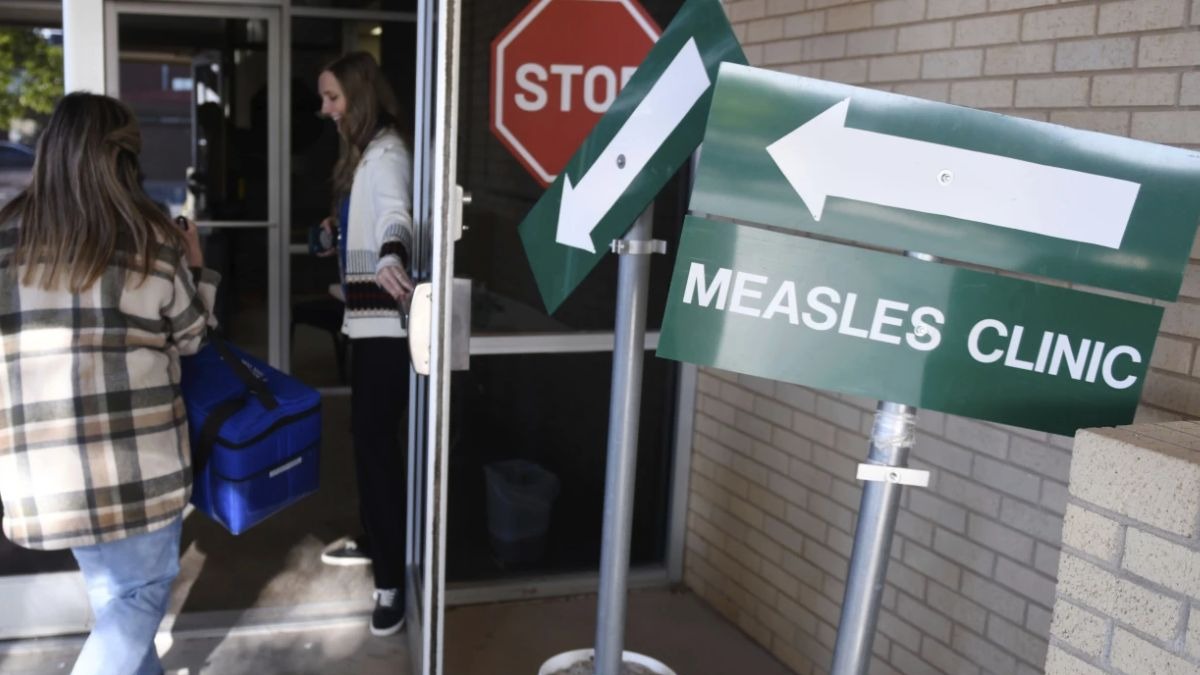
The US is facing its worst measles outbreak in over three decades with nearly 3,900 confirmed cases this year. Globally, 11 million people contracted measles in 2024. Dr Sandeep Reddy said, "Measles is like the early warning alarm of our immunisation programs." Many children missed doses, causing these dangerous outbreaks.
The US is facing its worst measles outbreak in more than three decades, with nearly 3,900 confirmed cases reported this year, while a massive outbreak in Pennsylvania alone has crossed 1,000 cases and caused five deaths.
New York has also declared a statewide disaster emergency after cases surged in under-immunised rural communities.
The US outbreak of the disease, a highly contagious, serious airborne viral disease caused by the morbillivirus, is not an isolated problem. Across regions, measles is exploiting the same vulnerability: children who missed one or both vaccine doses during years of disrupted healthcare, weak routine immunisation, access barriers and, increasingly, vaccine hesitancy.
In Bangladesh, the warning has been particularly stark. Media reports suggest that so far this year, the country has recorded 1,134 suspected or confirmed measles deaths while there have been over 1.75 lakh hospitalisations due to the condition since March.
Nearly four in five reported patients were children under five. These alarming figures have prompted a targeted measles-rubella vaccination campaign, but the outbreak continues to rage.
Globally, the World Health Organisation (WHO) estimates that around 11 million people contracted measles in 2024, nearly 800,000 more than in 2019.
Even more concerning, only 84% of children received their first measles-containing vaccine dose and 76% received the second - well short of the roughly 95% two-dose coverage needed in every community to prevent sustained transmission.
"Measles is like the early warning alarm of our immunisation programs," Dr Sandeep Reddy, infectious diseases specialist from Bengaluru told India Today. "It shows the kinks in our coverage before any other disease does."
THE 95 % PROTECTION LINE
Measles is among the most contagious human infections. One infected person can transmit it to as many as 18 others who are susceptible. That means even countries with relatively high national vaccination rates can see outbreaks when unvaccinated children are concentrated in particular communities.
WHO and UNICEF say 95% coverage with two doses is needed to maintain community protection.
That is exactly what is happening in several parts of the world.
Europe and Central Asia recorded nearly 34,000 measles cases in 2025, down sharply from more than 127,000 in 2024 after outbreak-response vaccination campaigns.
But WHO and UNICEF warned that the decline does not mean the problem has gone away. Nineteen countries in the region had continuing or re-established endemic transmission, up from 12 a year earlier.
The Americas have seen an even sharper reversal. By July 2026, more than 47,000 confirmed measles cases had been reported across the region, the highest number in 22 years. Pan-American Health Organisatio (PAHO) has described the public-health risk as very high, citing declining vaccination, accumulated immunity gaps, population movement and vaccine hesitancy.
The US is now the most visible example.
As of October 1, the CDC had recorded 3,887 confirmed cases in 2026. Pennsylvania has accounted for more than 1,000 of them, making it the state's biggest outbreak in more than 30 years. New York's latest outbreak has been concentrated largely in under-immunised rural communities.
The US also faces a wider debate over vaccine policy.
In June 2025, US Department for Health and Human Services (HHS) removed all 17 members of the Centre for Disease Control and Prevention (CDC)'s Advisory Committee on Immunisation Practices, or ACIP, and replaced them with new members.
The administration said the move was intended to restore public trust. Subsequent legal challenges have questioned the appointments, while a federal court order has stayed the January 2026 revision of the childhood immunisation schedule; the CDC currently lists the July 2025 schedule as the operative one.
For infectious-disease experts, the larger concern is what happens when scientific uncertainty or political controversy becomes mixed with public messaging around vaccines.
INDIA HAS ITS OWN GAPS
Sadly, India is not watching this from a distance. The country has made substantial progress in childhood immunisation, but coverage gaps remain large enough to create pockets where measles can take hold.
The latest National Family Health Survey (NFHS) 6 data show that coverage of the second dose of a measles-containing vaccine improved from 58.6% in NFHS-5 to 71.8%. Full immunisation among children aged 12-23 months also rose to 87.1%. That is significant progress, given the context that the Universal Immunisation Programme (UIP) had taken a hit during the COVID-19 pandemic but the second-dose figure remains below the level required to reliably prevent outbreaks.
Over the last few years, the country has seen several limited measles outbreaks, including in states like Maharashtra, Gujarat and Delhi and more recently in Madhya Pradesh where 31 child deaths in just a few villages were recorded- with measles, along with other factors listed as possible causes.
Dr Reddy points out that national averages can hide these vulnerable pockets.
"In India, the problem is mostly a gap in delivery," he said, noting that missed children tend to cluster among poorer, marginalised and hard-to-reach communities. Pandemic disruption adds to those gaps, while misinformation and vaccine hesitancy can compound them.
Dr Roli Munshi, paediatrician and neonatologist at Yatharth Super Speciality Hospital, Noida, too, said the resurgence is being driven by inadequate vaccination and poor awareness about timely immunisation.
"The disease spreads easily because of which any small number of unvaccinated people can cause an outbreak," she said.
According to experts, the priority should therefore be to find zero-dose and missing children, close the second-dose gap, strengthen surveillance and work with local communities.