
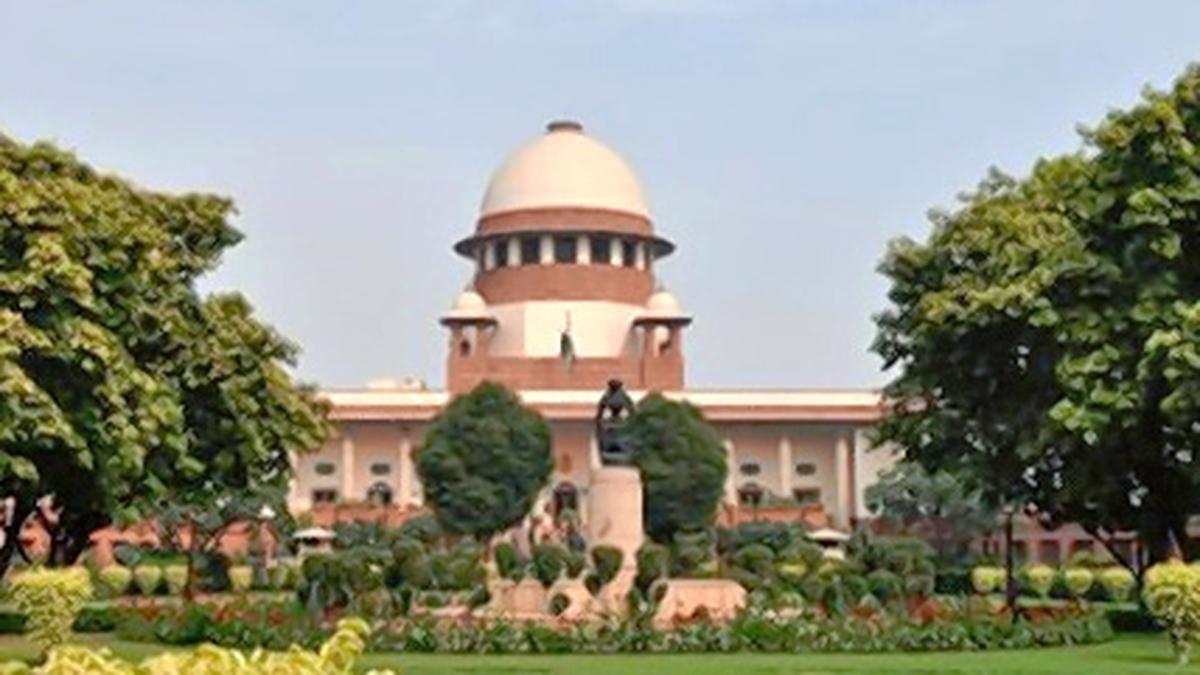
The Supreme Court disposed of a long-pending reference regarding legislative privileges and free speech. The case started after a 2003 Tamil Nadu Assembly resolution sought to arrest editors of The Hindu. The Court kept substantial questions of law open for future proceedings, noting the case raised complex constitutional interpretation issues.
The story so far: The Supreme Court has disposed of a long-pending reference concerning the scope of legislative privileges and their interplay with free speech arising out of a 2003 Tamil Nadu Assembly resolution to arrest editors of The Hindu for an editorial criticising then Chief Minister Jayalalithaa.
However, the Court clarified that all substantial questions of law regarding the precedence between parliamentary privileges and free speech are kept open for determination in appropriate future proceedings.
What was the case about?
The case began with a series of events in 2003. The Hindu published articles reporting on speeches made in the Tamil Nadu State Assembly. The reports led the Speaker to move a resolution accusing the newspaper of “distorted the proceedings of the Assembly, commented contrary to the events in the Assembly”.ma
The resolution said the editorial’s comments “amounts to breach of privilege of the entire House” under Article 194 of the Constitution, which gives State legislators certain privileges and immunities.
The Assembly passed a resolution seeking the arrest of senior editorial staff of The Hindu. Soon after, police raided the newspaper’s Chennai office while attempting to arrest its senior editors. In November 2003, N. Ravi, then Editor of The Hindu, approached the Supreme Court.
Senior advocate Harish Salve, appearing for the newspaper, argued that Article 194(3) could not be used to restrict the freedom of the press protected under Article 19(1)(a). The larger question before the court was whether critical reporting or publication about legislative proceedings could amount to a breach of legislative privilege.
On December 8, 2003, a Bench of Justices Y.K. Sabharwal and B.N. Krishna referred the matter to a five-judge Constitution Bench. The Bench said the case raised “substantial questions of law as to the interpretation of Articles 194(3), 19 and the interplay between these two Articles and Article 21 of the Constitution”.
On December 8, 2004, the five-judge Bench heard Mr. Salve’s submission that two earlier decisions, the 1959 Pandit M.S.M. Sharma v. Shri Sri Krishna Sinha case and the 1964 Presidential Reference, had taken different views on the relationship between free speech and legislative privilege. The matter was then referred to a seven-judge Bench for an authoritative decision.
Salve argued that legislative privilege should protect legislators’ speech inside the House and should not be used against the press as a means of restricting free speech.
The case then remained pending for several years. On October 12, 2023, a seven-judge Bench headed by then Chief Justice D.Y. Chandrachud impleaded the Union government and asked the Attorney General to assist the court. The case was next listed on February 2, 2024, for a procedural matter.
It came up again before Chief Justice Surya Kant on August 12, 2026, after more than two years.
What did the court say?
The Bench comprising Chief Justice Surya Kant, Justice Aravind Kumar, Justice Prashant Kumar Mishra, Justice Joymalya Bagchi, Justice Vipul Pancholi, Justice Shree Chandrashekhar and Justice V Mohana disposed of the matter as infructuous, since the Tamil Nadu Legislative Assembly had withdrawn the 2003 resolution in 2004.
The Court did not decide the larger constitutional questions concerning the scope of legislative privilege and its relationship with Article 19(1)(a). The Court kept these questions of law open for consideration in an appropriate future case.
What is legislative privilege and free speech?
Article 105 provides certain privileges and immunities to Parliament and its members. For State legislatures, Article 194(3) provides that their powers, privileges and immunities may be defined by the legislature through law, and, until so defined, shall be those of that House and of its members and committees immediately before the coming into force of section 26 of the Constitution (Forty-fourth Amendment) Act, 1978. These privileges are intended to ensure that legislatures and their members can function independently and effectively, without undue external interference. They include protection for speech and proceedings within the House, as well as powers necessary to safeguard the authority and functioning of the legislature.
Article 19(1)(a) guarantees citizens the fundamental right to freedom of speech and expression. However, this right is not absolute. Article 19(2) permits the State to impose reasonable restrictions on this freedom on specific grounds, including the security of the State, public order, decency or morality, contempt of court, defamation and incitement to an offence.
The question before the Supreme Court is the extent of these powers in context of the rights guaranteed to citizens outside the House.