
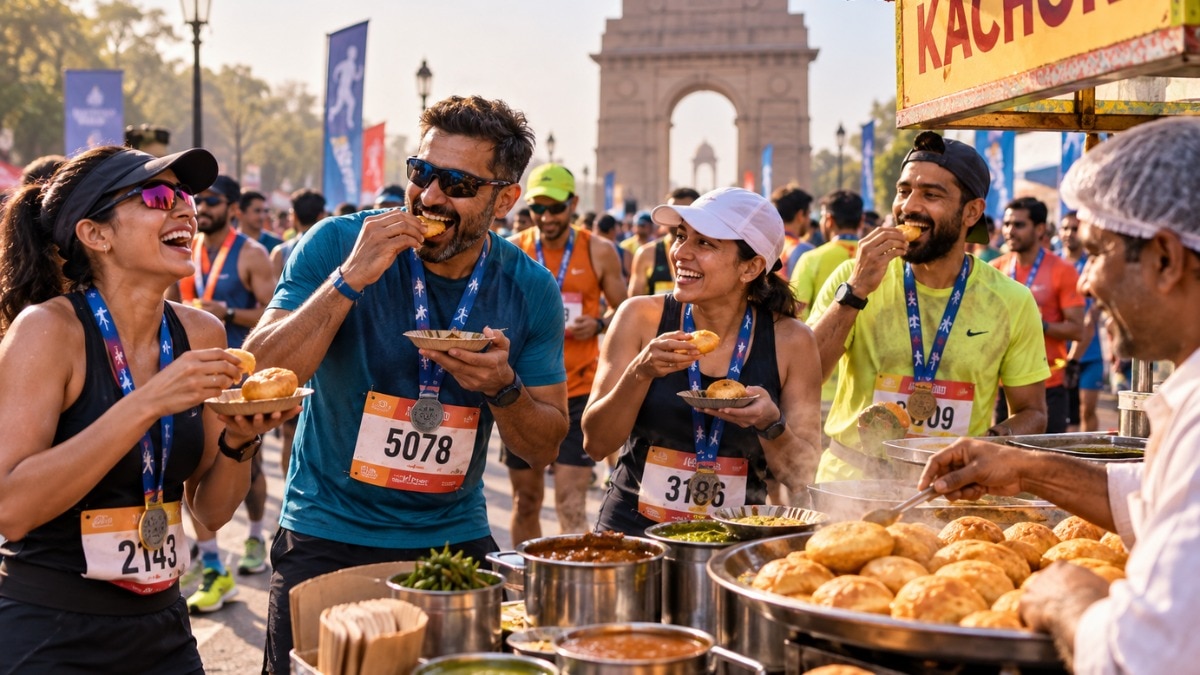
Food-themed runs are becoming a visible part of India's expanding community fitness culture. Instead of focusing on pace, these events combine short runs with local snacks like kachori or ice cream. Naina Kapoor said, "I had always assumed running clubs were for serious runners, who were constantly checking their pace."
A morning jog followed by kachori, tiramisu cake or ice cream may sound contradictory, but food-themed runs are becoming a visible part of India's expanding community fitness culture. Instead of being built around pace, distance or personal bests, these events combine short recreational runs with a food stop or meal at the end, turning exercise into a social outing.
In Bikaner, for instance, runners have taken part in 'kachori' runs, finishing their route with the city's famous snack. Bengaluru has seen 'bakery-hop' runs, wherein participants cover a few kilometres while stopping at bakeries along the route. Hyderabad's running communities have experimented with 'tiramisu' and 'ice-cream' runs while Mumbai has hosted festive 'modak' runs around Ganesh Utsav.
The foods vary with the city and the occasion, but the idea is similar: create an event that attracts people who might not sign up for a conventional running group.
That distinction matters. Traditional running clubs can sometimes appear intimidating to beginners, particularly when conversations revolve around timings, training plans and race distances. Experts say food-centred runs deliberately lower that barrier. They tend to be shorter, slower and more conversational, giving participants time to interact rather than simply complete a workout.
For Naina Kapoor, 29, a brand manager in Bengaluru, joining a food run-based group exercise feel less daunting. "I had always assumed running clubs were for serious runners, who were constantly checking their pace," she says. "Here, people were talking while running, waiting for each other and stopping together. By the end, you knew several people by name. And the food gave everyone something to gather around afterwards."
The trend also reflects a broader change in the way some younger urban Indians approach fitness. Exercise is increasingly being combined with socialising, whether through run clubs, cycling communities, pickleball groups or weekend fitness events. For people whose weekday routines involve long work hours and considerable time in front of screens, a weekend run can serve two purposes at once: physical activity and an opportunity to meet people outside the workplace.
This can be particularly important at a time when loneliness and weak social connections are becoming a concern among younger adults. Group exercise provides repeated, low-pressure contact -- participants may meet the same people every weekend without having to formally arrange a social plan. Adding breakfast or a food stop extends that interaction beyond the run itself.
Rohan Batra, 33, a consultant in Gurugram, says that the social element makes him much more likely to turn up. "If somebody tells me to wake up early on a Sunday only to exercise, I am likely to very easily cancel," he says. "But if four or five people I know are going and there is breakfast afterwards, it feels like meeting friends. The run becomes part of the plan rather than the entire plan."
There are, however, health caveats, caution experts. A kachori or dessert does not automatically become healthy because it follows a run, and exercising should not be viewed as a way of "earning" high-calorie foods. Heavy, oily or sugary food consumed immediately before or during strenuous exercise can also cause bloating, reflux and gastrointestinal discomfort. For serious runners training for endurance events, nutrition around exercise needs to be planned very differently.
But food runs are generally not presented as athletic training. Their appeal lies precisely in removing some of the rules and seriousness that can make fitness regimens difficult to sustain. A short run followed by breakfast may not produce an elite athlete, but if it encourages somebody sedentary to move regularly, meet people and return the following weekend, it serves a significant purpose. The kachori, in that sense, is less a reward for calories burnt and more an encouragement to stay on the fitness course.