
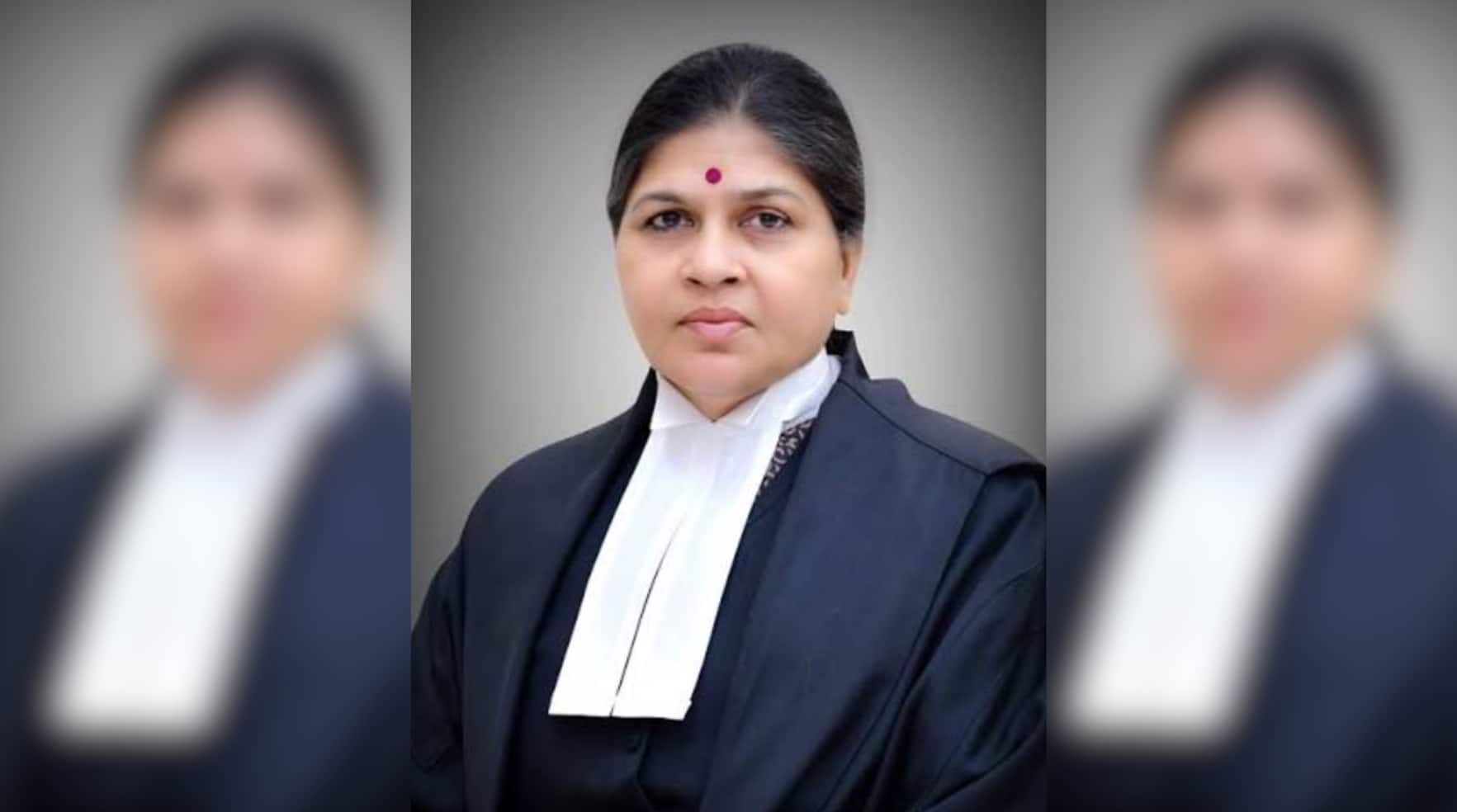
The Supreme Court Collegium recommended Gujarat High Court Chief Justice Sunita Agarwal for elevation to the Supreme Court on September 28. The Collegium placed her first among three names to fill existing vacancies. Agarwal, who became Gujarat High Court Chief Justice on July 23, 2023, has a long legal career.
Market Mastery
Webinar by Vishal Malkan
Find the weak links
in your portfolio by Vishal Malkan
Justice Sunita Agarwal, the Chief Justice of the Gujarat High Court, has been recommended for elevation to the Supreme Court. The Supreme Court Collegium, headed by Chief Justice of India (CJI) Surya Kant, made the recommendation on September 28, along with Delhi High Court Chief Justice Devendra Kumar Upadhyaya and Telangana High Court Chief Justice Aparesh Kumar Singh. The Collegium placed Agarwal first among the three names.
Agarwal is the second woman proposed for the Supreme Court in 2026. Senior advocate V Mohana was directly elevated from the Bar earlier this year. The Supreme Court has 34 sitting judges against a sanctioned strength of 38, including the Chief Justice, leaving four vacancies.
Born on April 30, 1966, Agarwal completed her B.Sc. from Lucknow University in 1986 and obtained her law degree from Awadh University in 1990. She enrolled as an advocate on December 16, 1990, and spent 21 years practising principally in civil, writ, original and commercial matters at the Allahabad High Court. She became an additional judge of that court on November 21, 2011, and a permanent judge on August 6, 2013. After 12 years on the Allahabad High Court Bench, she became Chief Justice of the Gujarat High Court on July 23, 2023. Her scheduled retirement is April 29, 2028.
A career across courts, administration and mediation
Agarwal is a trained and certified mediator and belonged to the first batch of Allahabad High Court judges trained in mediation and conciliation. In April 2023, she became Executive Chairperson of the Uttar Pradesh State Legal Services Authority because she was then the senior-most judge of the Allahabad High Court.
Her administrative assignments included the Internal Complaints Committee dealing with workplace sexual-harassment complaints, the Family Courts Committee, Rules Committee, committees monitoring criminal-case disposal, law-clerk appointments, special judicial magistrates, magistrates' courts, judicial accommodation, PIL matters, recruitment and promotions of Class III and IV employees, jail reforms, inter-district jurisdiction transfers, monitoring cases pending with the Uttar Pradesh government and designation of senior advocates.
Judicially, she has sat in single-judge, Division Bench and larger benches across civil and criminal appeals, service matters, land acquisition, intra-court appeals and constitutional litigation. She was also part of a seven-judge Allahabad High Court bench examining infrastructure and facilities for subordinate courts and the High Court.
What her judgments show
Her record includes matters involving maintenance, jurisdiction, criminal procedure, public emergencies, PILs, insolvency and commercial disputes.
In 2020, in Munna v State of UP, a Division Bench of Agarwal and Justice Saumitra Daya Singh dealt with FIRs registered under Sections 188 and 269 of the IPC against people accused of violating COVID-19 restrictions while distributing food. The court stressed that “Create awareness and consciousness amongst people rather than putting them in jails or lockups which are already overcrowded.” The petitioners received partial relief and protection from arrest subject to conditions; the FIRs were not simply quashed.
In Santosh Kumar Jaiswal v Union of India, another Division Bench involving Agarwal declined a plea against the re-telecast of Vishnu Puran. The court said ancient texts remained open to debate and described plurality as a feature of society.
Her 2020 work also included a Full Bench decision on territorial jurisdiction under Article 226, where the principle was that jurisdiction turns on where the cause of action arises, rather than merely on the petitioner's residence.
Her commercial record includes Covestro (India) Pvt Ltd v State of UP, where a bench comprising Agarwal and Justice Vipin Chandra Dixit held that change-in-shareholding charges could not be imposed merely because an allottee company changed its name without a corresponding change in ownership or shareholding. In Narendra Singh Panwar v Pashchimanchal Vidyut Vitran Nigam Ltd, the court held that approval of an insolvency resolution plan did not automatically extinguish a personal guarantor's obligations.
In Vaibhav Singh v Divyashika Singh, the court also held that a wife's education or efforts to earn enough to survive after being forced out of her matrimonial home could not, by themselves, justify denial of interim maintenance.
PM Modi degree case
Just a day after the Collegium recommendation, Agarwal presided over a Gujarat High Court Division Bench that delivered a 52-page judgment in Arvind Kejriwal v Gujarat University, concerning disclosure of Prime Minister Narendra Modi's educational records.
The bench, comprising Agarwal and Justice DN Ray, rejected Kejriwal's appeal and retained the Rs 25,000 cost imposed by the 2023 single-judge judgment. The dispute arose from a 2016 Central Information Commission direction concerning Modi's degrees. The bench held that the CIC had acted beyond its jurisdiction and found the information protected under RTI exemptions concerning personal and fiduciary information.
The judgment stated: “No public interest, much less larger public interest, would require seeking of information of the educational qualification of the Prime Minister of India, who is an elected representative of the people and when his educational qualification has no bearing on his election to the Constitutional post.”
The Modi degree case forms an important part of the record immediately preceding her proposed elevation.
Controversy at Gujarat High Court
Her tenure as Gujarat Chief Justice has also included a public confrontation with sections of the Bar.
In February 2025, the Gujarat High Court Advocates' Association unanimously passed a resolution seeking her transfer, alleging that recent administrative developments had affected confidence in the judiciary. The move followed a February 15 letter by senior advocate Asim Pandya questioning changes to court rosters. Among the issues cited were the shifting of contempt matters between benches and a later change that moved criminal matters from a single judge to a Division Bench. Pandya nevertheless acknowledged that the Chief Justice's authority as “master of the roster” was undisputed.
The association sought intervention from then CJI Sanjiv Khanna and other members of the Supreme Court Collegium. Hours later, a presidential notification announced that Agarwal would remain on leave from February 18 to March 2, with Justice BA Vaishnav performing the Chief Justice's duties. The contemporaneous report did not establish that the leave was caused by the transfer demand.