
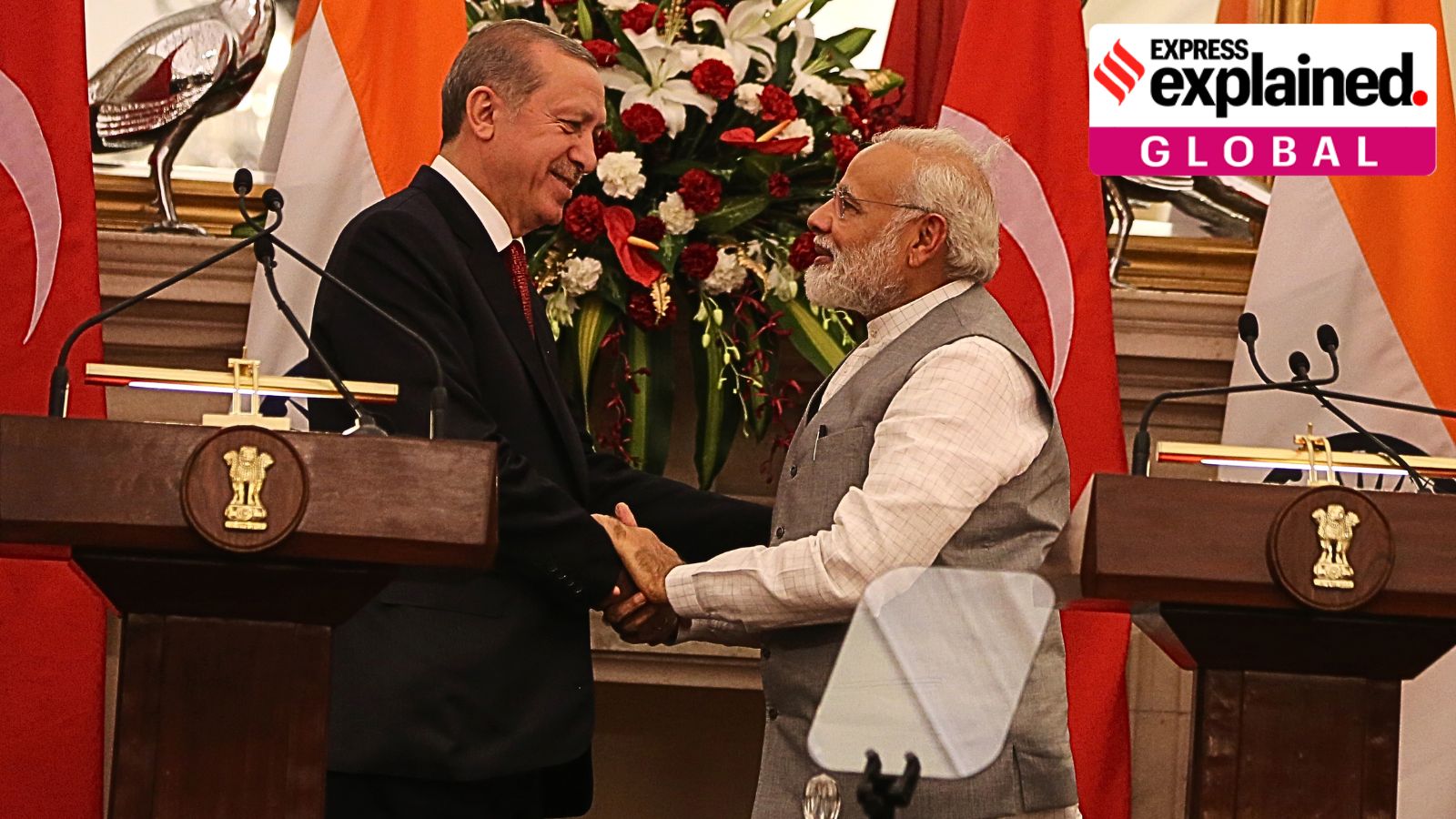
India secured the extradition of drug kingpin Navpreet Singh from Turkey after President Erdogan raised the Kashmir issue at the 81st United Nations General Assembly. Union Minister Amit Shah called the extradition a "historic milestone." Despite ongoing diplomatic friction over Kashmir, both nations continue to find ways for sporadic cooperation.
Days after Turkish President Recep Tayyip Erdogan raked up the Kashmir issue during his address to world leaders at the high-level 81st session of the United Nations General Assembly, India secured the extradition of drug kingpin Navpreet Singh from Turkey, a development hailed by Union Minister Amit Shah as 'historic milestone'.
India's relationship with Turkey has been fraught for years, with both countries suspending foreign office consultations from 2022 until this year.
Bilateral ties came under further strain following the April 2025 Pahalgam terror attack and Operation Sindoor launched by India against terror infrastructure in Pakistan and Pakistan-occupied Kashmir. Erdogan then expressed solidarity with Pakistan and called for de-escalation.
We explain the differences between the two sides, the avenues for cooperation despite discord, and the seeming contradictions in India-Turkey ties.
Kashmir remains the biggest irritant
The biggest issue between the two sides - which has often caused strain - is Turkey's repeated references to Kashmir, especially on international fora, and its constant siding with Pakistan in asking for a third-party solution to the so-called "Kashmir issue". New Delhi maintains that Jammu & Kashmir and Ladakh are integral parts of India, and dismisses calls for third-party intervention.
In the last week of September, Erdogan said that "all disputes in South Asia, including Kashmir", should be addressed through dialogue within the framework of the UN Charter and relevant resolutions. The Ministry of External Affairs (MEA) quickly rebutted, emphasising that J&K is an integral part of India and that external parties have no locus standi or role in an internal, bilateral matter.
Erdogan spoke extensively about the issue in 2019 after India abrogated Article 370, and also raised Kashmir at the UNGA in 2021. In 2020, he referred to Jammu and Kashmir in his pre-recorded video statement to the General Debate.
Turkey's close relationship with Pakistan
On August 7, Turkey entered into the Mecca pact along with Saudi Arabia and Pakistan, even as experts say the pact may entail the risk of Turkish drone and military technology reaching Pakistan. Indian defence planners are evaluating potential technology and military-industrial cooperation between Ankara and Islamabad, particularly concerning advanced drone technology and electronic warfare systems.
It also risks potential diplomatic friction with Ankara or Riyadh regarding future cross-border anti-terror operations on the lines of Operation Sindoor. New Delhi says it's tracking the trilateral arrangement and remains fully prepared to take all necessary steps to protect its national interests.
With alignments in West Asia reshaping in the wake of the Makkah pact, the India-UAE-Israel alignment may offer a strategic counterweight, even though it functions as a pre-existing partnership rather than a formal military response.
Where interests converge: crime and security
Despite recent diplomatic strain, legal and law-enforcement cooperation has acted as a stabilising factor. This was recently evidenced by Turkey's active assistance in extraditing high-profile fugitive criminals, such as drug trafficker Salim Dola, back to India. Both were wanted by Indian agencies such as the Narcotics Control Bureau for running international syndicates smuggling heroin and synthetic drugs into India from Afghanistan and other regions.
Experts say India's 2001 extradition treaty with Turkey mandates a legal basis for cooperation on serious criminal offences, even amidst broader geopolitical differences. The Indian intelligence agencies worked to unmask the forged documentation and fake foreign citizenships of these fugitives, utilising Interpol red notices and prompting Turkish authorities to block citizenship-by-investment bids and detain the individuals.
Expert Explains | How Turkey emerged as a winner from a fractious NATO summit
Turkey itself faces issues with narco-terrorism primarily because of its unique geographic position as a bridge between Asia and Europe, sometimes going against its own security interests. Cracking down on narco-terrorism fundamentally helps Ankara's own national security, geopolitical stance, internal stability, and economic health, as per experts.
Beyond the disagreements, a pragmatic relationship
This April, both sides resumed foreign office consultations after being in abeyance for four years. Ankara dispatched Turkish Deputy Foreign Minister Berris Ekinci, who co-chaired meetings with Sibi George, the Ministry of External Affairs' (MEA) Secretary (West).
According to the MEA, both sides focused on trade, investment, tourism, technology, innovation, energy and educational cooperation. Discussions also touched upon security matters, including the fight against cross-border terrorism.
"We believe dialogue is better than not talking and deepening disagreements and misunderstandings. And the conversations have been satisfactory," former Ambassador Muktesh Pardesi had told The Indian Express.
In fact, after the economic backlash in India, Turkey began to actively insulate its broader economic interests in Asia from its Pakistan alliance. Ankara also assured New Delhi that it had no inherent bilateral dispute with India.
Turkey stands to gain economic, geopolitical and infrastructural benefits from its relations with India. For India, a working relationship with Ankara offers crucial geopolitical leverage in the Islamic world, a strategic gateway to European and Central Asian markets.