
The Supreme Court on Monday agreed to list a plea seeking directions to Delhi Police to allow peaceful protests. The bench said, "If some similar matters are there, we will find out. Then we will list it." Many citizens recently faced restrictions while protesting against the Election Commission's recent decisions.
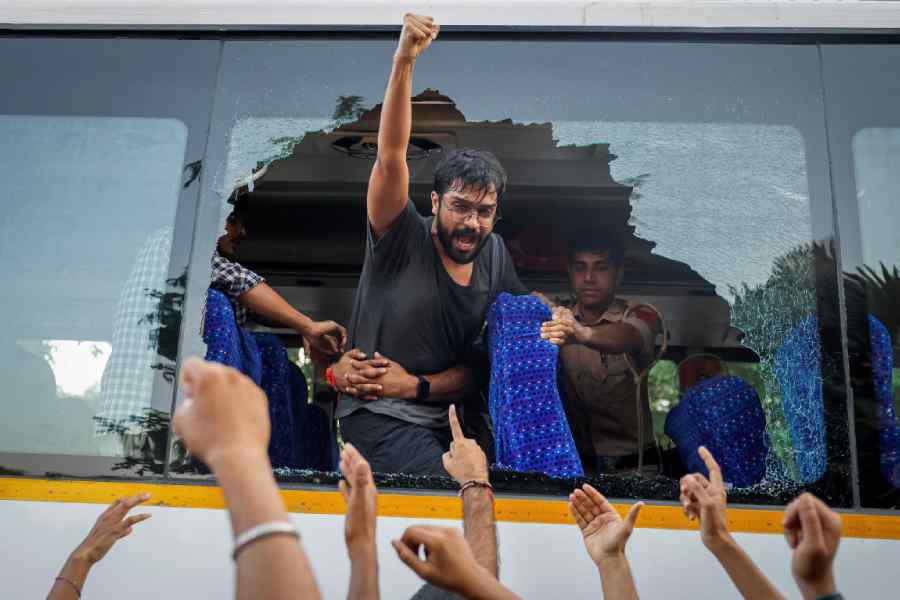
A detained man tries to jump out of a police bus through a broken window on Sunday during a protest against Delhi Police's alleged assault on female protesters and journalists and against Gyanesh Kumar's continuation as CEC. Reuters
The Supreme Court on Monday agreed to list a plea for an early hearing of a PIL seeking directions to Delhi Police to allow peaceful protests in the capital.
The bench headed by Chief Justice Surya Kant did not specify a date, but said the plea would be heard after ascertaining whether related petitions were awaiting clearance from the registry.
"If some similar matters are there, we will find out. Then we will list it. Then you argue," the bench, which included Justice Joymalya Bagchi and Justice V. Mohana, told a counsel appearing for PIL petitioner Priya Mishra during the morning mentioning time.
"Delhi Police are not allowing peaceful protests. This is a very important issue. Students, ordinary citizens, party leaders, MLAs and MPs are not allowed to peacefully protest," the counsel told the bench while seeking an early listing of the matter.
When the CJI asked whether it was a PIL and enquired about the nature of relief being sought, the advocate submitted that the petition was seeking specific directions to ensure that the Delhi Police permitted peaceful protests in accordance with law without enforcing any unwarranted restrictions.
The counsel submitted that the right to protest democratically was a fundamental right guaranteed to every citizen in the country, but the Delhi Police had been imposing several restrictions, including taking protesters into custody illegally.
Over the past few days, the capital has witnessed several protests demanding the resignation of chief election commissioner (CEC) Gyanesh Kumar after an Indian Express investigative report said election commissioners Sukhbir Singh Sandhu and Vivek Joshi had objected on record at least 14 times over the last 10 months to decisions and orders on the special intensive revision of electoral rolls that they said were issued without their knowledge or recommendation.
The Election Commission had tried to put up a defence, saying the decisions had been taken unanimously and differences, if any, were a normal part of any deliberations.
Though the poll panel claimed that all decisions were statutorily backed, it has rolled back or altered a number of controversial decisions since the protests and the report. These include directing booth-level officers to visit every household to recheck and enrol voters whose names had been deleted during roll revision.
The Supreme Court on Monday directed the Centre and the EC to place before it, within 10 days, records establishing that all decisions were taken "unanimously" or "with majority".