
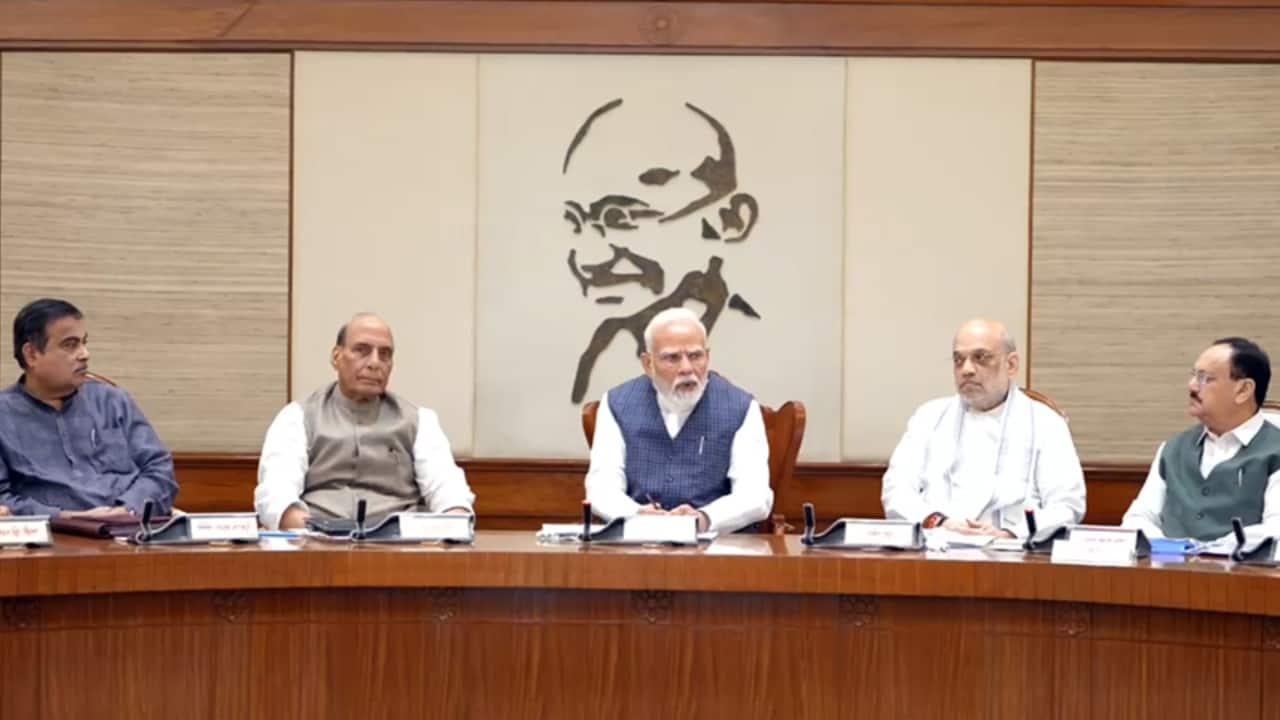
Prime Minister Narendra Modi completes 25 uninterrupted years in public executive office on October 7. His journey shows a major shift in India’s approach to terror, moving from restraint to direct action. Officials said the administration focused on improving intelligence capabilities, modernising the police force and pushing for stronger legal measures.
Off-grid LoRa radios recovered from slain LeT commander, pose new surveillance challenge in Kashmir
Prime Minister Narendra Modi completes 25 uninterrupted years in public executive office on October 7, marking a political journey that has also seen a significant shift in India's approach to counter-terrorism, from strategic restraint to direct and punitive action against terror networks across borders. His quarter-century in executive office, spanning 12.5 years as Gujarat Chief Minister and more than a decade as Prime Minister, has been marked by a strong focus on national security, intelligence gathering, police modernisation and a tougher response to terrorism.
The foundations of Modi's security approach were laid during his tenure as Gujarat Chief Minister. As the head of a state with a strategically important coastline and an international border, he placed considerable emphasis on strengthening maritime and land security.
Officials familiar with strategic policymaking said the administration under Modi, first in Gujarat and later at the Centre, focused on improving intelligence capabilities, modernising the police force and pushing for stronger legal measures to deal with terrorism.
One of the first major security challenges of his tenure came with the Akshardham temple attack in Gandhinagar on September 24, 2002. Officials said Modi quickly recognised the seriousness of the situation and sought to avoid bureaucratic delays in the response.
He coordinated with the Centre for the airlifting of National Security Guard commandos, who carried out Operation Vajra Shakti. The terrorists were eventually neutralised by daybreak.
Six years later, Gujarat faced another major security challenge when a series of blasts struck Ahmedabad in 2008. As many as 21 explosions took place within around 70 minutes, killing 56 people.
The attack exposed the scale of the Indian Mujahideen's network and prompted a further strengthening of Gujarat's counter-terror machinery. Under Modi, a Gujarat Police unit was developed into a specialised tactical force, with greater operational freedom.
Officials said the team subsequently helped crack the Indian Mujahideen's logistics network across the country within a month.
When Modi became Prime Minister in 2014, his government signalled that India would adopt a more muscular response to terrorism. Instead of relying primarily on diplomatic protests after attacks, the government increasingly stressed that those behind terrorism would face direct consequences.
The first major demonstration of this approach came after the Uri terror attack in September 2016.
Terrorists stormed an Army camp in Uri, killing 19 Indian soldiers. In response, the Modi government authorised the Indian Army to conduct surgical strikes across the Line of Control.
The Army targeted terror camps and launch pads, killing several militants, in an operation that marked a clear departure from India's earlier approach to cross-border terrorism.
Experts say the operation broke with the longstanding precedent of exercising considerable restraint and keeping retaliatory military action within India's borders.
The shift became even more pronounced after the Pulwama attack in February 2019, when a Jaish-e-Mohammed suicide bomber rammed an explosive-laden vehicle into a CRPF convoy, killing 40 personnel.
The attack triggered widespread anger and put the government under intense pressure to respond.
The answer came with the Balakot air strikes, when Indian aircraft struck a Jaish-e-Mohammed terror facility in Pakistan. The operation sent a broader message that India was prepared to cross the Line of Control, and even the international border, to target terror infrastructure.
The government effectively established a new doctrine: sponsors and perpetrators of terrorism could be targeted on their own territory, with traditional concerns over nuclear escalation no longer acting as an automatic deterrent.
The next major test came after the Pahalgam terror attack, in which tourists were killed after being asked about their religion. The attack triggered widespread anger across the country and created expectations of a response stronger than the strikes carried out after Uri and Pulwama.
According to officials, the government faced a difficult balancing act. The response had to be forceful, but it also needed to be carefully planned, with an element of surprise as Pakistan prepared for possible Indian military action.
The result was Operation Sindoor. The Indian armed forces struck terror infrastructure linked to the Lashkar-e-Taiba, Jaish-e-Mohammed and Hizbul Mujahideen. Several terrorists were killed during the operation.
Officials said Operation Sindoor represented another significant step in the evolution of India's counter-terrorism doctrine under Modi.
The message was no longer simply that India would retaliate against an attack. Terrorism originating across the border would be treated as a direct national security challenge, with the response extending to the infrastructure and networks supporting it.
The evolution from the 2002 Akshardham attack and the 2008 Ahmedabad blasts to the surgical strikes, Balakot and Operation Sindoor illustrates how India's response to terrorism has changed over the past two decades.
What began with an emphasis on intelligence, policing and internal security gradually developed into a doctrine that combines those capabilities with the willingness to undertake military action beyond India's borders.
"Strategic restraint has been replaced with an unyielding zero-tolerance policy," an official aptly summarised.
Under Modi, the fight against terrorism has therefore become not only a question of preventing attacks, but also of imposing a cost on those who plan, support and execute them.
(With IANS inputs)
Stay informed on all the latest news, real-time breaking news updates, and follow all the important headlines in india news and world news on Zee News.