
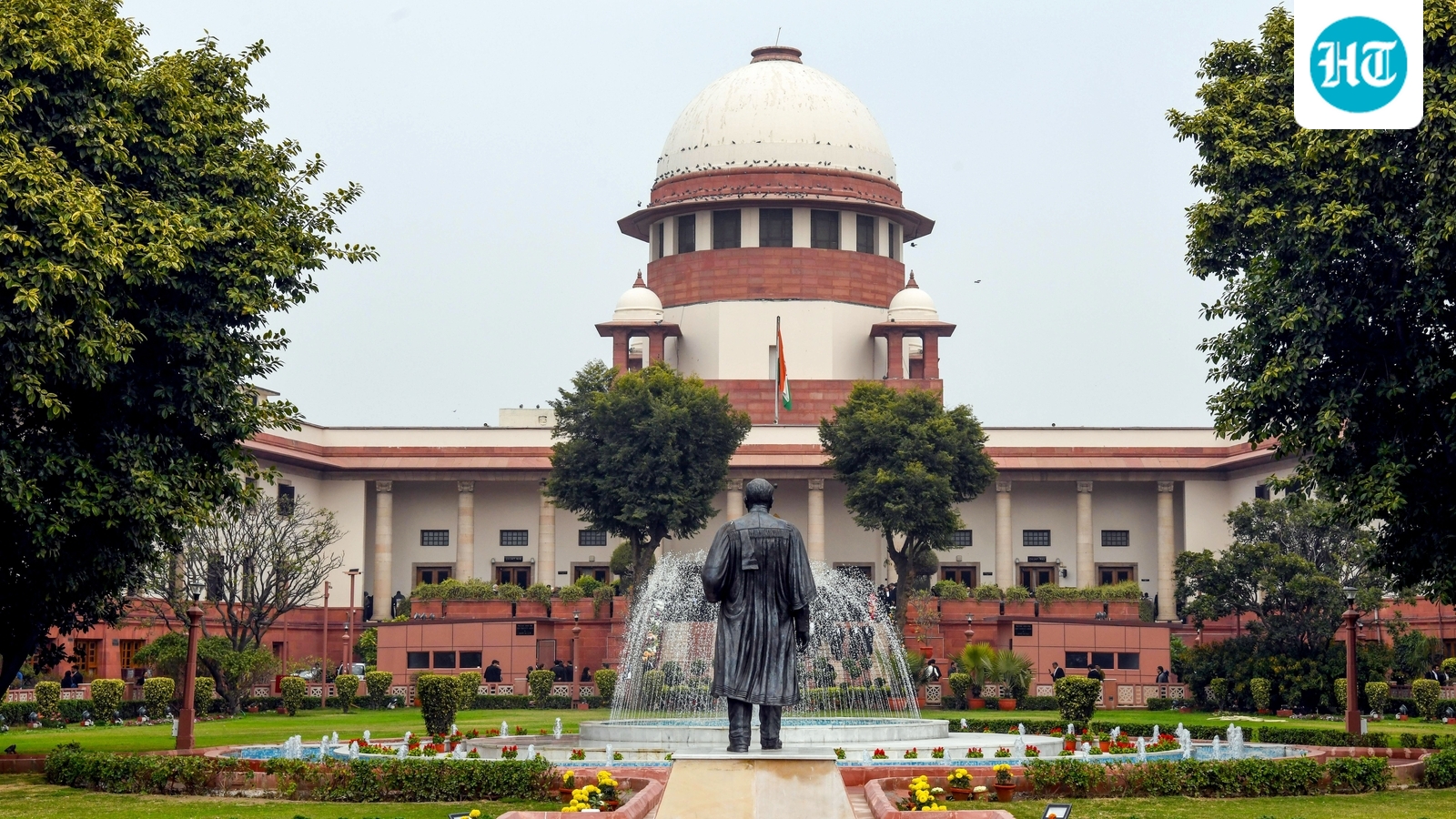
The Supreme Court said on Thursday that its forgiving nature in commuting death sentences has led to more crime. Justice Dipankar Datta remarked, "It is because of the Supreme Court's forgiving nature India is facing this problem." The bench heard a remission plea from a couple convicted of mass murder.
The judiciary's forgiving nature in commutation of death sentences has led to an increase in crime in the country and somewhere this practice of sparing mercy to heinous offenders has to end, the Supreme Court remarked on Thursday, as it reserved its order in a remission plea.
A bench of justices Dipankar Datta and Sheel Nagu was hearing a petition filed by a life term-serving couple seeking premature release in the 2001 gruesome murder of eight members of a former Haryana legislator's family in Hisar district.
"It is because of the Supreme Court's forgiving nature India is facing this problem. We just forgive, forgive, forgive, one must draw a line somewhere," justice Datta remarked.
The judge recalled an incident where a father had raped and murdered his elder daughter and was handed death penalty. The conviction was based on the mother's sole testimony. The Supreme Court commuted death to life sentence.
"After some years, the father comes out on parole and murders the mother in front of his younger daughter. On the younger daughter's testimony, he is given death sentence. And then death sentence is commuted to life sentence by the Supreme Court on the ground that he did not murder the younger child," justice Datta said. "That is why we say, our forgiving nature has to come to an end somewhere." The oral remarks came as the bench was hearing a remission plea filed by a couple serving commuted life term in a mass murder case.
According to the case details, the incident took place on August 23, 2001, when Sonia (then 19) and her husband Sanjeev Kumar murdered her father and former MLA Relu Ram Punia (50), her mother (41), her two siblings (sister 16 and brother 23), sister-in-law (20) and her brother's three children (aged 4, 2 and 45-day-old) while they were asleep. The family had gathered to celebrate Sonia's birthday, when the couple bludgeoned them to death over a property dispute between Sonia and her half-brother Sunil.
In 2004, the trial court sentenced them to death and the same was upheld by the Supreme Court, but it was later commuted to life sentence by the top court in 2014 noting the delay in deciding their mercy petitions. On December 9, 2025, the Punjab and Haryana high court allowed the couple's petition for remission and directed the state government to consider their plea for premature release under a 2002 remission policy.
In their SC plea, the convicts argued that the remission policy permits those prisoners whose death has been commuted to life sentence to seek remission after completion of 20 years of incarceration.
Opposing the remission plea, the members of Punia family, represented by senior advocate Mukta Gupta along with advocates Aaina Verma and A Jaswanthi, pointed out that the murders were gruesome and the convicts deserve no mercy.
The Haryana government, led by senior additional advocate general Lokesh Singhal, also opposed the plea, saying the right to remission is a discretion of the state and cannot be claimed as a matter of right by life convicts. After hearing all sides, the court closed the matter for orders.