
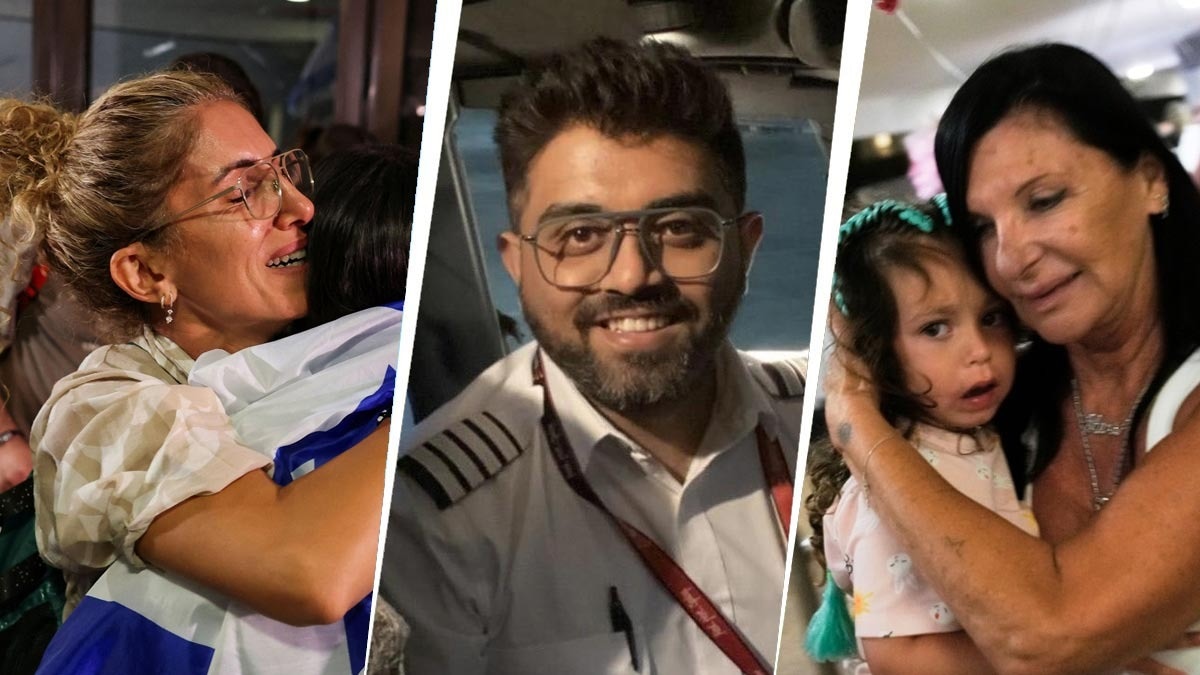
Captain Smit Machchhar saved 174 passengers on flydubai flight FZ 1073 on Wednesday after his co-pilot attacked him. Despite being stabbed, the Indian pilot sent emergency signals and opened the cockpit door. Doron Spielman said, "Some of the passengers who realised something was happening raced forward and entered the pilot's cabin."
Bleeding heavily after being stabbed multiple times inside the cockpit by his co-pilot, Captain Smit Machchhar's quick thinking proved to be critical to the survival of the 174 passengers aboard the Israel-bound flydubai flight. Machchhar, who is being hailed as a hero worldwide, not only sent out emergency signals but also, crucially and on time, opened the cockpit door, allowing passengers to rush in and overpower the attacking co-pilot. Israeli officials said the co-pilot, an Omani national, wanted to take over the aircraft's controls and crash it.
On Wednesday, pure chaos unfolded on board flydubai's flight FZ 1073. Two hours into the three-hour flight from Saudi Arabia to Tel Aviv, the aircraft transmitted distress code 7700, the signal for a general emergency. Seconds later, it transmitted the code 7500, which indicates possible hijacking or unlawful interference.
HOW THINGS UNFOLDED ON FLYDUBAI FLIGHT?
While details of the sequence of events remain sketchy, Machchhar likely sent the signals even as he fought back the co-pilot. While eyewitness accounts said the captain was attacked with a folding knife, some reports suggested that the co-pilot could have well used the fire axe that is factory-fitted in the cockpit.
As is the norm everywhere, pilots in the Middle East go through the same security screenings as passengers, meaning they would not be able to bring weapons such as knives or guns on board.
As the drama played out, the aircraft plummeted and spun out of control - reportedly spiralling 17,000 feet. Due to the emergency signals sent by the Indian captain, Israel scrambled its fighter jets, fearing a hijacking attempt.
But what unfolded inside the Boeing aircraft was nothing short of a Hollywood thriller. Lying on the cockpit floor and covered in blood, Machchhar used the "last moments of his energy" to click open the cockpit door, Doron Spielman, the Israeli Prime Minister's spokesperson, told The Times of Israel.
The split-second decision proved to be massive.
It allowed passengers to enter the cockpit and subdue the co-pilot, who was allegedly interfering with the aircraft's controls in a likely attempt to crash it in Israel. Tel Aviv was just an hour away.
"At that moment, some of the passengers who realised something was happening raced forward and entered the pilot's cabin. They saw the injured pilot on the ground, and the other... pilot was standing over the control panel, bashing the control panel," Spielman said.
The move by Machchhar was also praised by US President Donald Trump. "The pilot was in very bad shape... But in a way, he was a hero to open the door," Trump said.
The timing also proved to be crucial in saving his own life as well. Among those who ran to the cockpit was Dr Shota Musaev, a dentist. His timely intervention saved Machchhar's life.
"He was covered in cuts – his head, his hands – they were practically sliced open. He lost a lot of blood and was in bad shape," Musaev told CNN.
"I think that if we had waited even a few more moments, we would have lost him; his blood pressure had plummeted," he further said.
Subsequently, two off-duty flydubai pilots, who were among the passengers, took control of the aircraft and carried out the emergency landing at Tabuk in Saudi Arabia. Machchhar rushed to the hospital for treatment. His condition is now stable.
WHY THE COCKPIT DOOR MATTERED?
The cockpit door is not an ordinary door. It is deliberately built to be very hard to get through.
After the 9/11 attacks, aircraft manufacturers reinforced the doors and made them bullet-resistant. They were designed to prevent unauthorised access from the passenger cabin.
Basically, cockpit doors cannot be opened from the outside. They can only be opened from the inside. The purpose is simple - no one from the cabin could force their way into the cockpit and seize control of the aircraft.
However, aircraft like Boeing 737s do have an emergency mechanism.
A keypad on the cockpit door allows flight crew to enter an emergency code if the pilots are in danger or incapacitated. Entering the code unlocks the door after a delay, unless a pilot denies access.
This creates an important security balance to prevent possible hijackings.
In the flydubai incident, the action was happening inside the cockpit itself. That is why Machchhar's decision to release the door from inside was so critical in preventing a possible 9/11-type incident.
The incident will come as a new headache for airlines. How do airlines now address the reality that a terror threat could emerge inside the cockpit as well?